Most AI note-takers just transcribe and summarize. Granola is an AI notepad. You jot down what matters during the call, and Granola uses your notes plus the transcript to generate summaries, action items, and next steps from your point of view. The powerful part: you can chat with your notes. Write follow-up emails, pull out decisions, prep for your next meeting — all in seconds.
I don’t promote tools lightly. This one earned its place.
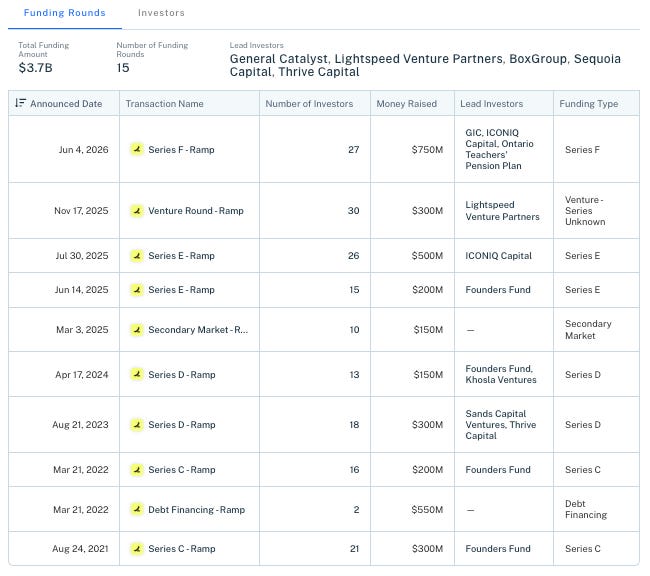
Two companies fought over the same customers with the same product for 6 years and one of them is now worth 8.5x what the other sold for, with quite the cap table:
There’s also a poetic detail in here that almost nobody mentions which is that the founders sold their first startup to Capital One, worked there, and left in 2019 to build Ramp.
So I spent the past week pulling apart 20 founder and operator interviews, every funding round since 2019, every blog post and leaked detail about how they’ve grown.
What you’ll learn
The interchange math that pays for software Ramp gives away for free
How a team of 8 engineers built an Amex competitor in 3 months
The down round they took on purpose while revenue 3x’d
The internal panic when they finally started charging for software
Why direct mail (of all things) became one of their biggest channels
The honest math under $44B (take rates, float, regulation, and the $700B government contract fight)
📐 Quick note on editorial and methodology: this analysis focuses on the 80/20 mechanics that help explain their growth (not a comprehensive profile, and not an endorsement or investment advice). It draws on 20 founder and operator interviews and long-form podcasts (Invest Like the Best, 20VC etc), plus Ramp’s own posts and reporting from TechCrunch, Bloomberg, etc. All revenue figures sourced. Reported revenue is an annualized run-rate figure, so treat directional estimates as directional.
From expense reports → autonomous finance
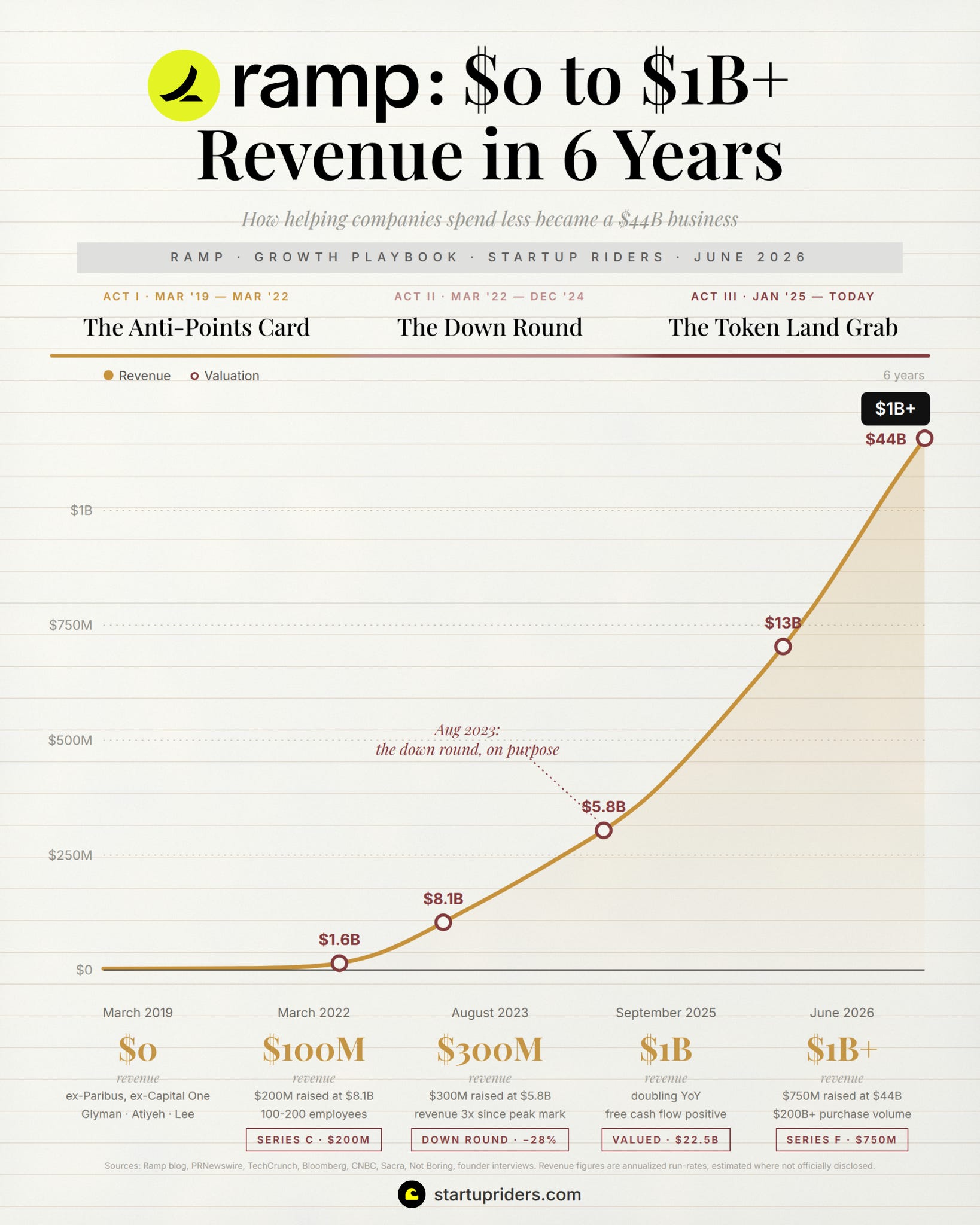
Ramp: $0 to $1B+ annualized revenue, 2019–2026. Valuation: $8.1B → $5.8B (the down round) → $44B. All figures sourced, annualized run-rates.
A little about how this market evolved before we get to the growth levers:
Where we come from
For decades business spend ran on 2 tools that barely spoke to each other, a corporate card from a bank like Amex or Chase that made more money the more you spent + expense software like Concur (still gives me nightmares) or Expensify that you paid for by the seat. On one hand the issuer wanted volume and on the other the software vendor wanted seats, so the finance team was left stitching the 2 together by hand every month.
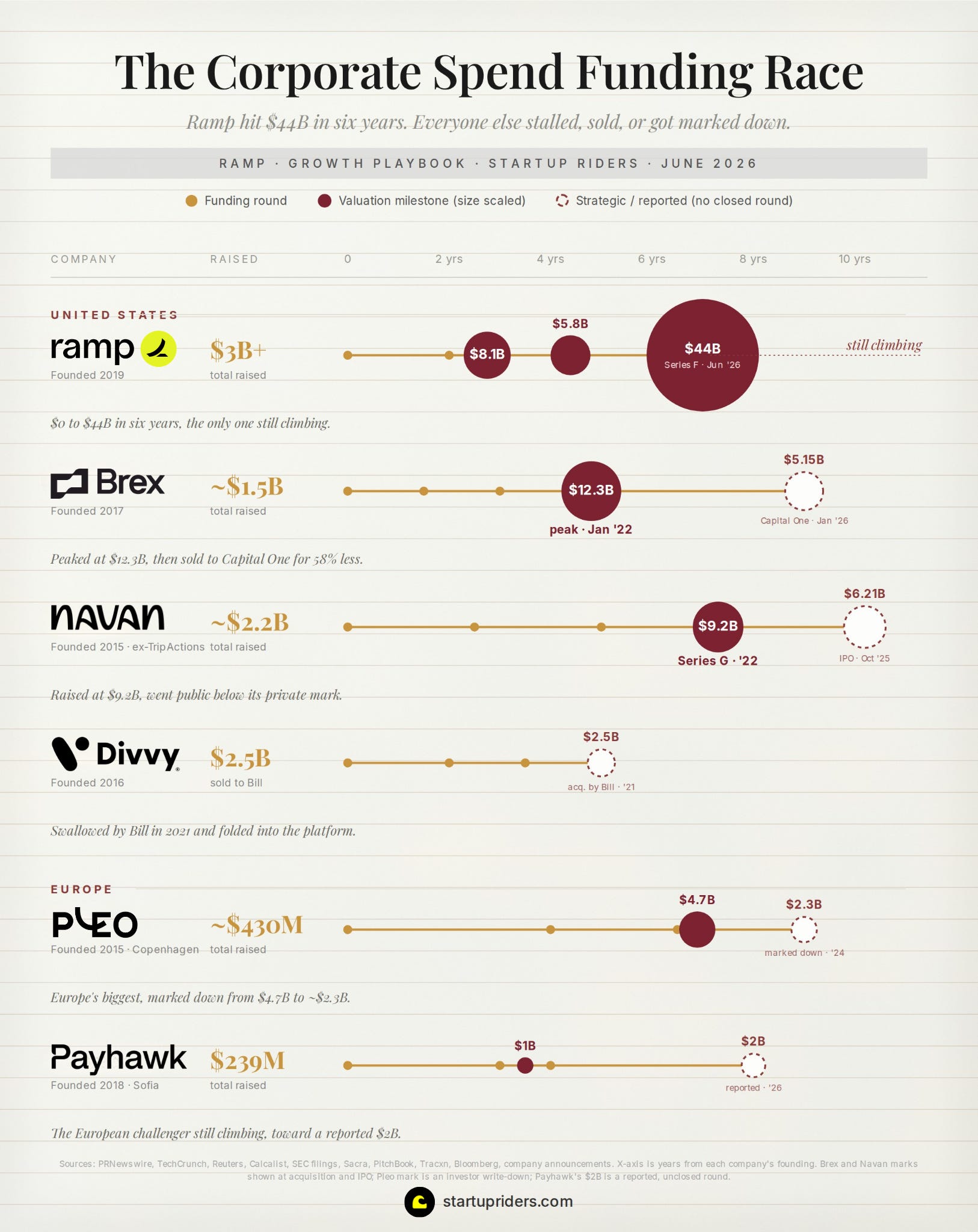
Then a wave of startups tried to merge the card and the software into one platform, and for a while it looked like one of them would run the table:
Navan came at it from the travel-and-expense side and raised at a $9.2B valuation in 2022, and pushed into corporate cards and spend from there.
The category had a name (spend management) and a clear leader in Brex.
Where we are
2 things broke that order between 2022 and 2026. The first was rates going up, and once money stopped being free the fintechs that had raised at 2021 marks could no longer grow into them. 2 different things happened depending on which side of the Atlantic you were on:
Spendesk (Paris) reached profitability rather than chasing the next mark.
The second thing that happened was Ramp going the other way from everyone, taking a 28% markdown on purpose in August 2023, compounding all the way through the downturn, and re-rating from $5.8B to $44B.
Where the market is going
The fight is shifting from selling a card with some software attached to owning the system of record for every dollar a company spends, and 3 things will shape the next couple of years:
The incumbents are awake: Capital One paid $5.15B to get a modern spend platform it can aim at this exact shift and Amex and the big banks are the slower better-funded version of the same threat.
AI spend is the new battleground: Tokens are a cost line that barely existed 3 years ago and they are growing fast. They sit invisible to every legacy finance tool so whoever builds the layer that sees them has a real claim on the next decade of corporate spend.
Consolidation keeps running: With Brex gone and Divvy absorbed the independent field is thin and the survivors will keep buying whatever is left.
Now to Ramp’s origin and the 9 levers:
Act 1: The Anti-Points Card
March 2019 → March 2022 · $0 → $100M+ annualized revenue
In 2016, Capital One acquired Paribus, a price-tracker built by 2 Harvard classmates, Eric and Karim, that had saved consumers over $100M by automatically claiming refunds when prices dropped. They stayed long enough to make the acquisition work and then left in March 2019 with one of their Paribus engineers, Gene Lee.
Before writing a line of code they set themselves a goal that sounded like a joke at the time, they wanted to build a company worth $1 billion in 18 months and they reverse engineered the plan from there. Glyman confirmed the story on My First Million (well worth your time listening to the episode), and their founding engineer later looked it up and found that no New York company had ever hit $1B inside 3 years, let alone 18 months.
They got there in roughly 2 years, which is close enough, with the aim to “build a technology-driven financial services company” (email from Karim to Founders Fund in 2019):
The founding idea came from asking what would happen if your credit card could help your business spend less money. They interviewed around 100 entrepreneurs and finance leaders before launch and found something better than the original idea which is that people hated expense reports (I can vouch for that) even more than they hated wasted spend.
Lever 1: They made money when clients spent, and won them by helping clients spend less
“The traditional corporate card world was all about excess. When I asked people what they wanted? It wasn’t points or cash back, it was money in their bank.”
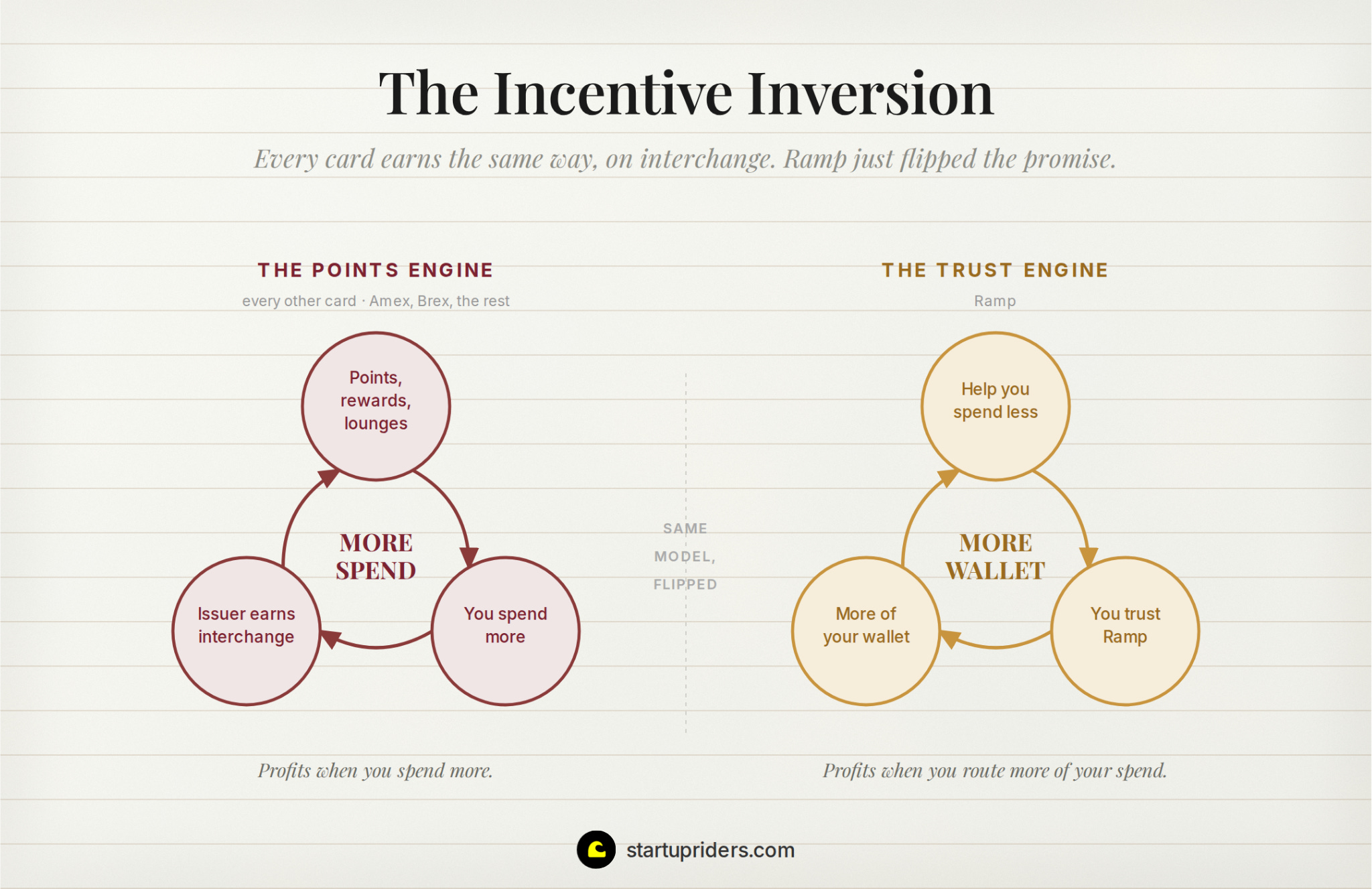
Every card company on earth earns interchange, the small cut taken every time a card gets swiped, which means every card company on earth gets richer when you spend more. The whole industry built points, rewards, lounges and steak dinners on top of that incentive, anything to make you swipe. Glyman on Stripe’s Cheeky Pint said:
“We entered into this industry where it was very profitable, but not only was it misaligned, but people were fighting over basis points.”
Ramp kept the revenue model (interchange) BUT inverted the promise:
No points, no rewards theater, just 1.5% flat cashback and a pitch that they will supposedly help you spend less
Savings insights as the product, flagging duplicate SaaS subscriptions and unused seats (i.e. you’re paying for 200 Asana seats but only 100 people log in, which they detect from Okta data, etc).
A public number to anchor it (claim to save the average business about 5% per year).
Spending less sounds like revenue suicide for a company paid per dollar spent but the bet was that it works the other way around. Every dollar Ramp saves a customer buys trust, and trust is what gets a finance team to route more of its total spend through you. You lose basis points per dollar and win all the dollars.
Hold onto the word subsidy (give away the thing your rivals charge for, get paid on the flow underneath it). In Act 3 we’ll look at what that trade actually costs though.
Lever 2: They gave the software away and let the card pay for it
“We’re a corporate card and we are the fastest growing corporate card in America, but we’re actually a productivity company.” — Eric Glyman, 20VC with Keith Rabois
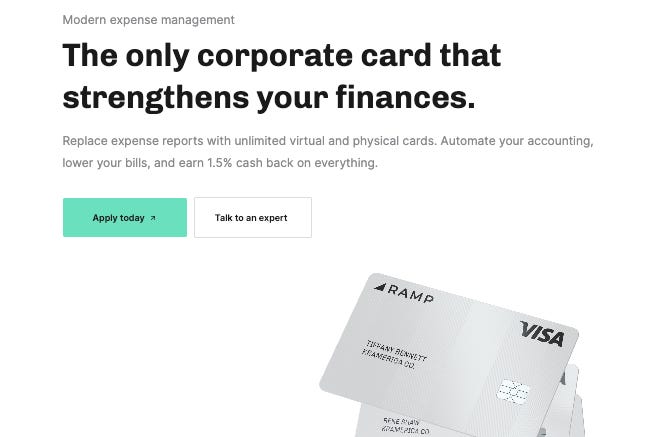
Ramp’s landing c.2020
Every time someone pays with a Ramp card the store pays a small fee (usually 2-3%) Ramp keeps a slice. That slice supposedly pays for everything else, which is why the software is free:
Expense reports, receipt scanning, bill pay, approvals, accounting that updates itself
No per-user fees, contracts, interest, or late fees
The tools Expensify, Bill.com, and Concur charge for, they give away to anyone who spends on the card
The more spending crosses the card the more Ramp earns, so its job is to capture as much of a company’s card spending as it can. As Glyman put it:
“if you want to grow interchange, grow purchase volume.”
That sounds like it contradicts Lever 1, but the two measure different things:
Spending less is about the total bill, the duplicate subscriptions and unused seats Ramp cuts.
Growingvolume is about how much of the spending you were doing anyway runs across Ramp’s card instead of an Amex or a bank wire. Ramp pitches shrinking your total spend and grows its own volume at once, because the volume comes from taking share off the incumbents (not making you buy more).
As you can imagine this is probably pretty brutal to compete with, because a rival charging monthly for expense software now faces the same thing for free, basically funded by a card fee they can’t touch.
By March 2022, 2 years after launch, they were doing $100M a year with 100 to 200 employees, and Founders Fund valued it at $8.1B just before the market turned.
Bessemer State of the Cloud 2019
Lever 3: They shipped products faster than competitors shipped features
“Our culture is velocity. It shapes every process and team ritual. It’s how we develop our people. It’s our solution to nearly every problem.” — Geoff Charles, VP Product
One small team built a competitor to Bill.com in 3 months (pre vibe coding)
It cloned the core products of AmEx, Expensify, Concur, and Bill.com and gave them away free, each built by a pod of 3-5 engineers
Keith Rabois (backed Stripe, DoorDash, etc), called the pace “absolutely unprecedented in my 21 years working with technology businesses”
Some of the 80/20 choices that probably help shaped the culture:
2 kinds of engineers: After a Capital One reprimand for shipping too fast inside a regulated bank the founders split the team in 2, careful builders on the things that can’t break like underwriting and payments, and fast movers on a long leash for new products, in 3-to-5-person pods (I love this).
Hire for slope (not résumé): 1 in 3 of the first 60 hires was a former founder, and the rule was to bet on people for 10x upside rather than screen for 0 defects.
An org built to force cooperation: Product, design, engineering, and data all report to the CTO, and every spec and decision is published in the open, so teams hunt for dissent rather than sign-off and nothing waits on a gatekeeper.
Sequence new products on rails you already have: the VP Product’s rule is to pick the next product that reuses the last one’s plumbing (cards, expense, and reimbursements all share the same employee identity).
Organize teams around outcomes (not features): Each pod owns one big business result rather than a product surface (drive half of qualified leads, raise bill-pay attach rate), and has to publish an open contract laying out its goal, strategy, roadmap, and metrics so the whole company can see what it is accountable for.
One gem worth stealing is the product strategy template their VP Product shared on Lenny Rachitsky’s newsletter, which makes every team answer the same 7 Q’s before building (goal, hypothesis, right to win, metric, initiatives, risks, compounding).
By early 2022 the flywheel looked unstoppable, but then the market broke, opening the most interesting growth levers of the story:
📌 Price rises after the first 100 paid members (almost there). €19/month, €195/year - anyone in before keeps €10/€100 forever. Expense it 👇
Act 2: The Down Round
March 2022 → December 2024 · $100M → ~$500M annualized revenue