Your sales team needs a CRM that runs your entire GTM motion. That’s Attio.
Get agents working on every account, surfacing new opportunities, and handle the work that used to take your team days. Whether you’re working in your browser, inbox, or favorite agent, connect to your customer data in real-time through Attio’s web app, MCP, API, and SDK.
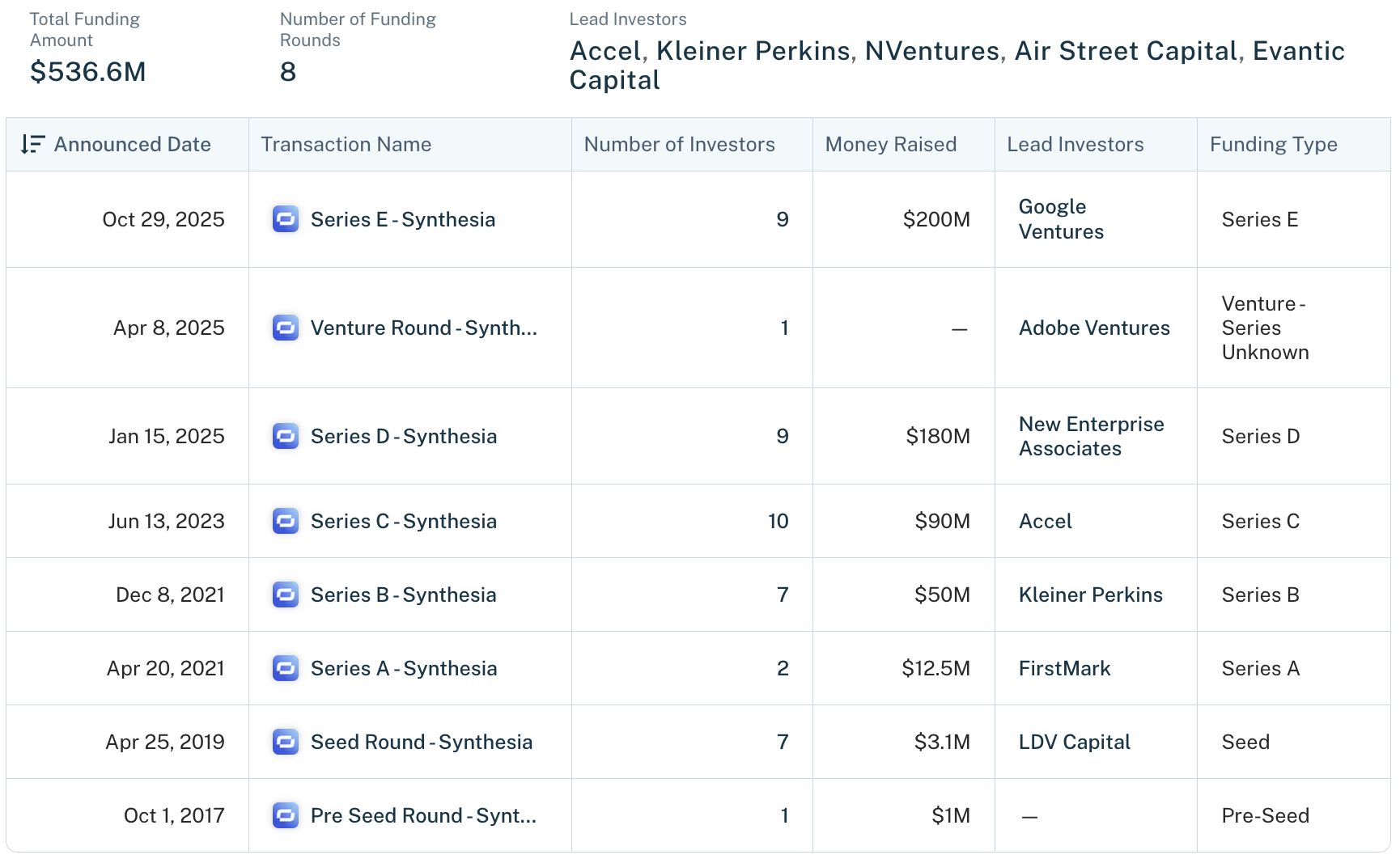
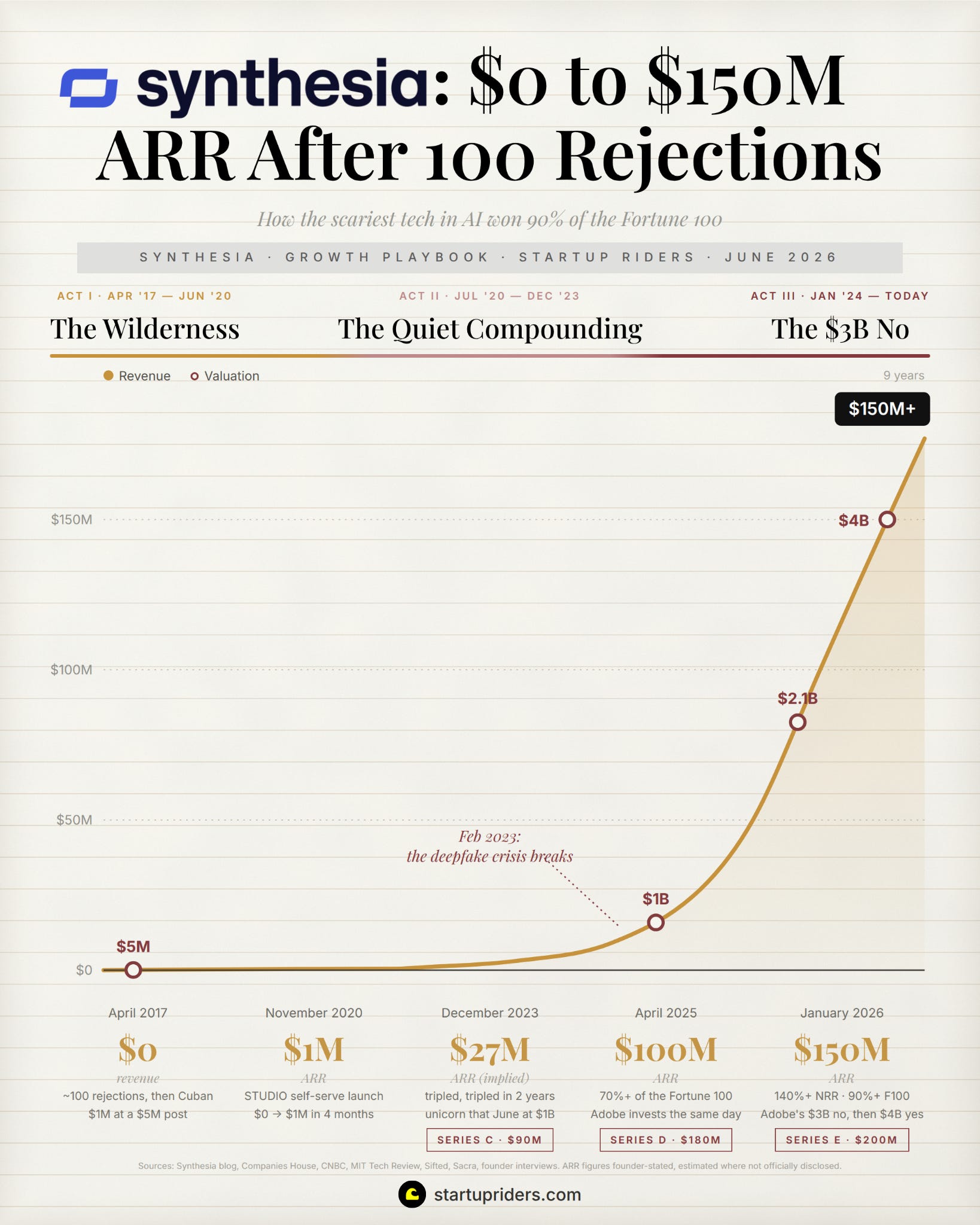
In January Synthesia (ai video platform) announced a $200M Series E at a $4 billion valuation led by Google Ventures, capping a run from roughly 100 investor rejections to $150M ARR, (aiming to get past $200M this year).
What’s really interesting to me is that they started pre-ChatGPT, before the AI wave made any of this obvious. Building a video-AI company in 2017 was a true contrarian bet and the timing is a big part of why they’re so far ahead now.
Also, apparently >90% of the Fortune 100 now pays for their technology, surprising after all the drama surrounding “deepfake tech” over the past few years.
They have a 140%+ net revenue retention, meaning their average customer spends 40% more every year after they’ve bought. Their cap-table is equally impressive:
So I spent the past week pulling apart 18 founder and operator interviews, every funding round since 2017 and every leaked detail about how they’ve grown.
What you’ll learn
The cold email inside the Sony hack that turned into $1M at 5am
Why they killed a product with revenue after 18 months
The pricing ladder that runs from a free demo video to $1M+ contracts
How “we moderate in the Word document” became a key feature
The 140% NRR engine hiding inside translation
Why the CEO says they won the enterprise with the non-AI things
📐 Quick note on editorial and methodology: this analysis focuses on the 80/20 mechanics that help explain their growth (not a comprehensive profile, and not an endorsement or investment advice). It draws on 18 founder and operator interviews and long-form podcasts, plus the UK Companies filings and reporting from CNBC, MIT Technology and others. All revenue figures sourced, treat estimates as directional.
From deepfake panic → enterprise utility
A little about how this market evolved before we get to the growth levers:
Where we come from
In the fall of 2016 a research paper called Face2Face showed a neural network puppeteering a real person’s face in real time, work that would have taken (in the CEO’s estimate) 3 months and 10 people in a Hollywood VFX studio.
2 Danish operators, Victor Riparbelli (World of Warcraft player as a youngster, wild how this pattern repeats across outlier founders) and Steffen Tjerrild, saw it, quit their jobs, and recruited the professor behind the paper (Matthias Niessner, then Stanford, later TUM) plus UCL’s Lourdes Agapito.
Back then the world looked at the technology and reached a different conclusion:
Hollywood saw a toy: they saw de-aging actors and resurrecting Princess Leia as useful for a handful of $200M productions a year, meh.
Investors saw a lawsuit generator, roughly 100 of them in Europe and the US.
So the panic is what probably made the market cheap to enter, nobody “serious” wanted to build a business on the most distrusted technology in AI (contrarian).
Where we are
AI video split in 2, on one side the spectacle models (Sora, Veo) that generate anything and live in your feed, and on the other the workflow products companies actually run on, where Synthesia owns the second category with 65,000+ customers and 90%+ of the Fortune 100. Their neighbors:
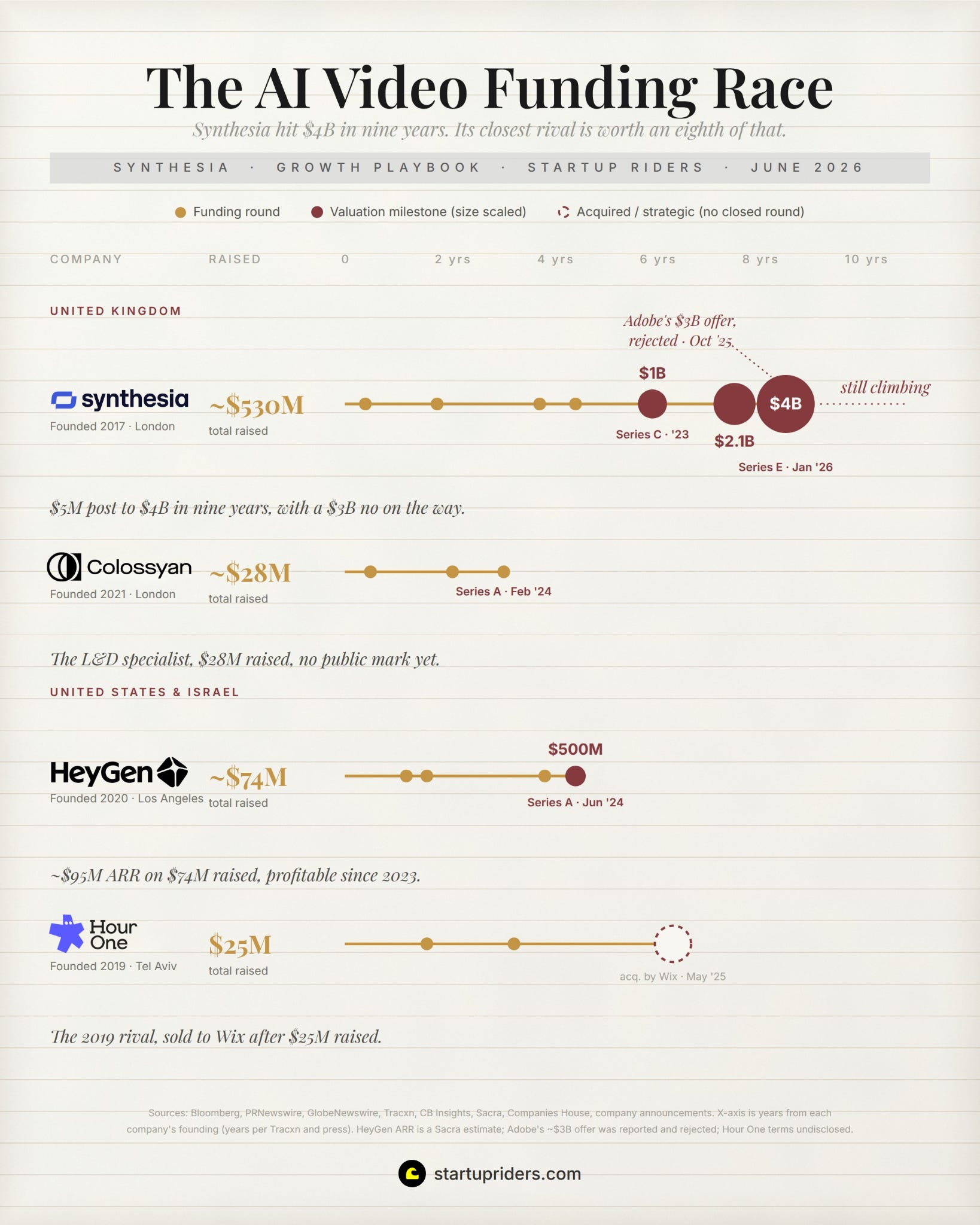
HeyGen is the closest pure rival at ~$95M ARR, skewed to creators and SMBs, now moving upmarket.
Colossyan ($22M Series A) and Hour One (~$20M raised, acquired by Wix) are an order of magnitude smaller.
Adobe and Vimeo are bolting AI onto camera-era tools, and Adobe took a strategic stake in Synthesia the same day the $100M ARR announcement went out (more on Adobe in Act 3).
What also makes Synthesia a positive anomaly in this AI wave is their margins. The Google Ventures partner who led the Series E describes them as an AI company with 2021-SaaS economics:
“Really great growth, but really great margins and really solid retention.”
Where the market is going
The fight is shifting from video you watch to video you “talk to” and 3 things will shape the next couple of years I think:
The frontier labs commoditize the pixels: rather than fight Sora 2 and Veo 3.1, Synthesia embeds them inside its own editor for B-roll and keeps the workflow.
The interface shifts from playback to conversation: their new Skills product puts an agent at the end of a training video that role-plays an objecting customer with your sales rep and scores the exchange (funnily enough I actually started building that product a couple years back). It’s apparently in beta.
Trust becomes regulated table stakes: provenance standards and AI acts favor whoever already built the compliance stack, and (as we’ll see in Lever 6) Synthesia started building theirs in 2017 (again, vision!).
Victor’s bet on formats is worth keeping in mind throughout. He thinks Hollywood adopts AI video last, the same way drum machines were built to replace drummers and instead invented house music.
Now to Synthesia’s origin and the 8 growth levers to a $4B valuation:
Act 1: The Wilderness
Apr 2017 → mid 2020 · $0 → <$1M revenue
Their initial pitch was that in 10 years you’ll make a Hollywood film from your laptop. Victor was 25 (not an AI researcher), not even a software developer, and they ran on personal savings and maxed credit cards.
After ~100 rejections, one name was left on their list. Mark Cuban, who had built broadcast.com in the first internet-radio wave and (it turned out) had personally implemented the Face2Face paper at home.
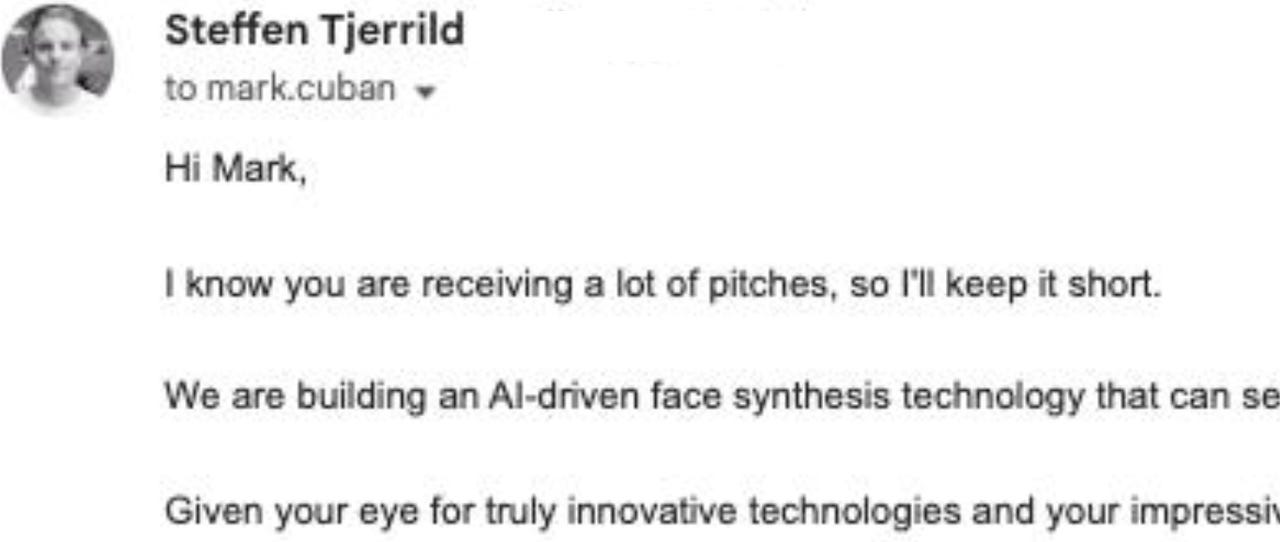
Steffen found Cuban’s private Gmail inside the Sony Pictures hack data dump (which anyone could download at the time, wild), and sent a short cold email with a video of the tech: