


👋 I’m Ivan. I study how top 1% startups grow.
Over 30,000 subscribers turn to us for startup growth strategy deep-dives.
In case you missed it:
🏆 P.s. Startup Riders recently became a Substack Bestseller!
Price is going up next week, lock in your early-bird discount forever 👇.
Hello there!
I’m a big music nerd, and this week’s deep-dive is about one of the companies that is truly breaking the frame for a lot of people in the industry.
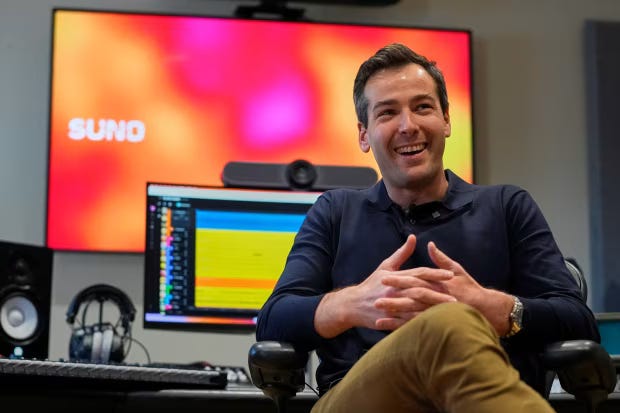
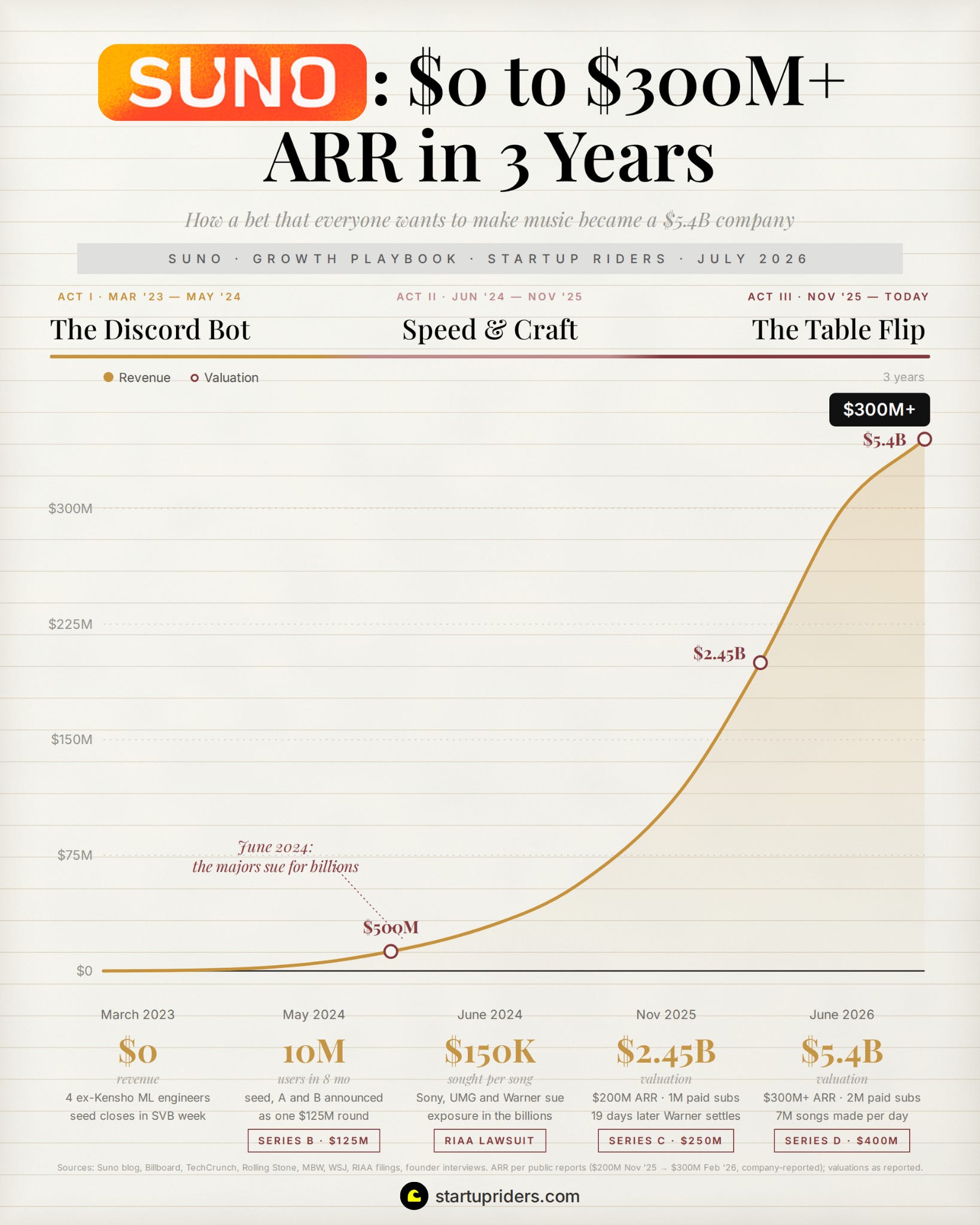
Suno, the AI music generator app, recently raised $400M at a $5.4B valuation. Their ARR has also skyrocketed from $200M to $300M in roughly 90 days this winter, and the same week they announced it a group of artist groups published an open letter titled “Say No to Suno.”
In any case, this is the kind of company that leaves a mark. This is giving me flashbacks from when artists said Spotify would kill music, Napster and the MP3 drama before that, home taping was “killing music” in the 80s before that, radio before that… you see the pattern right?
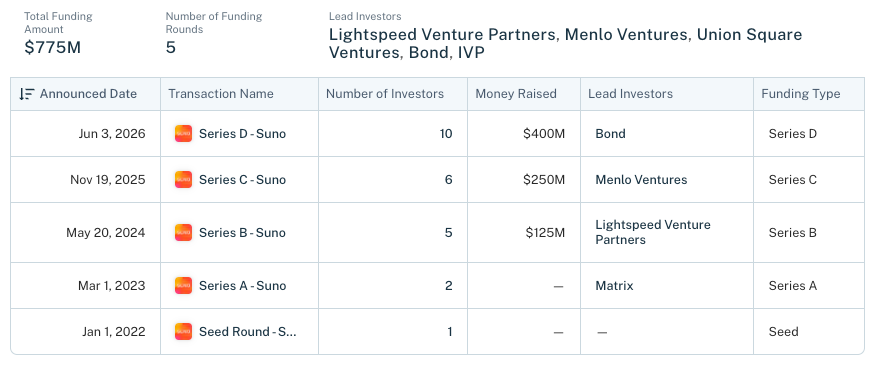
I’m excited about this one, and trying the product is honestly pretty magical (I lost a few hours to it while writing this edition). No surprise they’ve attracted some of the sharpest money in tech over the past 3 years:
So as usual I spent the past week pulling apart everything I could get my hands on regarding their product and growth tactics.
What you’ll learn (from the 7 growth levers inside):
Charging before it was good: the day-1 paywall that ~50% of new users hit
Renting distribution: how 12 people got inside Microsoft Copilot
Shipping the shareable unit: why full fuzzy songs beat competitors
Users as the training team: the 2-songs-per-click trick
Pricing the lawsuit: why their first investor wanted no label deals
Pros as proof: the contest that pulled 100,000 remixers.
Flipping the table: how the defendant bought Songkick from the plaintiff.
Lets dive in.
📐 Quick note on editorial and methodology: this analysis focuses on the 80/20 mechanics that explain Suno’s growth (not a comprehensive profile, and not an endorsement or investment advice). Long-form founder interviews (20VC, indie.vc, Inspired, etc) plus Sequoia’s Training Data and No Priors, reporting from TechCrunch, Forbes, WSJ, etc. Company-reported figures are marked as such. Treat directional estimates as directional.
Act 1: The Discord Bot
Mar 2023 → May 2024 · $0 → 10M users
In 2022 4 machine learning engineers leave Kensho (the fintech AI startup S&P Global bought for over $500M) to start an “audio” company (not a music company yet). The pitch is an audio understanding tool, because they think generating music is out of reach (for now).
“We said we would need a hundred times more compute to be able to produce good audio,” —Shulman
They close a seed round the same week Silicon Valley Bank collapses in March 2023.
“Most people didn’t know where their money was”
Weeks later they realize they were wrong about the compute, they see open-source tooling from the text world (Shulman name-checks Karpathy’s nanoGPT) had made small-scale generative audio possible, and they basically decide to throw away the company they pitched.
“We were building these speech things during the day and we would play with these things at night making music, and at some point it was just like…
what are we doing?”
Growth Lever 1: They made the paywall their quality benchmark.
“We didn’t want to be a novelty item. We wanted to be giving people something that they enjoyed enough to pay for.” — Shulman, 20VC
One of Suno’s most important problems early on was measurement.
Whereas a coding model has benchmarks and a math model has right answers a song or music is “taste”, I would imagine it’s harder to run a test to objectively know whether your music model is getting better every week.
So their paywall (which started as “maybe a bit of a happy accident”, free tier capped at 10 songs a day then pay for more) became the company’s substitute for an eval:
Day-one paywall hits are the quality score: the number the founder watches most is how many new users burn all 10 free songs in their first session, because if you did, “you just enjoyed the last 10 or 12 minutes of your life.” Almost 50% of new users do (myself included). And when a model update ships that number is the verdict they pay attention to.
Early subscribers mark the magic moments: some users pay before ever hitting the wall, “Let’s go talk to them and figure out what was that magical moment.”, which also gives them a way to find and deeply understand those people / power users.
The money mattered too: since compute apparently runs a few times payroll.
An investor gave the founder a framing they now repeat internally:
“Let me write the obituary of the company for you. A bunch of brainiacs who think they’re smart enough to intuit what the best consumer experience is going to be, and they get their lunch eaten by a bunch of people who just iterate their way there faster.”
If your product’s quality is subjective then charging early might be a great measurement instrument (disguised as monetization).
Growth Lever 2: They rented distribution 3 times before building their own surface.
“I said we’re going to be on Discord forever. I look at Midjourney, they’re printing money.”

📌 Quick answer to something a reader asked after the Lovable edition:
👉 Where did the first users come from?
In Suno’s case it was an open source repo. In April 2023 they released Bark, a free text-to-speech model, the first very realistic open one at the time. It blew up (39K GitHub stars) and per Shulman “it put us on the map, people started to reach out: potential employees, investors, potential customers.”
The clever part is that, if you notice, the Bark README points everyone to Suno’s Discord. So when the music bot launched in August 2023, Shulman announced it with one line, “AI can now sing,” pointing at that same Discord.
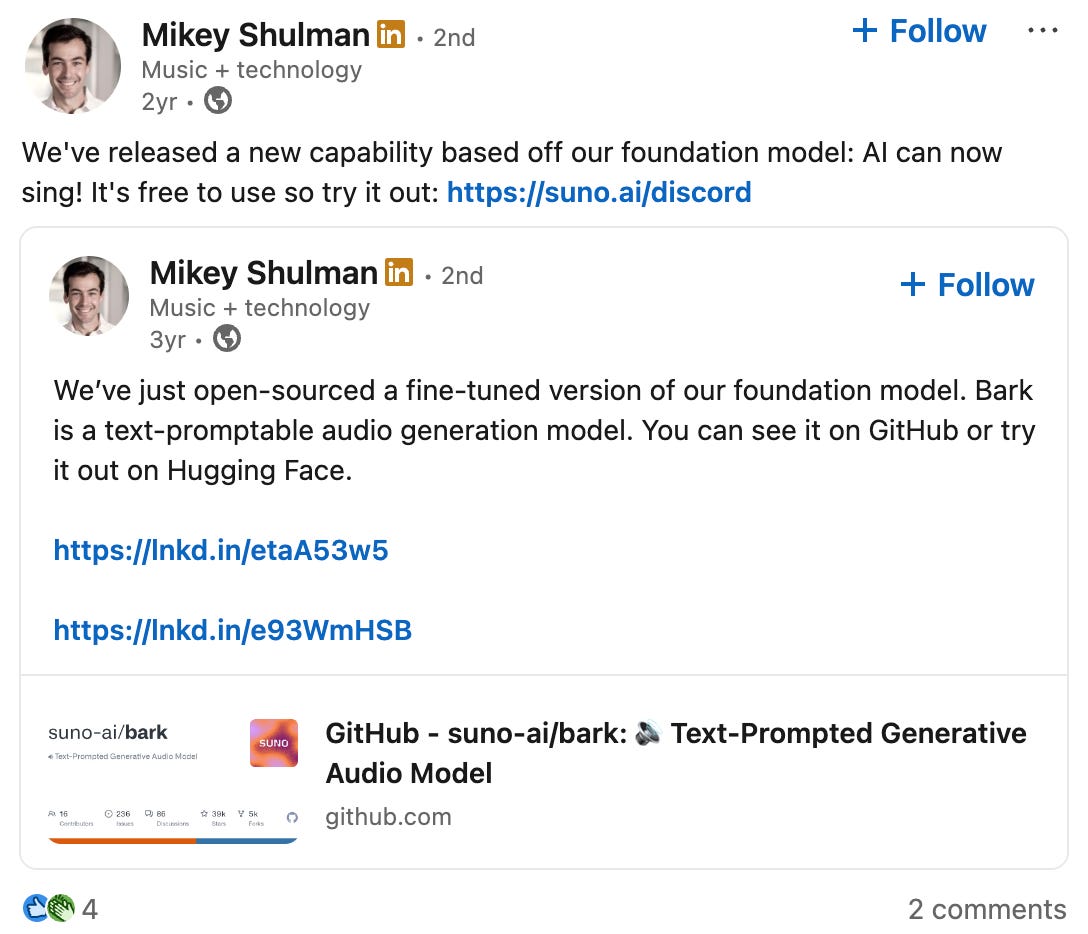
The first product in August 2023 was a Discord bot with zero UI to build, community included, straight from the Midjourney playbook.
It grew to hundreds of thousands of members (today almost 400K).
Then in December 2023, Microsoft integrated Suno as a plugin inside Copilot, putting song generation in front of one of the largest distribution surfaces on earth (while they had about a dozen employees at the time).
In November 2023, co-founder Martin Camacho pushed a thin web app over Shulman’s objections (”I’m like no no no no”). It launched with less functionality than the Discord bot and within 5 days, 90% of traffic had moved to the web.
“There’s no world in which you can say that I got that right,” Shulman says.
Also, they didn’t shut the Discord down, it became a permanent free feedback firehose with hundreds of thousands of members. So distribution got rebuilt in-house but the community stayed rented. I also like Discord for this type of product / feedback.
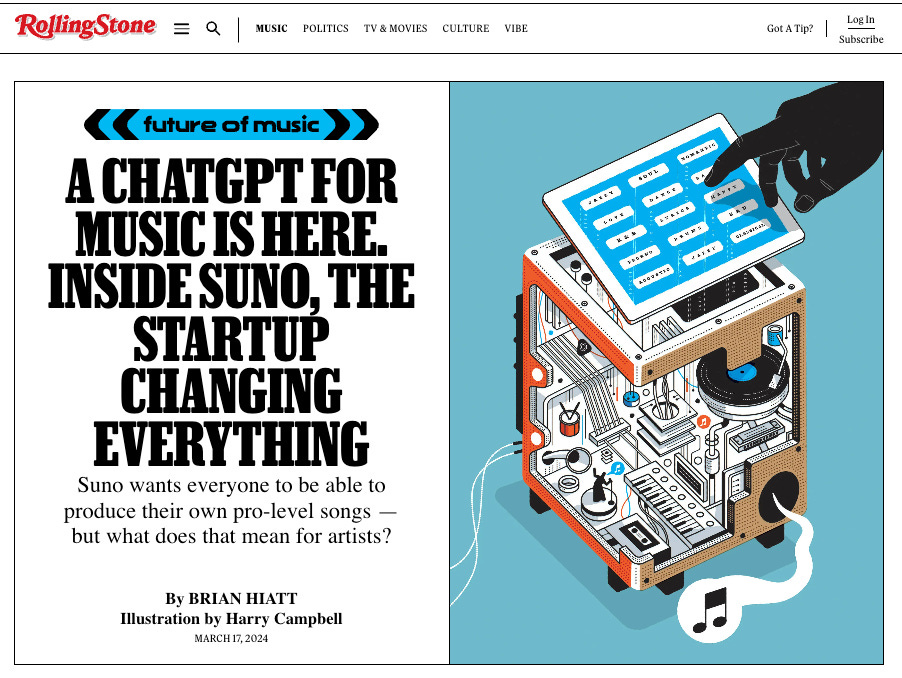
Then in March 2024, Rolling Stone ran a cover-level feature and released "Soul of the Machine," a blues song generated from the prompt "Mississippi Delta blues song about a sad AI" and it went viral with 36,000+ plays in 4 days.
That same week they pushed v3 to the free tier, and 10 million people made a song in the first 8 months.
Growth Lever 3: They shipped whole songs when everyone else shipped clips (trade-off).
“We’re going to make full songs, and yes, they’re not going to sound amazing, but they are still going to tell the story.” — Shulman, Sequoia Training Data
Early on, Suno’s model could only make 12 seconds of rough audio and the competition (and there were plenty of research demos) optimized for pristine 10-second loops and expected users to stitch them together.
But Suno went the other way and everybody could hear it, Shulman’s own words:
“Everybody could hear 1 second of a Suno song and know: oh, that sounds like crap, that’s a Suno song.”
Here’s why I think in this case the “worse-sounding” product won aka why the (hard) trade-off decision worked:
You can share a full song: a 10-second clip is a demo for other musicians, you need editing software and some skill to turn it into anything, but a two-and-a-half-minute song with your friend’s name in the chorus tends to go straight to the group chat (I’ve done it, multiple times).
That sharing was the growth engine: Shulman says all growth to date has been organic, “because music is really meant to be shared.” Every song made on Suno is an ad for Suno.
Bad audio was a problem that fixes itself: every new model version sounds better and v3 through v5 did exactly that. A clip never turns into a full song no matter how crisp it gets, whereas in their case they picked a flaw that time tends to erase (considering the past 2 years especially).
One technical detail here is that Suno generates music the way ChatGPT generates text (one token after another). Most audio research at the time used diffusion (the approach behind image models) which sounds cleaner but is worse at holding a song together over 3 minutes. They also refused to program music theory into the model, so it learns everything from raw audio:
By May 2024 they announced $125M raised at a reported ~$500M valuation, led by Lightspeed with Nat Friedman, Daniel Gross, Matrix and Founder Collective.
Then 6 weeks after the announcement the music industry sued them…
Act 2: Speed & Craft
Jun 2024 → Nov 2025 · ~$40M → $200M ARR
On June 24, 2024, the RIAA filed suit on behalf of Sony, Universal and Warner. They now had billions in exposure, with roughly $40M in revenue and 12 employees.
17 months later they’d be worth $2.45B, here’s what they did next: