Attio is the CRM that transforms how top teams grow. Ask Attio how to win this deal, what to say in your follow-up, where your pipeline actually stands, and get answers with full context, instantly. With Universal Context, Attio’s intelligence layer, every signal across your tools becomes instantly actionable.
The engine behind every top 1% startup is a great CRM.
One of the tools that fascinates me most is Lovable, both because of how fast their product ships (daily?) but also for how spectacular it is to enable creativity (i.e. meet my friend Arnold) and give you what genuinely feels like superpowers.
So I decided to deep dive into how this European outlier grows.
Here’s what actually worked, stage by stage:
📐 Quick note on methodology: this analysis focuses on the 80/20 mechanics that help explain Lovable’s growth (not a comprehensive profile, and not an endorsement or investment advice). Based on 40+ sources including podcasts, company blogs, investor analyses, and third-party teardowns. All revenue figures from TechCrunch or public statements. This company moves so fast that data from 3 months ago is already outdated, I used the latest confirmed source in every case. Treat all numbers as directional.
Act 1, The Spark: $0–$10M
Founder brand as a permissionless acquisition channel
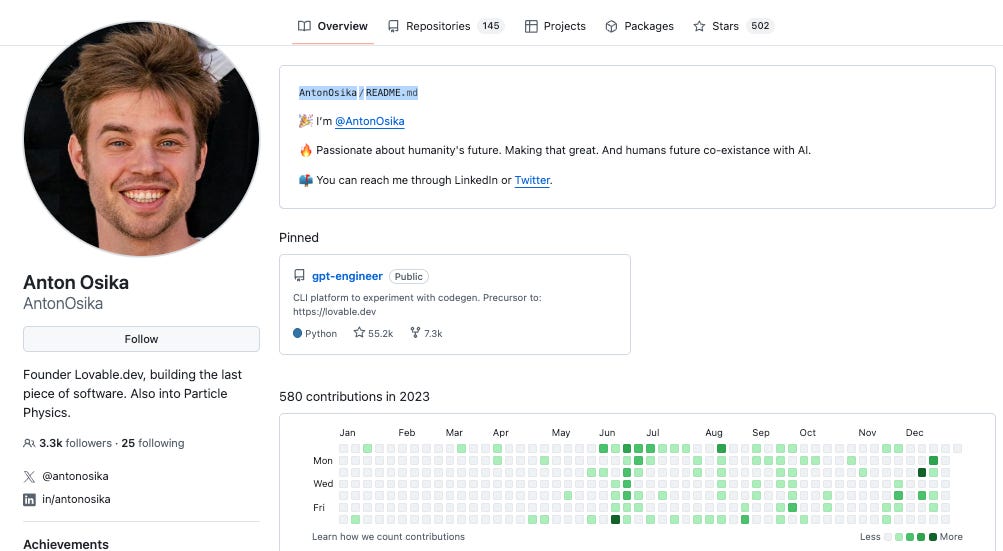
Anton Osika studied engineering physics at KTH, worked at CERN, was the first engineer at Sana Labs, and co-founded Depict.ai through YC. In 2023 he built GPT Engineer as a side project, an open-source experiment to see what LLMs could do with code.
It hit 50K GitHub stars which was the fastest-growing repository on GitHub that year. GitHub’s systems temporarily shut it down thinking it was a DDoS attack 😅, because it was spawning 15,000 new repositories a day.
He tried to productize it twice.
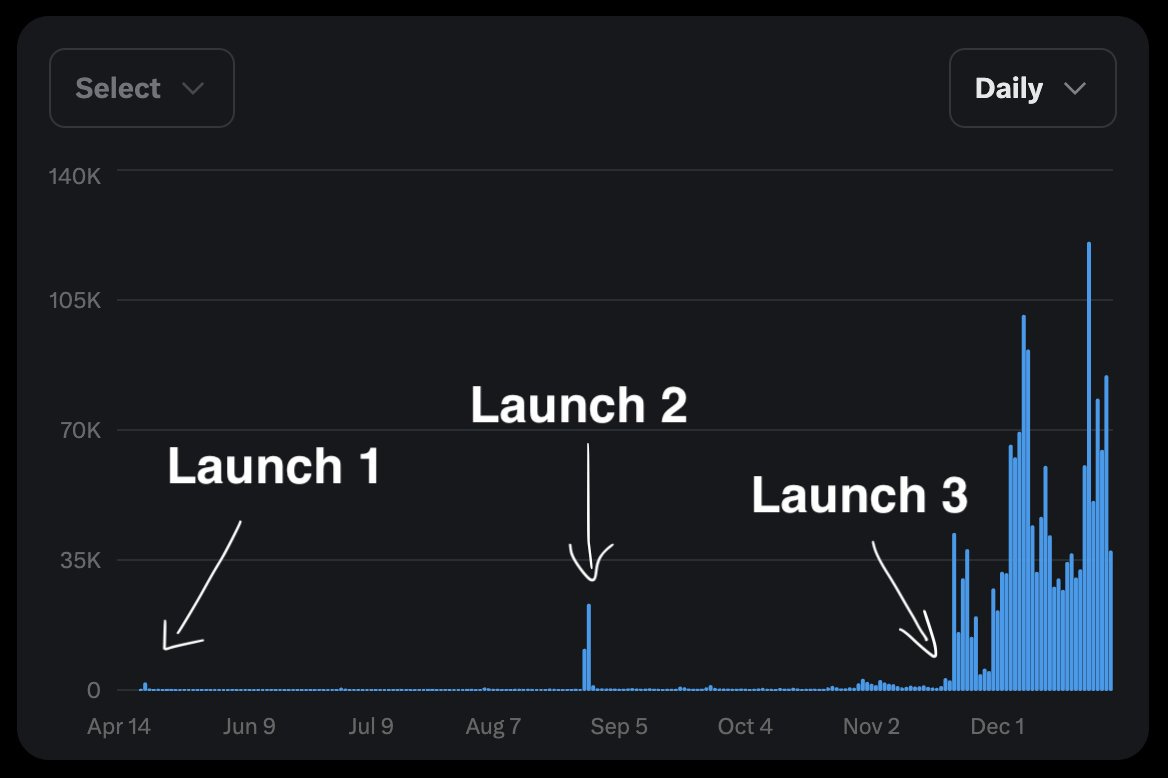
Launch 1 (early 2024): user growth stalled almost immediately.
Launch 2 (mid-2024): retention collapsed, the AI got stuck on anything complex, and the pricing model was bleeding money on power users.
Most people read that as a no, but Anton read it as a spec.
He and co-founder Fabian Hedin migrated the entire backend from Python to Go, built new scaling laws for AI self-debugging so the model could get itself unstuck, and made the call that changed everything: stop targeting developers.
Their hypothesis was that the real opportunity was giving non-technical people the ability to build software from scratch (superpowers).
“Lovable” as a rebrand was spot on, as it told you how it should feel. Elena Verna, who joined later as Head of Growth, has a name for this: the Minimum Lovable Product, software with personality, software you trust because it feels alive.
The name has also become somewhat of a cultural enforcement mechanism inside the company, when someone says “this is not lovable” in a meeting, everyone stops what they’re doing.
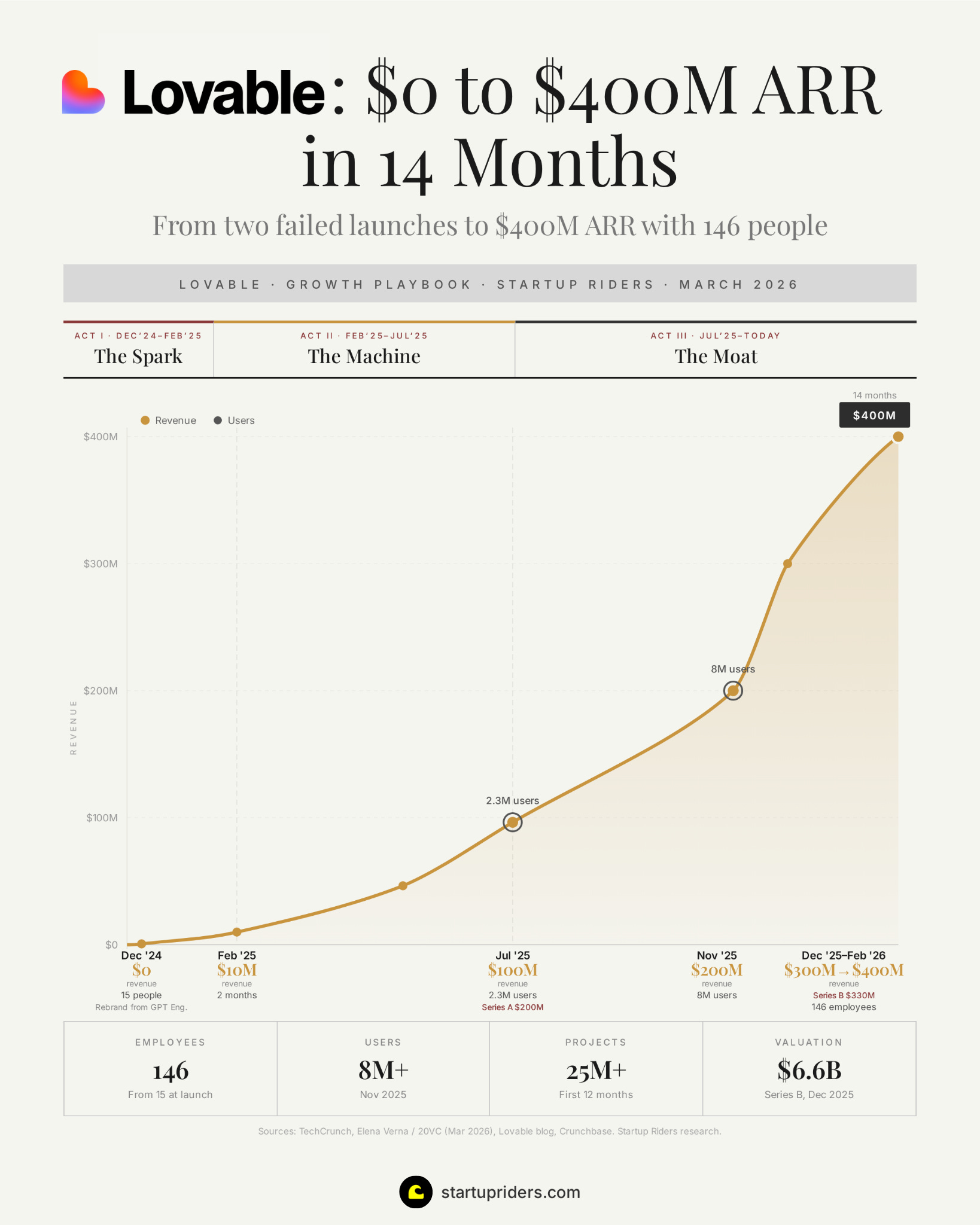
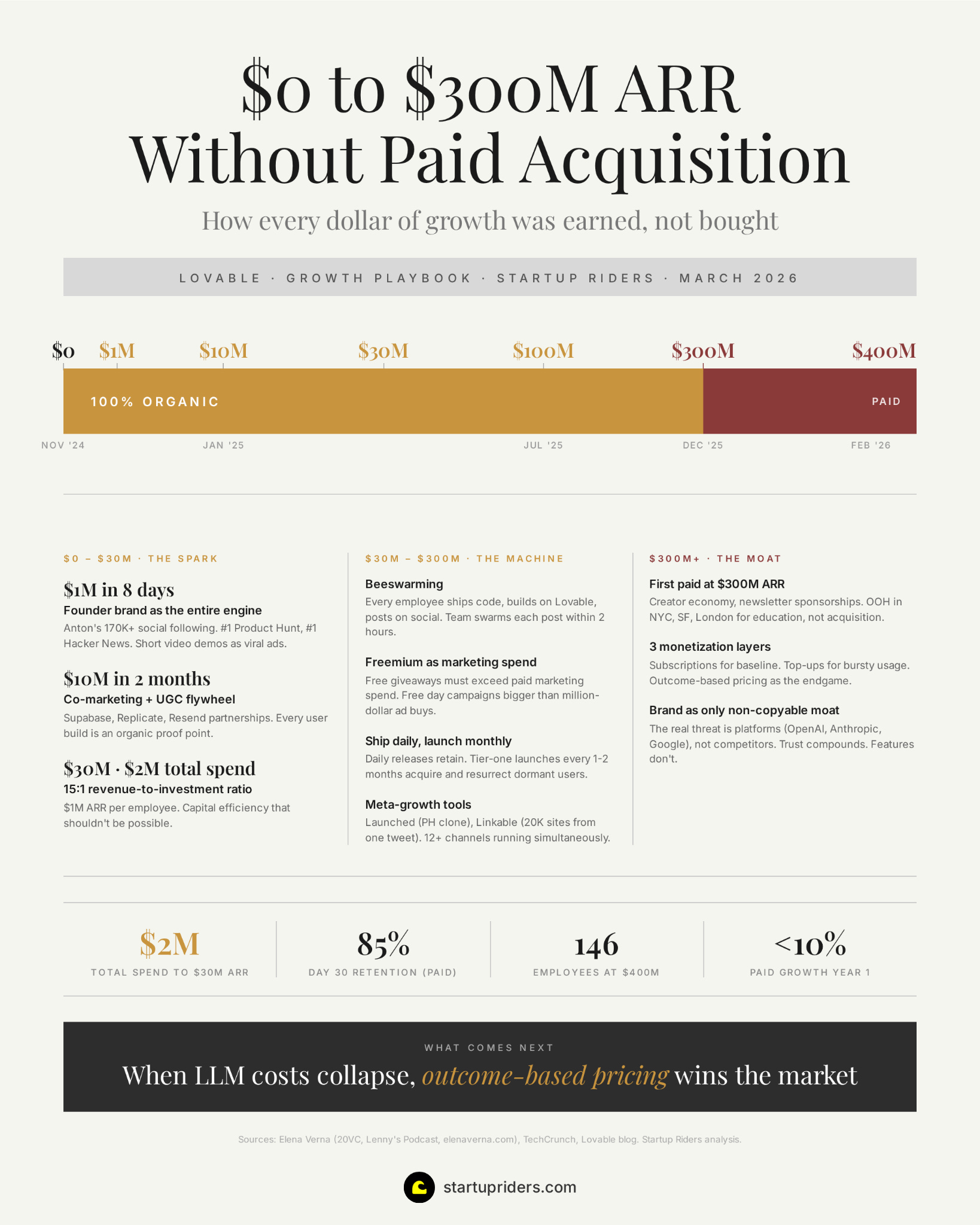
Third launch was in November 2024, which became #1 on Product Hunt, #1 on Hacker News and drove $10M ARR in 2 months with 15 people.
The levers that drove it:
Founder brand as distribution: Anton had already been cultivating an audience on socials built over years of posting raw numbers, failed experiments, hiring photos, half-formed ideas a-la Pieter Levels. When hey launched people already trusted the person before they trusted the product. This deserves a deep-dive on its own, worth having a trip down memory lane on Anton’s timeline.
GPT Engineer’s 50K GitHub stars were a pre-built trust base: Thousands of developers already knew the name and the credibility likely transferred directly to the new product, again part of a long-term founder brand investment.
Short video demos as an ad: Nobody knew what vibe coding was in late 2024 but you watch 10 seconds of someone building a real app by typing a sentence and you think “I had no idea this was possible.” / what kind of sorcery is this. I think Twitter, Tiktok and YouTube drove real curiosity at scale due to the product’s inherent “magic moments”.
Co-marketing with Supabase, Replicate and Resend: gave them reach into audiences that were already product-curious and technically adjacent.
Product Hunt and Hacker News as coordinated launch amplifiers: as usual, but also with leveraged via points 1 and 2 above.
User-generated content from day one: Every post someone shared of their Lovable build was basically an organic proof point (PLG mechanics).
One mistake Anton calls out directly that caught my eye and is worth highlighting as it is a perpetual debate I had both working at Meta on product discussions but also with many of my founder friends (almost weekly):
On trying to keep the GPT Engineer open-source community alive alongside Lovable: “A bad idea to do two things that were like a bit too tangentially related.”
Building a trust machine without ever buying growth
A founder’s personal brand can get you to $10M (as wild as that is). But what gets you to $100M is likely, as is usually the case, a system.
And Lovable’s system has more moving parts than almost any company at this stage, and almost none of them are paid.
Before getting into the levers, the context that makes them all make sense is what I hear Elena Verna call “the product-market fit treadmill”. Which means that every 90 days, a new model drops, consumer expectations reset, and what felt like product-market fit the previous quarter feels shaky again.
Worth noting how they explicitly call out how growth work has totally flipped from 5-10% innovation, 80%+ optimization to, at Lovable = 95% innovation, 5% optimization.
Which means Lovable is rebuilding the growth engine while driving.
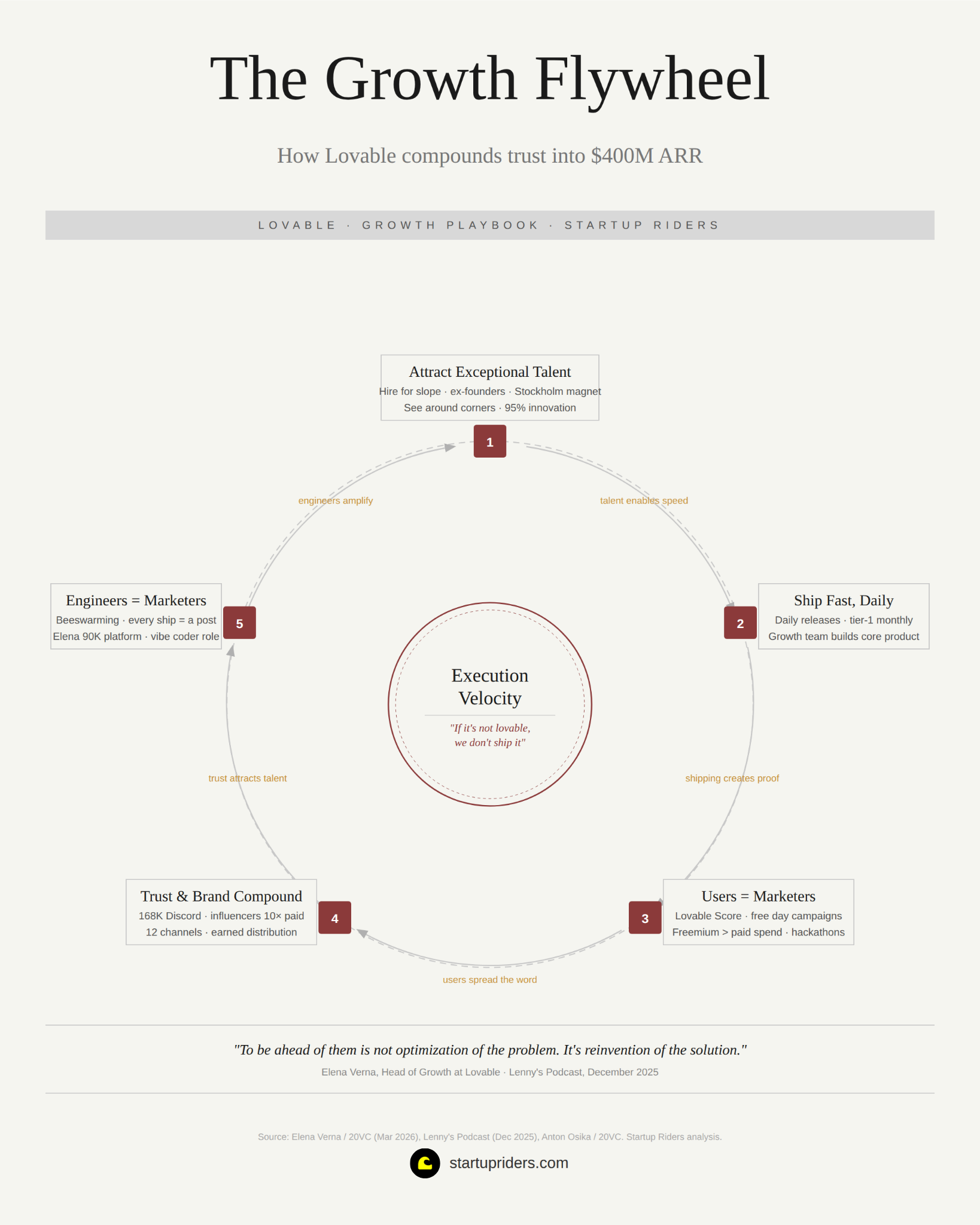
Growth lever 1: Hire for slope, surround yourself with people who see around corners.
This one sits at the top because it’s the precondition for everything else and the founder seems to be very direct / osbssessed about it (for good reason): the pocket moves fast, and the only durable advantage is being surrounded by exceptionally smart people who can see what’s coming before it arrives.
Lovable hires ex-founders and high-slope new grads, and Stockholm turns out to be a structural advantage here, where Lovable is quickly becoming the biggest talent magnet in the city, something that’s simply not possible in SF where OpenAI or Anthropic will outbid you on a bad Tuesday.
The cultural consequence is a growth team that builds core product (i.e. they’ve launched a Shopify integration, enabled voice mode, built agentic workflows, etc.). None of that would usually come from a growth team at a traditional company.
Growth lever 2: Turn every engineer into a marketer.
The system is called beeswarming and it’s more deliberate than it sounds. Every employee ships code to production, builds side projects on Lovable, and posts about their work on social. When a post goes up, it gets dropped in an internal channel and the whole team swarms it with comments and reposts within the first two hours.
There’s also somewhat of a structural advantage here because typicallly large companies cannot do this (requires review, approval, less incentive too etc).
“If you asked me what the organic marketing strategy was five years ago, I would have said SEO. Now it’s all about social, no matter how B2B you are.”
Influencer marketing seems to be 10x bigger for Lovable than paid social.
Growth lever 3: Freemium as a marketing budget, not a cost center.
Most companies treat freemium as a necessary evil but Lovable’s biggest cost bucket is freemium, and they track it explicitly as a marketing line item, not COGS.
The logic is that a free user who gets delighted posts on social, refers friends, and builds apps that other people see. They track this through the “Lovable Score” which measures referral propensity across the user base.
They have it as a rule that free giveaways must exceed your paid marketing spend. If you’re spending more on Google and Meta than on delighting free users, you’re subsidizing third-party platforms instead of building an earned channel you own.
The free day campaigns is another example of this tactic. They’ve run 3 as far as I can tell: a free weekend in early 2025 for acquisition when the brand was young, a summer 2025 free weekend near $100M ARR specifically for resurrecting dormant accounts, and Women’s Day 2026 with advance notice and mission alignment. The last one:
“All I see is people talking about the Lovable free day. That is something you cannot pay for. A campaign bigger than one that would cost us millions of dollars, and our users are doing all the marketing for us.”
Growth lever 4: Ship every single day.
Not bug fixes, teal product changes based on user feedback. You can see these happening in real time following Anton on Twitter, which is amazing.
Engineers ship, then post, Beeswarming kicks in. Which also means the marketing team has no involvement in daily releases (more focus), and has product engineers announce what they ship, directly, on their own channels.
On this wave, and in this market, daily or weekly shipping puts you in the habitual zone vs monthly tends to put you in the forgettable zone.
On top of the daily releases, they run tier-one launches every 1-2 months that bundle features into a story with a bigger narrative arc. The full circle is that daily retains existing users and tier-one launches acquire and resurrect dormant accounts.
And of course the “constant noise” is a deliberate retention strategy (and so is layering in each of these growth levers, across Act I and II).
“Micro-releases make the product feel alive. Users signed up for version X but keep getting version X+. It builds trust without you having to ask for it.”
Growth lever 5: Co-marketing from day one.
They used Supabase, Replicate, Resend at launch likely as credibility transfers. Technical audiences who already trusted these tools got a warm introduction to Lovable through partnerships with products they already used.
Growth lever 6: Community seeded with builders
Most communities become dumping grounds for negative sentiment. I know this first hand. A lot of thinking went into building our Spark AR community when I was at Facebook, so that it would become actually useful for feeding our product roadmap.
Usually the loop followed by most product teams is to create a community when the support team drowns “so people can help each other,” which then rapidly becomes a venting outlet, and Google indexes all the negativity (a big no-no).
Lovable’s Discord works because it was seeded with enthusiastic builders before frustrated customers had a chance to define the culture. And when done well, community tends to make people stick around because they feel invested, which creates emotional switching costs
Growth lever 7: The agent team owns activation
This one’s unusual enough to be worth calling out. The growth team barely touches traditional activation work because the AI agent IS the activation experience.
Improving the agent improves the entire user lifecycle at once, so the growth team can focus almost entirely on acquisition and expansion because activation is being handled at the product layer by the people building the core model. Which is a structural separation most PLG companies never really achieve.
Act 3, The Moat: $100M–$400M
Monetization discipline and brand as the non-copyable moat
Before getting into the growth levers, one thing worth understanding about who’s actually paying. The narrative around vibe coding for a long time was that it was for hobbyists, toy apps, weekend projects and so on.
But the revenue split at $400M ARR seems to tell a different story, with Anton mentioning 80% of revenue comes from founders building real, complex applications (although this was 7 months ago).
That matters for everything that follows because a product being used to run real businesses retains differently than one people play with.
Growth lever 1: No paid acquisition until $300M ARR.
When Lovable started out-of-home advertising in early 2026 (past $300M ARR) the purpose was education, and reaching the latent majority who haven’t tried AI app building yet.
So using ads in a relatively contrarian way to most software companies sponsoring subway ads in New York, billboards in San Francisco, bus ads in London etc.
Also pretty cool to see them being bullish on the creator economy sponsoring more and more creators with highly curated audiences + communities.
Growth lever 2: Three monetization layers, two of which most companies are too scared to run.
Layer 1 is subscriptions: €25/month pro plan, a €50/month business plan and a custom enterprise plan (predictable ARR base, nothing surprising).
Layer 2 is top-ups: ad hoc credit purchases on top of the subscription for bursty usage when a project sprint hits (I use these a lot on claude co-work…) It is likely pure incremental revenue (AI usage isn’t linear its often bursty, and fixed plans miss the peaks entirely), and if we were all being totally honest, I for one would pay way more for the intelligence I’m getting out of these tools (they are mostly subsidised by the wave of venture capital over the past couple years, use it).
Layer 3 is outcome-based pricing, which doesn’t exist yet but is where the whole market is (likely) heading. Every AI company right now is passing through LLM costs to users, and when those costs collapse, and every model provider is betting they will, the companies already charging for outcomes instead of tokens win.
There’s also a compounding structural advantage for Lovable which is a net-dollar retention sitting above 100%. Which means that when people build something real on Lovable they want more credits, and the more they build, the more they spend. And also, once you are live and active, and the system is trained on your logic, and your domains and connected, and etc etc, retention mechanics become layered and quite powerful.
Which is a monetization flywheel you can’t easily manufacture.
Growth lever 3: Track the right metrics, ignore the vanity ones.
Most startups are guessing CAC-to-LTV ratios based on 12 months of data.
LTV: “absolutely irrelevant under 5 years, you don’t know it, period.”
The north star at Lovable seems to be Daily Active Apps (how many apps are being actively built or actively receiving traffic on a given day).
Which makes sense as it captures both sides of the value simultaneously:
The person building
The person using what was built
Which is a leading indicator for both monetization and retention at once.
This number seems to be sitting around 85% Day 30 retention among paying users, which is quite remarkable for a product this young in an emerging category.
Growth lever 4: Brand as the only moat that doesn’t erode.
When you ask who Lovable’s most dangerous competitor is, the answer catches most people off guard:
“I always worry about the big boys and girls. OpenAIs, Anthropics, Googles, Apples. They just have the distribution hold in the market that is unparalleled.”
The logic is worth sitting with because when product functionality commoditizes, and it is commoditizing fast, every 90 days a new model drops and capabilities reset, the companies with the best earned, defensible distribution win.
A startup can out-build any platform on product but it cannot out-distribute them (look at our Freepik growth deep dive from last week on how they leveraged distribution to surf the AI curveball). This is why brand tends to be the only lever that compounds in a way that scale doesn’t automatically solve.
The Canva parallel is an interesting way to frame it. If Lovable becomes the trusted default for non-technical people building software, the same way Canva became the trusted default for non-designers making visuals, then a bigger player launching a competing feature is a footnote not an existential threat, because it is very hard to replicate brand trust with a product launch.
It was interesting to read Anton’s 5-year vision that makes the ambition explicit:
“We’re the most used interface for humans to AI.”
So, not a coding tool and not a website builder, but the entire stack. From idea to growing business, email to customers, marketing channels, all of it!
What actually matters here
What’s most interesting about this company and likely the thing that is hardest to copy is the cultural operating system.
A few observations that strike me most:
Hiring ex-founders and high-slope generalists who treat ambiguity as oxygen. Every person on the team is wired to see around corners instead of optimizing what’s already there.
They don’t wait to understand the market before moving because nobody understands this market, its a new emerging one. The airplane is being built mid-air and there is no playbook for where this market lands.
The only thing that separates the companies that survive from the ones that don’t is the speed at which they learn + quality of the people doing the learning.
They ship daily not because they have a process for it but because the culture makes sitting still feel like falling behind.
95% of growth work is innovation and 5% is optimization.
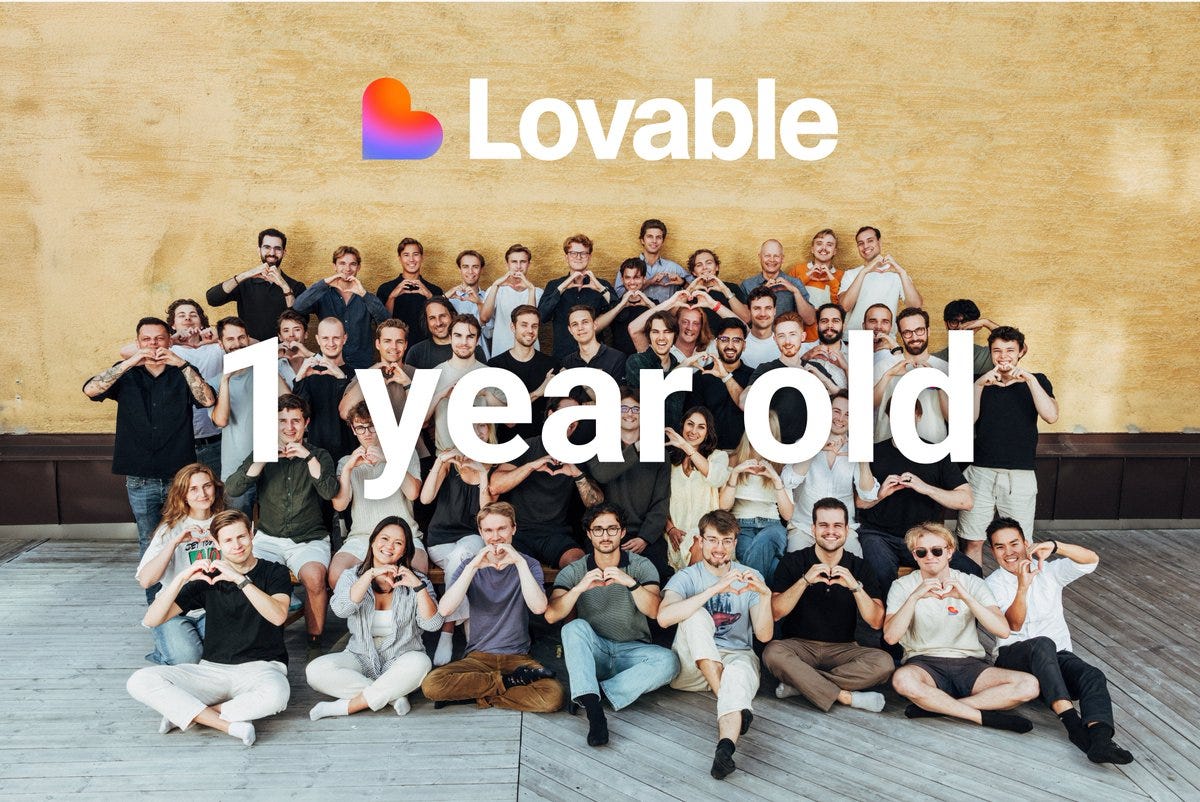
Execution compounds. Lovable’s capital efficiency ($2M to $30M ARR), headcount efficiency (146 people at $400M) and speed ($0 to $400M in 14 months) are symptoms of a culture where the default answer to “should we try this?” is yes, today, ship it tonight, which in turn collides with extreme market hunger (a perfect venture capital storm).
Talent density is almost everything. Being able to attract the best talent, people who can build, think, and move at the same time on this particular wave. People who don’t need to be told what to work on, in a market that resets every 90 days (or less).
Whatever ends up happening, what a fascinating company to watch.
📚 Bibliography
TechCrunch, “Lovable says it added $100M in revenue last month alone, with just 146 employees,” March 11, 2026
Anton Osika, “Building Lovable: $10M ARR in 60 Days,” Lenny’s Newsletter, 2025
Elena Verna, Lenny’s Podcast, “The new AI growth playbook for 2026,” December 2025
Elena Verna, 20VC podcast with Harry Stebbings, March 2026
Elena Verna, “Growth Lessons Behind Lovable’s $6.6B,” elenaverna.com, 2025
Elena Verna, “I’ve Joined Lovable to Lead Growth,” elenaverna.com, May 2025
TechCrunch, “Vibe coding startup Lovable raises $330M at a $6.6B valuation,” December 18, 2025
TechCrunch, “Lovable says it’s nearing 8 million users,” November 10, 2025
Lovable blog, “Series B Announcement,” December 2025
Lovable blog, “Rebranding GPT Engineer to Lovable,” January 13, 2025
SimilarWeb, lovable.dev traffic data, 2026
Product Hunt, Lovable listing, 2024
Elena Verna, “Trust is the New Growth Moat,” elenaverna.com newsletter, 2025
The Growth Mind, “How Lovable Grew to $17M ARR in 3 Months,” thegrowthmind.substack.com, 2025
🚀 Building something in this space? I invest €100K–3M at pre-seed and seed. If you’re raising or know someone who is - please send us your deck via DM.
That’s it for this week folks.
Cheers,
Ivan
P.s. send me your questions about startup growth by replying to this email, I’ll try covering them in future editions 🤙



Very well researched piece, Ivan. There's a lot in here worth stealing.
The freemium point is clever. So is turning engineers into marketers and treating daily releases as part of growth rather than a separate department.
The only caution is that not every startup can pull this off now.
Once a wave like vibe coding has already thrown up a few giants, the same playbook gets much harder to repeat.
Lovable’s rapid $400M ARR shows the power of organic growth done right