


👋 I’m Ivan. I study how top 1% startups grow.
In case you missed it:
Welcome back!
If you are into health-tracking gadgets this one might be for you.
I’ve pretty much tested all wearables under the sun (i.e. whoop, fitbit etc). The one that lasted the longest for me was the Oura, so lets dive into their growth story.
Hardware plus subscription can be a very tough business model (especially if you talk to any vc’s). You pay to build the thing, you pay to ship the thing then you ask the customer to keep paying after they already bought it, tough.
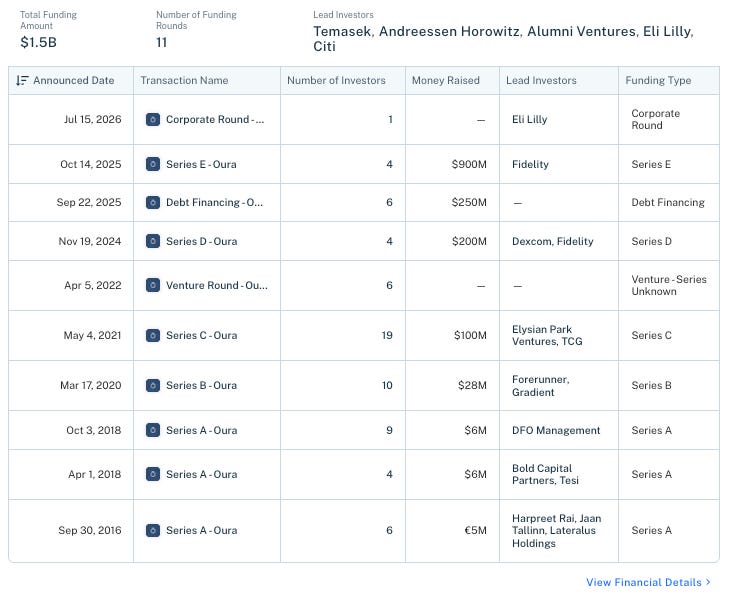
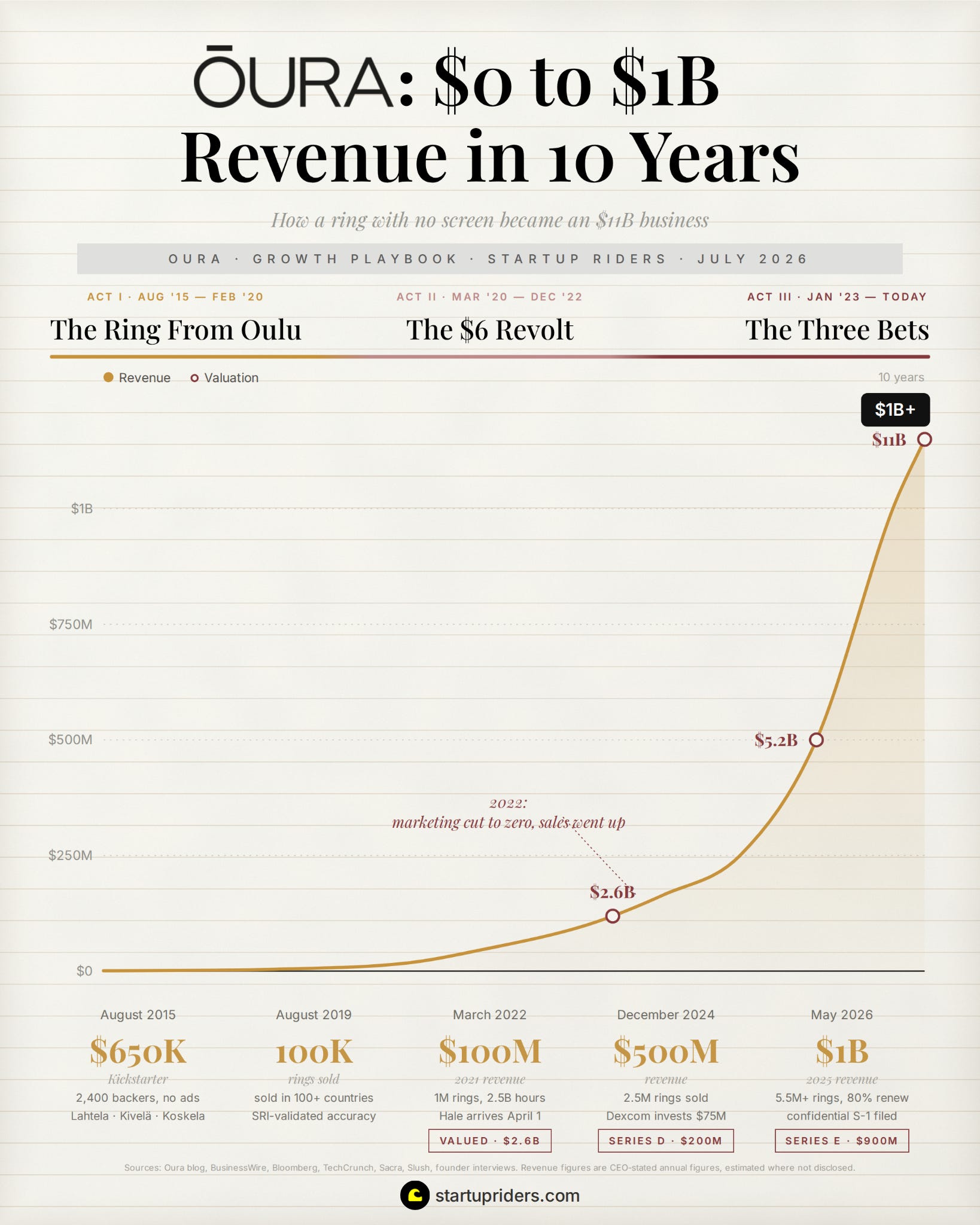
On May 21 this year, our Finnish friends at Oura here filed confidentially for an IPO at an $11B last-round valuation, with revenue that went $100M → $165M → $250M → ~$500M → ~$1B in 5 years with this cap-table:
What you’ll learn in this edition
Their 0 to 1 story, from a Finnish city to the world.
How they built a wearable in a way so you’d never take it off
How they let Stanford prove their claims for them
How they got 60% of sales to come from users recommending the ring
Why they sold to institutions in crisis and then let endorsements sell consumers
How “spend it or lose it” pre-tax money became a sales channel for them
And other growth mechanics, so lets dive in!
📐 A quick note on editorial + methodology: this analysis focuses on the 80/20 mechanics that explain their growth (it’s not a comprehensive profile, and not an endorsement or investment advice). I use AI like a fund leverages an analyst for groundwork. The direction and judgement are mine. Company-reported figures are marked as such and figures Oura has not disclosed are third-party estimates, so treat directional estimates as directional.
From sleep tracker → to the S-1 pile
A little about how this market evolved before we get to the growth mechanics:
Where we come from
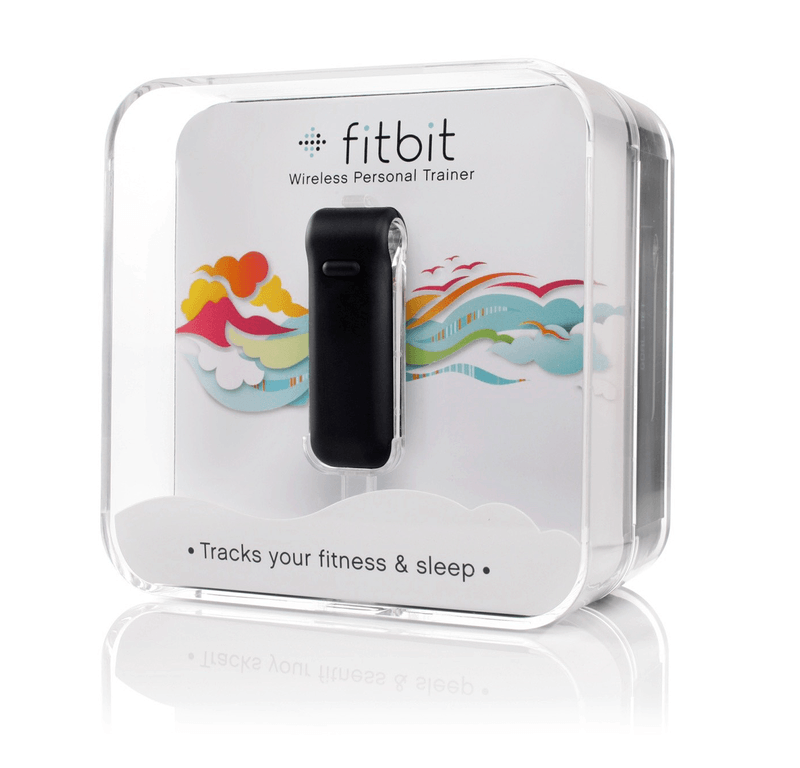
Wearables started on the wrist with Fitbit starting this wave in 2007, the Apple Watch arriving later in 2015, and for a decade or so the category was mostly a screen on your arm “counting” your activity (we all remember the old step counter).
The wrist won (the watch form-factor was already there) for the same reason that when you go to a hospital they clip a sensor to your finger, largely because the arteries sit close to the surface there and the signal is cleaner. Meanwhile sleep went mostly unmeasured, which is interesting considering it is the most information-dense 8 hours of your physiology, and tends to be the 80/20 to fix first.
Where we are today
Roughly 164 million smartwatches shipped in 2025. The ring is now basically its own category owned by Oura with 80%+ market share. Competitor pressure has also started to build up (as expected):
Samsung → launched the Galaxy Ring at $399 with no subscription.
The low-cost clones (Ultrahuman, RingConn) → attacked on price until the ITC banned their rings from the US in October 2025.
Apple → a rumor that comes and goes.
Oura stopped being “just” a gadget company somewhere along the way with at least half of its story now running through glucose sensors, blood panels, a Medicare Advantage sleep-apnea pathway, plus thousands of rings across the US defense sector (US Department of Defense is now its largest enterprise customer!).
Where the market is likely going next
The fight is moving from tracking your body to “prevention”, and 3 things will likely shape the next few years:
Platform owners set the price of software at 0: Samsung alredy did it and if Apple ships a ring bundled with an iPhone upsell it’ll build up more competitive pressure.
Healthcare: the ring already flags signs of sleep apnea and then pushes Medicare members toward an actual doctor (also Eli Lilly invested in the company recently). In Europe healthcare represents c.10% of GDP and Hale (the current CEO) keeps saying out loud that he wants Oura to be “a virtual doctor in your pocket” (Slush, 2025).
The IPO wave sets the price: Oura filed its S-1 recently and public markets will either read it as a hardware company or as a subscription company, we’ll see (big implications for how much they’d be able to reinvest in product + growth)
Act 1: A Kickstarter In Finland
2013 → 2019 · $0 → first 150K rings
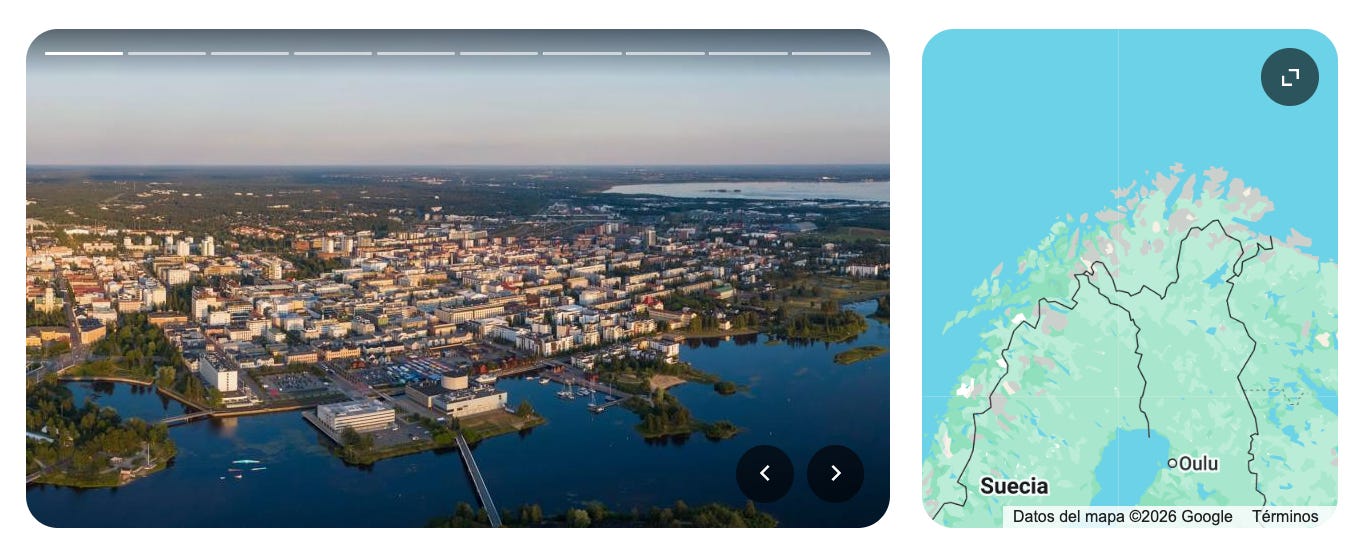
Oura was founded in 2013 in Oulu which is a Finnish city 2 hours below the Arctic Circle. It is also a place that Nokia’s collapse filled with unemployed hardware engineers at the time and usefully, world-class testing labs.
“behind Nokia we found big labs with the best equipment to test the device.”
The 3 founders (Petteri Lahtela, Kari Kivelä, Markku Koskela) came out of the Polar and Nokia orbit, and Lahtela’s obsession came from years building IT systems for chronic disease management, where he watched health data reach patients years too late. The company was originally called Jouzen (from joutsen the Finnish word for swan) with the zen for calm and a deliberate phonetic nod to the English “chosen” (members have chosen to prioritize their health). Cash was so tight that salaries sometimes ran months late:
“We lived off personal credit cards, but everyone showed up to work every day, driven by the vision to bring Oura Ring to the world.” (Marjut Uusitalo, early employee, Oura’s history blog)
The 0 → 1: how the first rings actually got sold
They decided on day one that the US was the market to go after:
March 2015 → came out of stealth on stage at the San Francisco Launch Festival, where Lahtela said “we all know the charge level of our mobile phones, but do you know the charge level of your body?” Gen1’s official job was a way to collect data to validate the science and hone the algorithms.
The first believers → not easy to find. Lahtela says it was “really hard, really really hard,” until they landed on people who “spoke the same language,” first the Quantified Self crowd in San Francisco, then the biohacking and self-optimization scene. Those early users were “in resonance” with the approach so they understood what Oura was going for and according to the founders “helped us to form the product as well”.
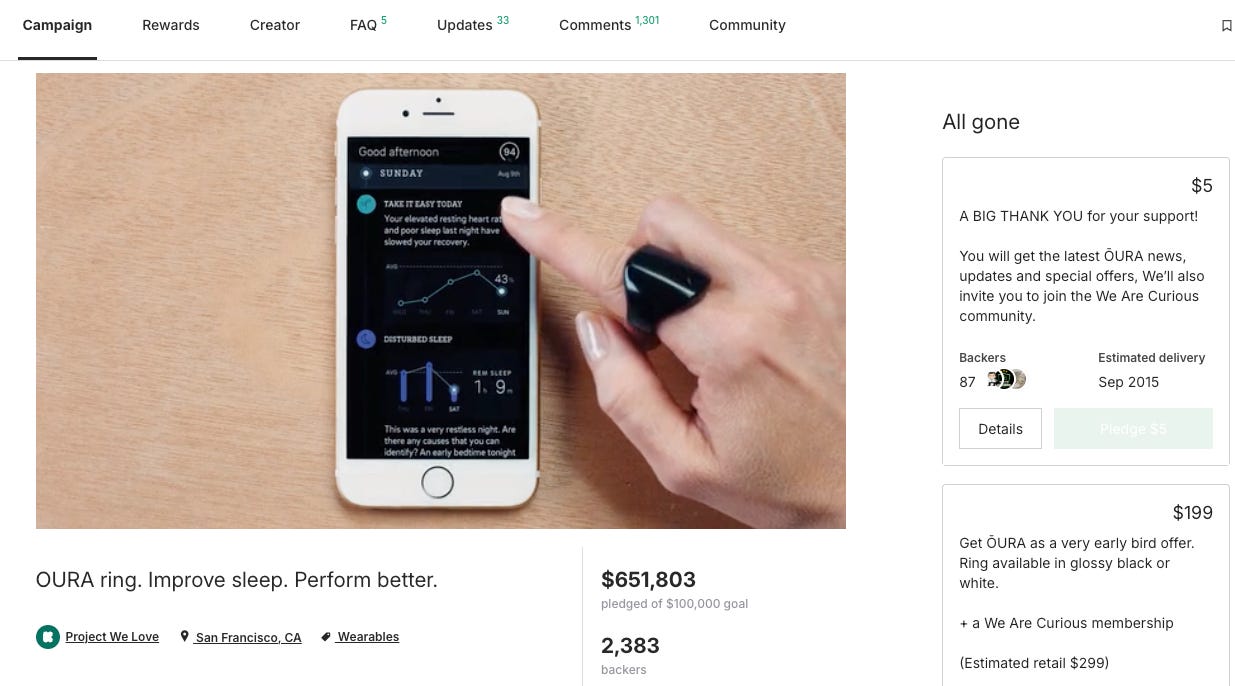
August 2015 → the Kickstarter hit its $100K target in 15 hours and closed at $650K from ~2,400 backers with apparently no PR and no paid ads. Those 2,400 backers were the first paying customers, recruited almost entirely through the communities above plus what Lahtela calls “lots of footwork in between and after.”
Investors said no → “it was really hard to find investors who were also driven by something else other than money”. The early cap table filled up with angels instead including Will Smith, Shaquille O’Neal, YouTube’s Steve Chen and Twitch’s Kevin Lin (per Nordic Business Report, so treat as reported).
Then 2 outsiders found the company and both became levers:
2015-2017, Stanford Research Institute → secretly bought 2 rings off Kickstarter to test them (more in Growth Lever 2).
2016 a Whole Foods in New York → co-founder Kivelä spotted the first stranger he’d ever seen wearing the ring. It was Harpreet Singh Rai, a hedge fund PM who had lost ~50 pounds using it! Rai invested in September 2017, joined the board, moved to San Francisco and became CEO in 2018 (who later stepped down).
Gen2 debuted at Slush in November 2017 and sales jumped to ~10K rings then 100K+ rings across 100+ countries by August 2019, and roughly 150K total before 2020.
Now lets dive into how they grew:
Growth Lever 1: They built a wearable you never take off
“It is just there for you, you don’t need to interact with it... that is a reason why our retention rates are so high.” (Petteri Lahtela, Ali Fitness podcast, 2018)
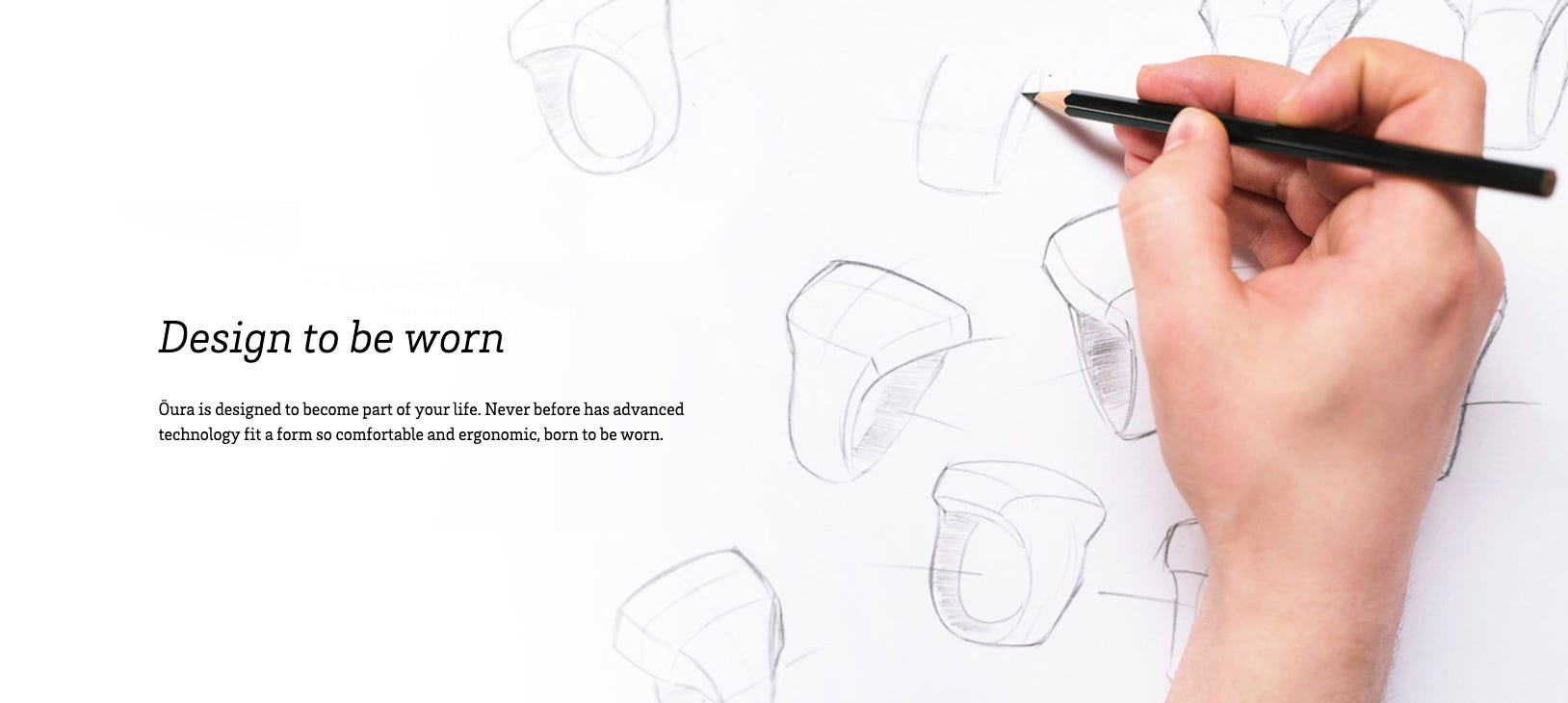
Wearable decisions flow from 2 architectural choices they made in 2013:
Measure from the finger → arteries sit closer to the skin than at the wrist there and the tissue is uniform so the signal tends to be cleaner + accuracy claims get “easier” to defend.
Put nothing on the ring → without a screen, LEDs, or an interface. You don’t feed it attention, you don’t charge it nightly (7-8 days of battery), and as Hale likes to put it, “it’s not another digital mouth to feed.”
These design decisions where important because they were intentionally building a product intended for you to forget you are wearing it (and this way you don’t take it off). So continuous wear tends to lead to continuous data and therefore insights that compound (i.e.cycle prediction needs months of temperature).
Lahtela claims retention runs 3 to 4x higher than any other wearable (Slush 2024).
Growth Lever 2: They let Stanford prove their claims for them
“Without anyone at Oura knowing, SRI had purchased two rings from Kickstarter to study Oura’s performance.”
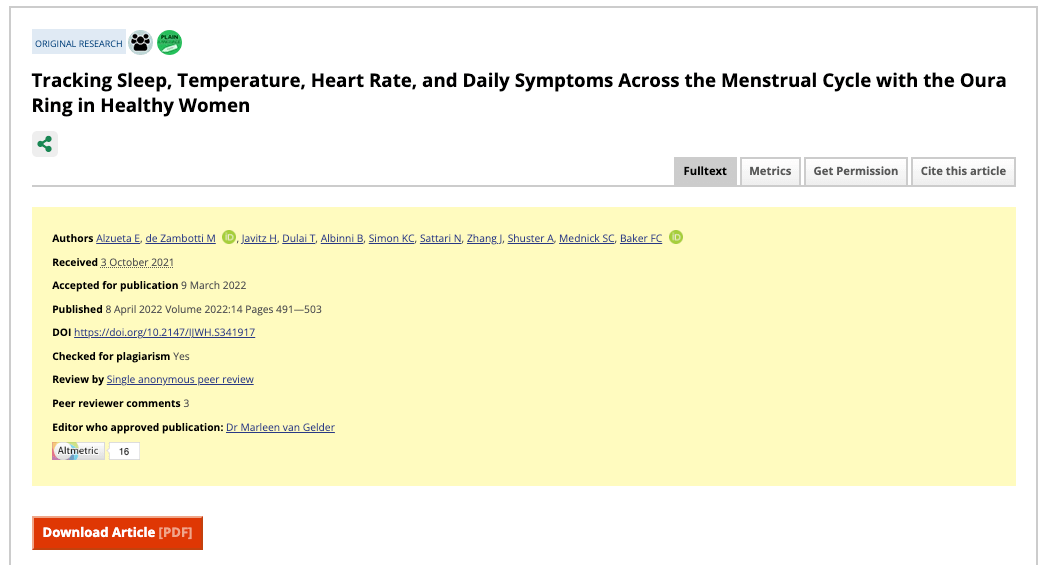
During their Kickstarter the Stanford Research Institute apparently bought 2 rings and ran them against polysomnography which is a sleep lab measurement. The study, published in March 2017 found that the ring was the most accurate wearable for sleep staging. And just like that Oura became the first independently validated wearable on the market.
They then decided to “industrialize” this happy accident with:
A real science org → with c. 70 people including 30+ PhDs and a 100K person blood pressure study.
Building a partner ecosystem doing distribution → 800+ partners by end of 2024.
A" “clinical-grade” internal bar → “we aspire to the level of accuracy and quality that would be appropriate for a medical device” (Hale, How Leaders Lead), without really being regulated like one though.
“By enabling other partners they become your salespeople and your distribution channel and your referral network.” (Tom Hale, Masters of Scale 2025)
Growth Lever 3: They got 60% of sales from users recommending the ring
“The best marketing is when you create such a (good) user experience that the user reveals something of themselves that they didn’t know before... he or she wants to tell about the product to everyone.” (Petteri Lahtela, Slush 2024)
The founders claim that c.60% of sales have come from existing users recommending the ring “and that has been the same for all the time” (Slush 2024).
The design goal was a product that produces a personal revelation (you learn you’ve been under-sleeping for x years or you see the night the wine impacted you etc), and that “revelation” is the thing those of us who’ve tried these sorts of wearables have screenshotted and shared with friends on whatsapp before.
The loop became something like this:
The product produces “tellable” moments → it can flag certain things like you’re getting sick a couple days before you actually feel it. The CEO tells the story of a stranger stopping him in an airport to tell him “Oura got me pregnant” (Slush 2025).
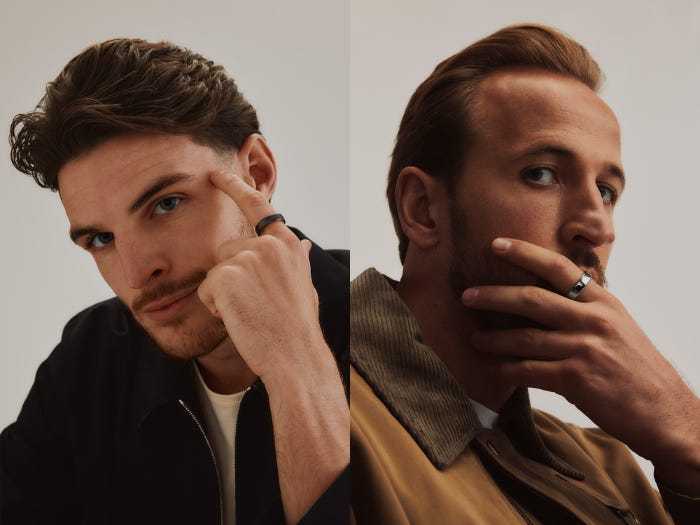
Celebrites started wearing it (without contracts in the background)→ Bill Gates, Bezos, Bono, Jennifer Aniston, and many others apparently. They didn’t sign their first paid ambassadors (Harry Kane, Declan Rice) until 2026.
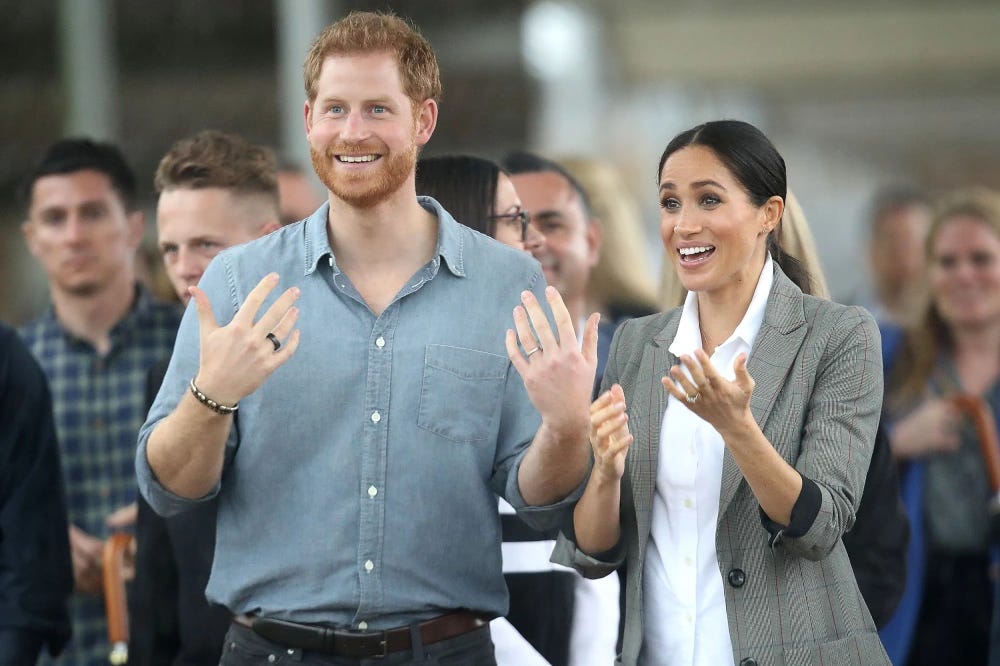
Prince Harry as an “extreme” case → he wore it on official tours in 2018 and the press went hunting for what that black band on his finger was. They apparently never paid him or met him. The whole thing went through his doctor and the note that came back was roughly to not talk about the ring but to talk about how this can help adults stay or become more healthy.
Act 2: The Bubble, the $6 Revolt, and the Missed Target
2020 → 2022 · 150K rings → $165M revenue
In 2020 COVID made body temperature front-page news for all of us, then 2 university studies said Oura could spot symptoms early and 65K users donated their data to prove it (everyone wanted one). But it didn’t last:
Growth Lever 4: They sold to institutions in crisis, then let the endorsements sell consumers
“From the NBA to Vegas casinos, everyone’s clamoring for the $299 ring.”

Who signed in 2020: