👋 I’m Ivan. I study how top 1% startups raise and grow.
This week’s sponsor is AI CRM Attio!
Attio is the AI CRM for modern go-to-market teams. Attio connects to your email, calendar, calls, product data, billing data and more — so your CRM is always complete, always enriched, always in sync.
Prep for any call in seconds with full context across your business
Instantly prospect and route leads with research agents
Build powerful AI automations for your most complex workflows
Hello there!
I’m moderating a panel at 4YFN Barcelona next week called “How Agents Are Prompting the Business Playbook” with Alvaro Higes (CEO, Luzia, 65M users), Daniel (Chief AI Officer, WPP), and Elisenda (CEO, Cala AI).
To prep I went deep on every framework I could find about what’s actually happening to SaaS (and it’s been quite a week to do so) to answer one question:
If AI agents eat the business logic of software applications…
what happens next?
Today’s tl;dr:
The stack is inverting: Microsoft’s framework.
We’ve seen this movie before: OpenAI Chairman’s analogies.
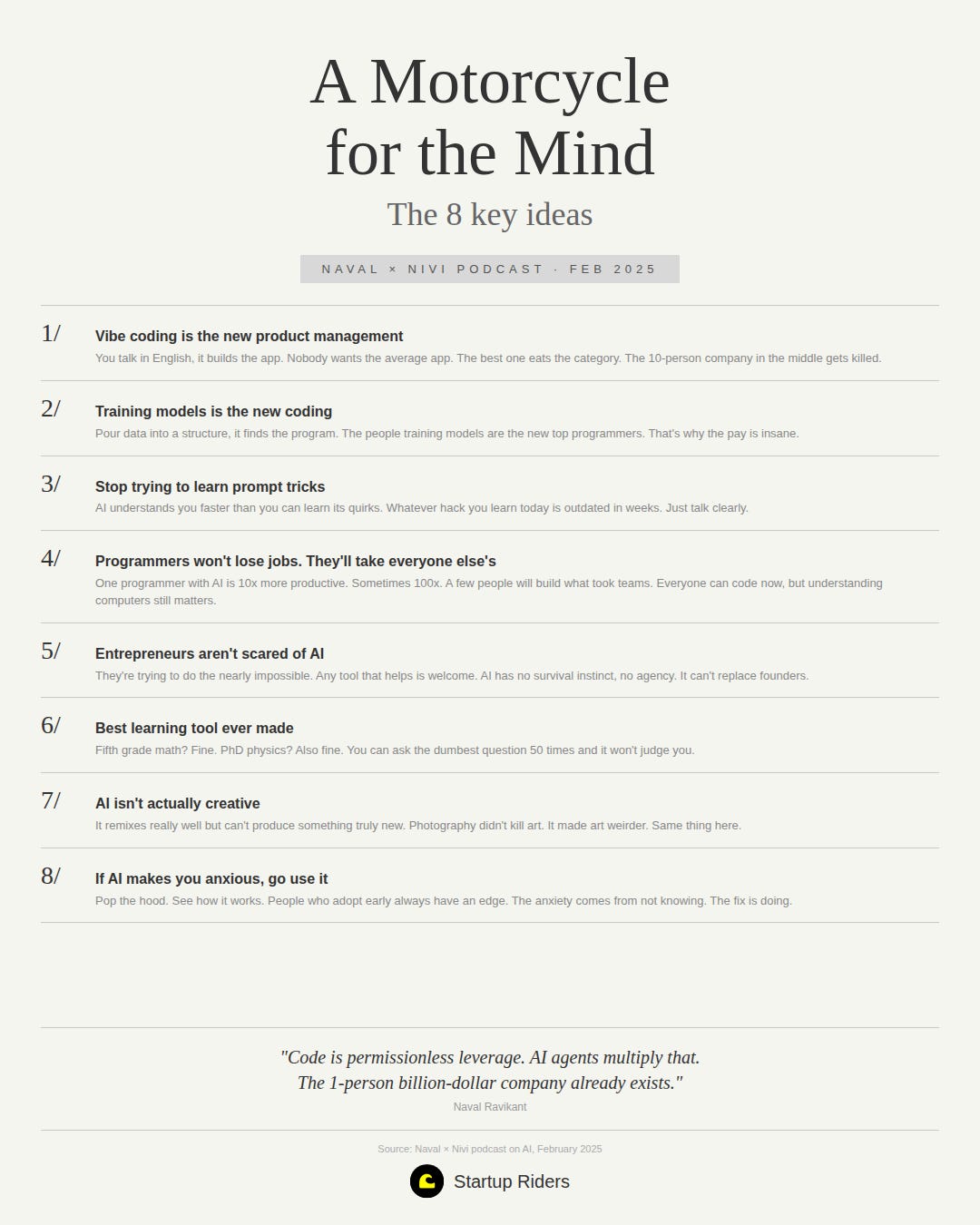
Builders aren’t scared: Naval Ravikant’s motorcycle for the mind.
The flywheel was designed this way: the ultimate flywheel.
Keynes predicted this in 1930: economic possibilities for our grandchildren.
Judgment is the scarce resource: 5 skills for anti-fragility.
1. The stack is inverting
A year ago or so Satya was already talking about this shift.
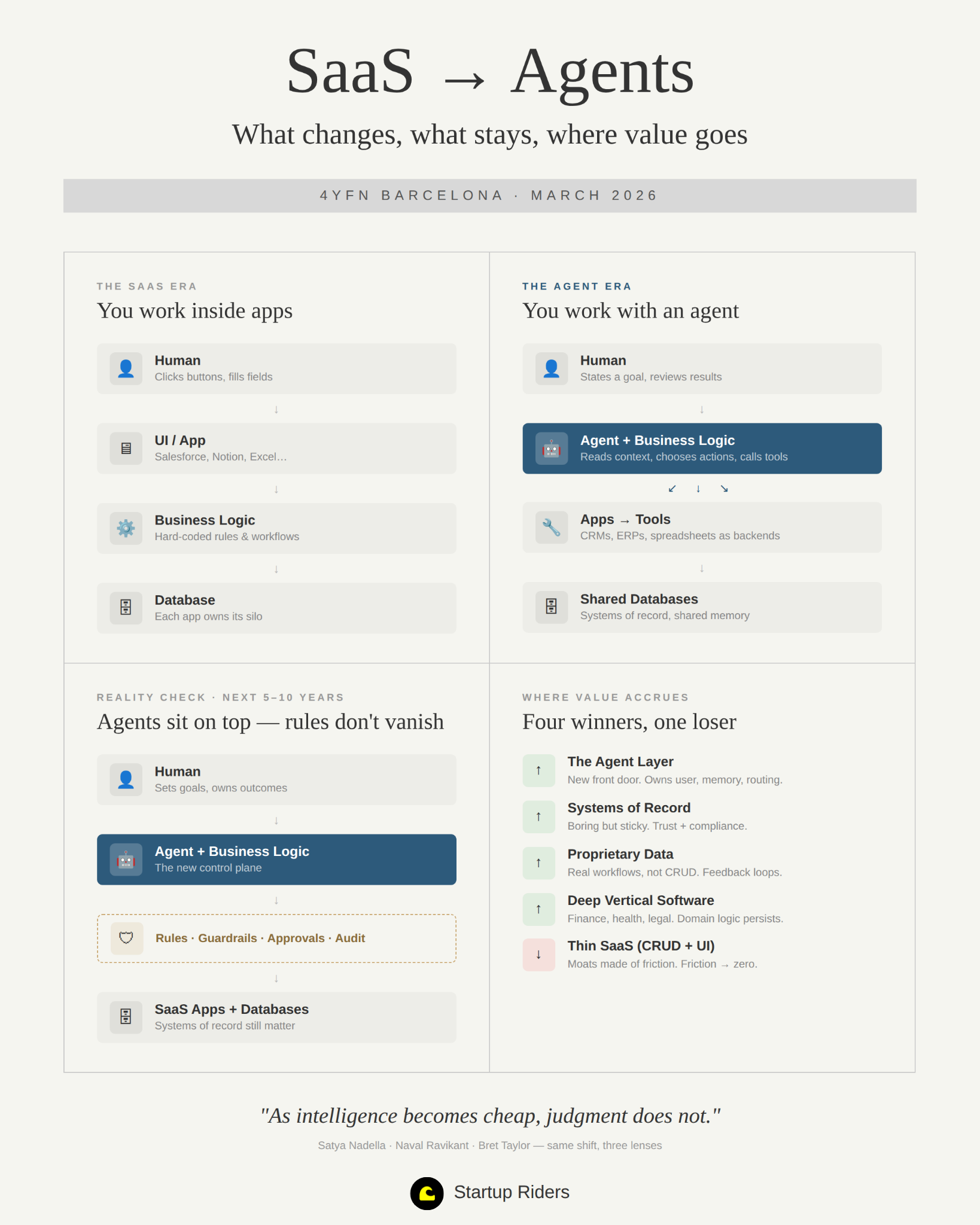
Before LLMs, you had a human interact with the UI of an app, which ran business logic, which ran on top of a database.
But today, as Naval coined recently, “AI is eating UX.” A new surface area of interaction is emerging: agents. A human-like presence in a box that reads context, chooses actions, and calls tools for us (what LLMs enabled).
Which raised questions about where power is shifting, and why we’re seeing big tech splashing cash and new startups popping up everywhere to surf this wave - because there is a platform shift (and therefore, opportunity).
In this context, and as we know from our friends Benjamin Graham’s Mr. Market definition (irrational, often contradictory) and John Maynard Keyne’s “animal spirits”, the stock market got fearful. All of a sudden.
Here’s my best attempt at representing Satya’s framework for going from SaaS → Agents, which has been helpful to keep in mind lately:
2. We’ve seen this movie before
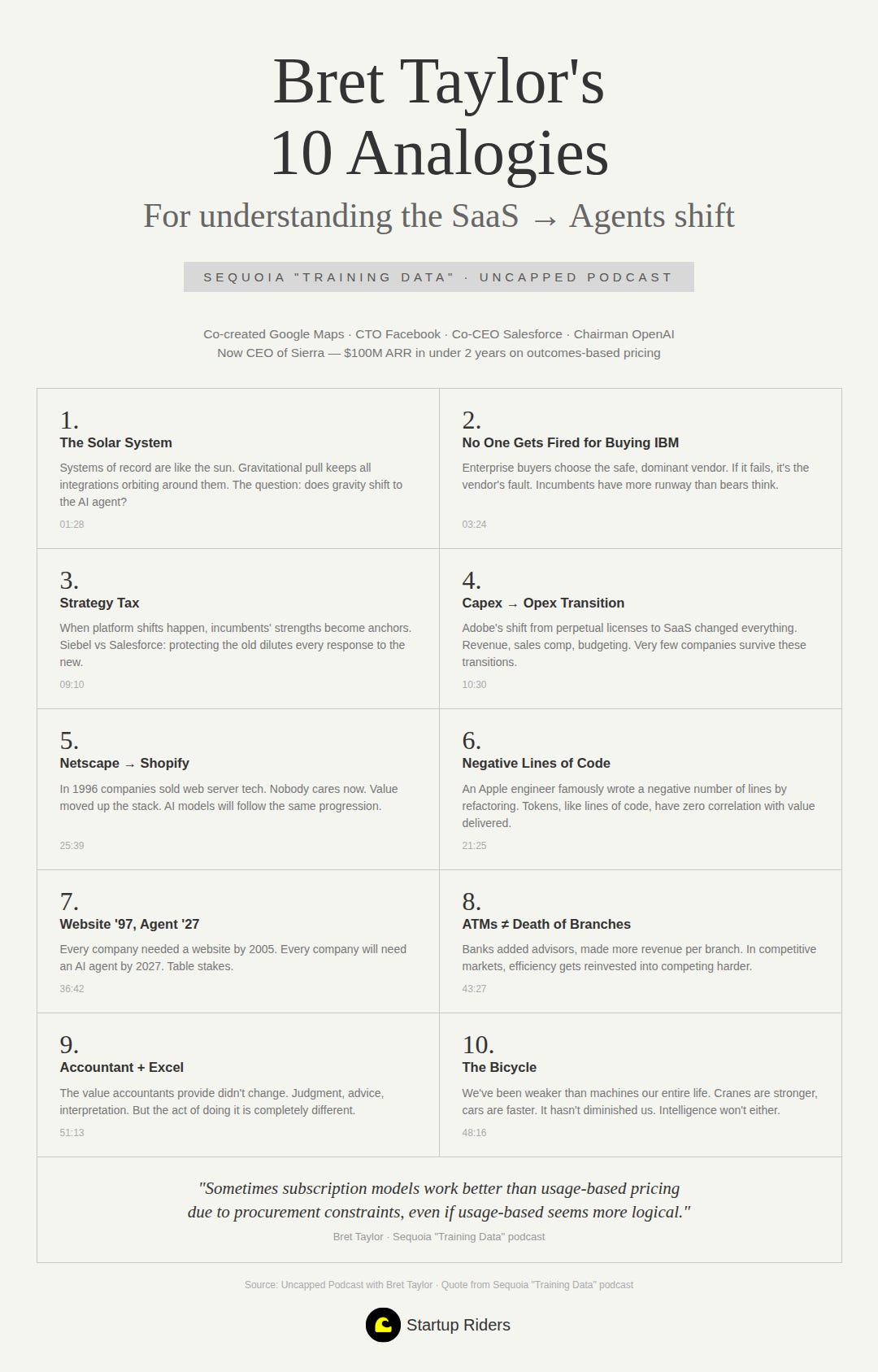
Came across this pod from Bret Taylor (Sierra founder, chairman at OpenAI) with tons of insight and a few super sticky analogies.
I noticed great leaders are often amazing at this, remember Jim Barksdale’s aphorisms.
The one that stuck with me most: Systems of record are like the sun in a solar system. They hold gravitational pull and everything orbits around them (think Salesforce).
The question is: does that gravity shift to the agents in this new “era”?
3. Builders aren’t scared
This opportunity window (SaaS → Agents) is also being turbo-charged with all these emerging tools, making high-agency entrepreneurs-to-be much more leveraged.
I found some gems in Naval’s recent podcast on this:
4. The flywheel was designed this way
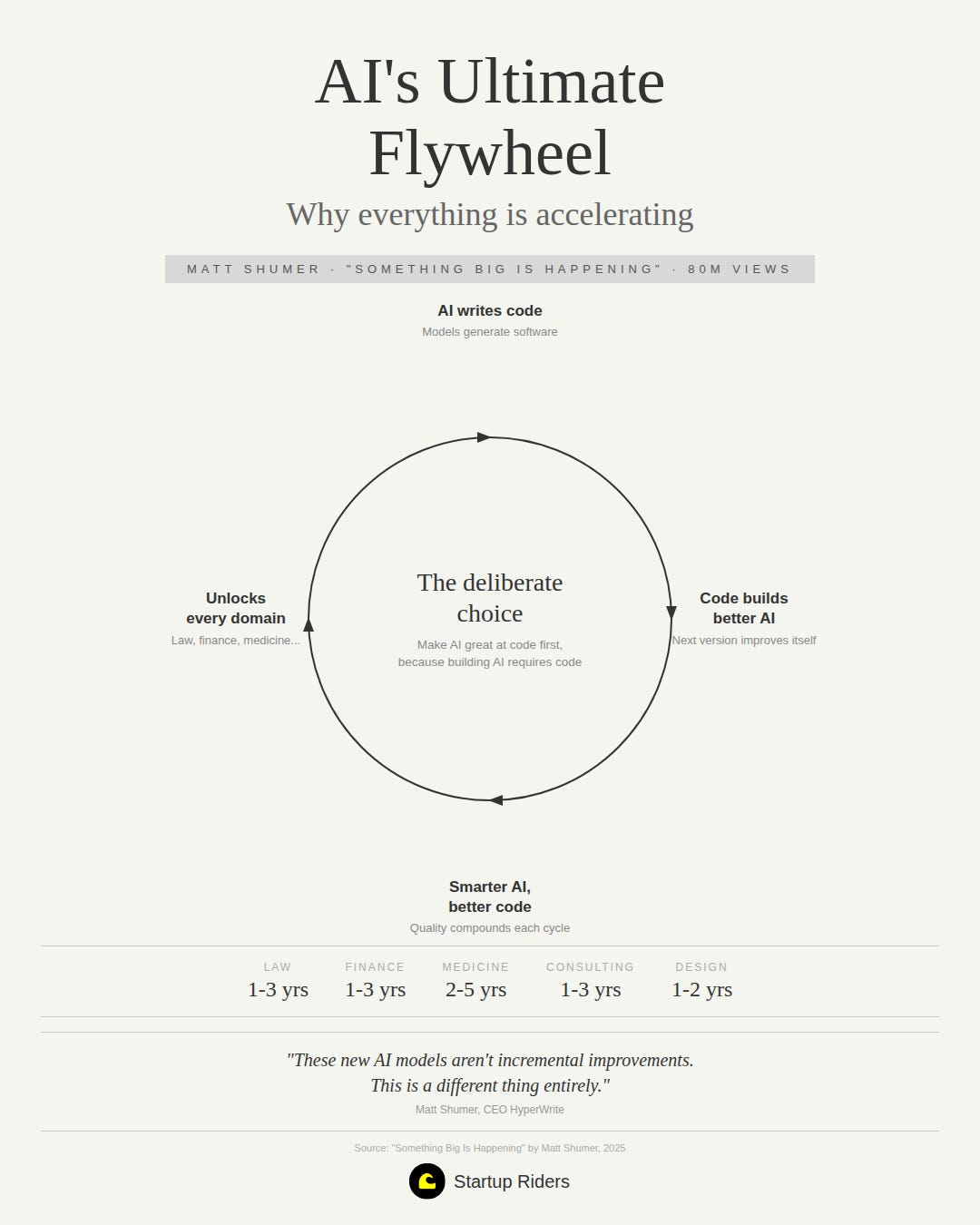
Matt Shumer’s essay “Something Big Is Happening” hit 80 million views recently, because it touched a social fiber that is really tender: agents are already here.
He openly talks about how recent this change has been (Opus 4.6 on Claude released earlier this month, and GPT-5.3 Codex idem), and I couldn’t agree more with him that you really don’t know what you are talking about until you feel the difference using these models and how they’ve dramatically improved in a matter of weeks.
To the point where he openly says:
I am no longer needed for the actual technical work of my job
His most important insight is that AI labs made a deliberate choice to make AI great at code first because building AI requires code. And if AI writes code, it helps build the next version of itself. Smarter version writes better code. Better code builds smarter AI. This is basically the flywheel of flywheels.
Which explains the acceleration we’re all feeling: