Most AI note-takers just transcribe and summarize. Granola is an AI notepad. You jot down what matters during the call, and Granola uses your notes plus the transcript to generate summaries, action items, and next steps from your point of view. The powerful part: you can chat with your notes. Write follow-up emails, pull out decisions, prep for your next meeting — all in seconds.
I don’t promote tools lightly. This one earned its place.
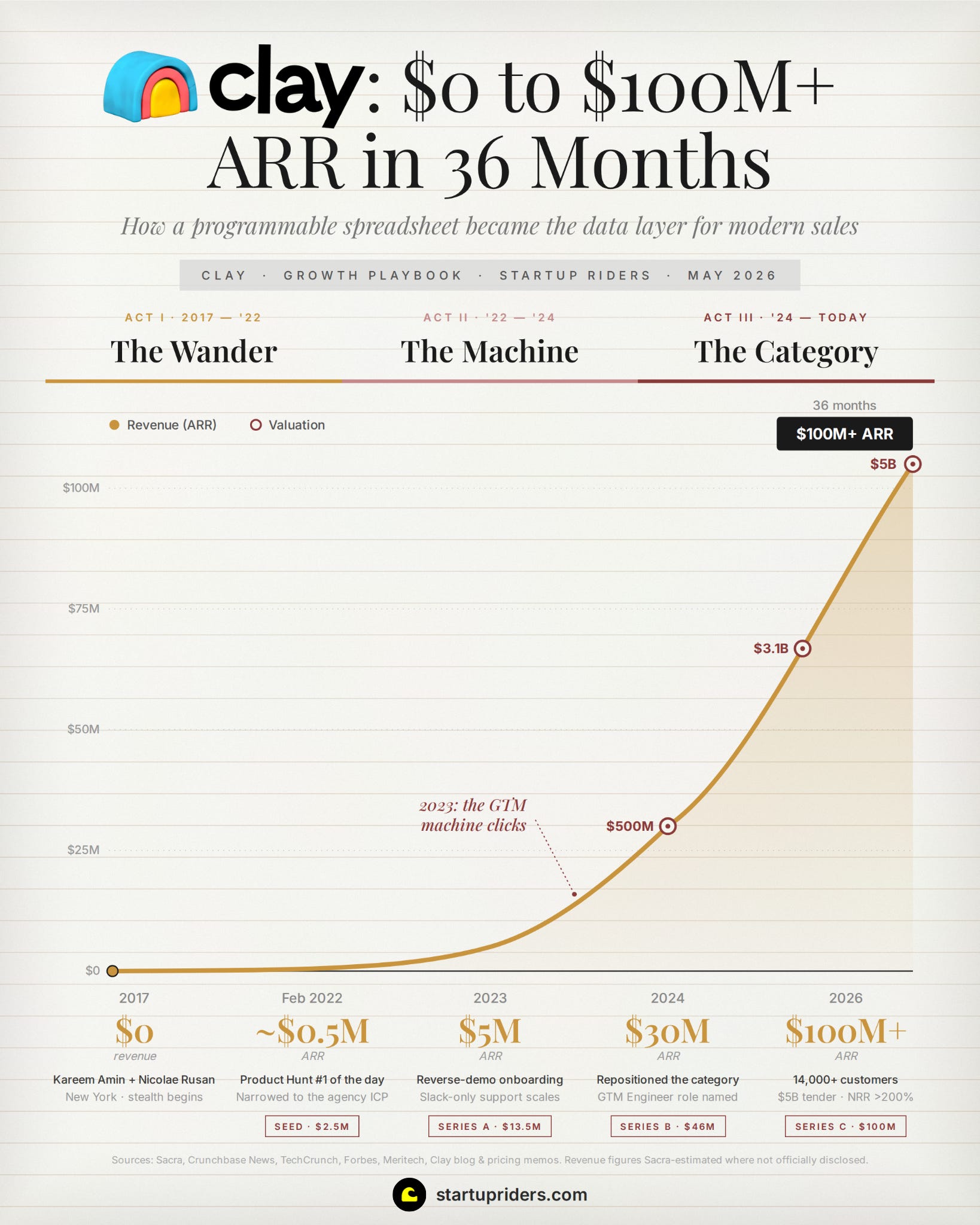
A “spreadsheet anyone could rebuild” (for the skeptics at the time) grew from near 0 revenue to a $100M+ in about 3 years.
So I spent the past week pulling apart 18 founder and operator interviews, every Clay blog post I could find, and the pricing memos Clay published themselves.
What you’ll learn:
Why 6 years of going wide nearly killed the company
The one tiny customer they bet on that helped them take-off
The “reverse demo” run 8 times a day, and how it killed an 8-call sales cycle
Why they deleted their support widget and forced everyone into one Slack room
The pricing bet every rival got wrong, and the rollout they had to walk back
How they invented a job title, then hired their own sales team into it
And as usual, a few growth lessons for you to steal at the bottom.
Let’s dive in:
📐 Quick note on editorial and methodology: this analysis focuses on the 80/20 mechanics that help explain their growth (not a comprehensive profile, and not an endorsement or investment advice). It draws on 18 founder and operator interviews and long-form podcasts, Clay’s own blog and published pricing memos, and funding coverage from various sources. All revenue figures sourced. Treat directional estimates as directional.
From rented lists to orchestrated data
A quick overview of how this market evolved before we get into Clay’s growth levers:
To understand the market Clay grew into we need to talk about ZoomInfo first. For two decades the center of gravity in sales was a single proprietary contact database you rented. Then Apollo, Cognism and others ran the same model where you license the list, load the sequencer, and dial.
The playbook on top was Aaron Ross’s Predictable Revenue (specialize the roles, label the lead types, build systems for repeatable lead gen).
specialization survives, systems survive, the tactics get rebuilt.
The bottleneck buyers cared about was raw pipeline, and pipeline needed contacts in bulk. So the category became contact data, profitable but commoditized, and the moat belonged to whoever owned the biggest list (ZoomInfo peaked as a public company worth more than $20B on this thesis).
Where we are
Two things shifted between 2022 and 2025:
AI collapsed the cost of outboundvolume to near zero, so everyone got volume and a resource everyone has stops being an edge, where the scarce resource moved from the contact to the context around it.
My friend Sunny, who had been an early employee at Gong, put it best when I interviewed him after his team analyzed 600,000 sales calls: the sales world is starving for data. Not the list but the accurate, current context on the specific buyer in front of you. Roughly 75% of a rep’s time goes to non-selling work, most of it the research that turns a name into a reason to call, and reps who cite two or more specific buyer facts convert about 30% more.
Enter Clay as a startup well positioned to solve this increasingly important problem.
Where the market is going
3 dynamics will shape the next 24 months.
Consolidation: teams are drowning in 20 single-purpose AI tools bought on experimental budgets. Clay wants to be that platform for the data layer.
The agentic shift: enrichment stops returning data and starts acting on it.
The threat: if the foundation labs or a revived ZoomInfo decide orchestration is core, they build down into Clay’s layer, and Clay’s defense has to be the ecosystem rather than the software.
ZoomInfo and Apollo still sell database access, Outreach and Salesloft own sequencing one layer up, but Clay built something structurally different underneath, and that structural choice is where the story starts today:
ACT 1 — The Wander
2017 to 2022. From an abstract mission to near-zero revenue, and a 6-year search for who Clay was for.
If you read the Replit Playbook two weeks ago, the shape here will feel familiar. Replit spent 8 years grinding before the curve went vertical, Clay spent 6.
The company was founded in 2017 by Kareem Amin and Nicolae Rusan who were McGill classmates and repeat founders. They believed “normal people” should be able to do things that only programmers could do.
But, they just didn’t know what to build. They tried making the computer terminal easier to use, then a tool to help people use APIs without code, but neither caught on. Then they looked at the spreadsheet (hundreds of millions of people live in them) and most would never call themselves “programmers”. So they asked a simple question:
What if a spreadsheet could pull live data from the internet?
Growth Lever 1: They picked one customer and cut everything else.
“It’s not that you don’t know who the customer is. It’s just that you’re not picking yet, or you have a hypothesis and you’re not committed to one over the other.” — Kareem on First Round
For about 5 years, Clay had too many customer problems they were solving for:
Recruiters used it to source candidates.
Salespeople used it for outbound.
Front-end engineers used it as a low-code backend.
This looks like a good problem at first but its typically a trap because a product 5 different people use for 5 different things has no clear pitch, no clear feature set, and no clear language on the website. The early spark kept dying because people would try Clay, say “wow, this is so powerful,” and never come back.
Kareem calls this stretch “the spiral” where they’d commit to salespeople, a customer would describe an exciting adjacent use case, and a few months later the team would land back at the same decision with slightly more information. Recruiting felt safe to chase because “recruiting is just sales, so it’s not really losing focus, is it?”
The fix was not a product but a positioning change. Kareem on Langchain’s pod:
“We took our positioning and marketing and narrowed that. We removed the workflow product and the function product. We kept the table. We narrowed down our go-to-market and kept the product flexible.”
He compares Clay to a guitar vs a microwave, where a microwave has one button and one job, a guitar has six strings and a lifetime of mastery in it. They kept the guitar and narrowed the story they told about it:
One customer: outbound sales.
One problem: great data enrichment in a table.
One page, one set of docs, one vocabulary.
This is one of those tough / brave product trade-off decisions where cost is real (apparently most of their original customers churned). The founder is honest that narrowing felt “claustrophobic” (letting go was a personal block). What got him out was reframing the chain:
“How do we get customers as quickly as possible, so we can learn as quickly as possible, so we can improve as quickly as possible?” — Kareem on First Round
There were 2 product principles underneath the discipline:
Aggregate every data source but own none: they hold no proprietary database. It orchestrates 150+ third-party providers, trying one after another until it has the best answer. Every rival builds and defends its own database but Clay’s bet was the opposite.
Flexibility beats ease of use (for their use-case): Everyone told them to make the product one-click simple but they refused, which again was a tough product trade-off, but helped them become a power-user tool vs a toy.
ACT 2 — The Machine
2022 to 2024. Clay finds its wedge, then builds a repeatable engine on top of it. Roughly $0 to $30M ARR.
In 2021 Varun Anand joined. He had been running a business unit at an insurance tech company, where a lack of engineers pushed him deep into no-code tools, and that is how he got obsessed with the space. He was in a Slack group about no-code products when someone posted a Clay webinar. He signed up, and he was the only person who showed up. So he cold-emailed Kareem, who ignored him because he was on a silent meditation retreat 😅.
Varun joined anyway (at a low point apparently as some of the team was leaving, again echoes of the Replit story).
Growth Lever 2: They grew inside other people’s communities before building their own.
“I’d been a member of Modern Sales Pros (sales community) for years, and I just searched in it.”
This was the first real growth motion and it cost close to nothing.
Varun went into Modern Sales Pros (a sales community) and searched its history for “data enrichment” and “outbound.” He found about 30 people who had said something intelligent on the topic and emailed all of them. Almost all took a call and on those calls, exactly one type of person actually understood Clay, which were lead-generation agency owners.
These were small, technical, scrappy, running low-margin services across many clients, feeling the pain the most (it felt they’d found their ICP).
Then they built a social-listening stack:
Slack keyword alerts on the words customers used.
A tool for monitoring Reddit and the open web.
A dozen-plus “dark social” WhatsApp group.
When someone in those rooms described a problem Clay could solve, Varun direct-messaged them. Kareem’s description of why:
“One of our earliest employees was an agency owner himself and a power user himself. He has a ton of credibility in the space and is a community builder in the space.”
He bought instant credibility in the rooms their customers lived in. Varun on whether seeding a community you don’t own feels like spam made me laugh a little:
“Do I care if I get kicked out of a community? Not really. I’m trying to help these people, I’m trying to solve their problem.”
Having built and sold a GTM community myself, doing this in a spammy way would get you kicked out pretty fast, but there’s a way to do it adding value to all (some of our best members at Revenue Squared did it regularly, including about Clay, adding value first + data + pov then soft “pitch”, lets call it intelligently).
By mid-2022 they had a customer, a community, and a wedge. What it did not have was a way to turn that into a machine that ran without them in the room. The next 4 levers are how a founder doing 8 onboarding calls a day built himself out of a job.
Growth Lever 3: They threw out the demo and let the customer drive.
“We’d call it a reverse demo. My goal was to blow Nick’s mind, to solve his problem in the first 20 minutes”
Clay wanted a self-serve product, but the path to self-serve ran through a year of brutal manual work. They ran roughly 8 onboarding calls a day for about a year, but without demoing Clay. Instead they did the opposite, or call it “the reverse demo”: