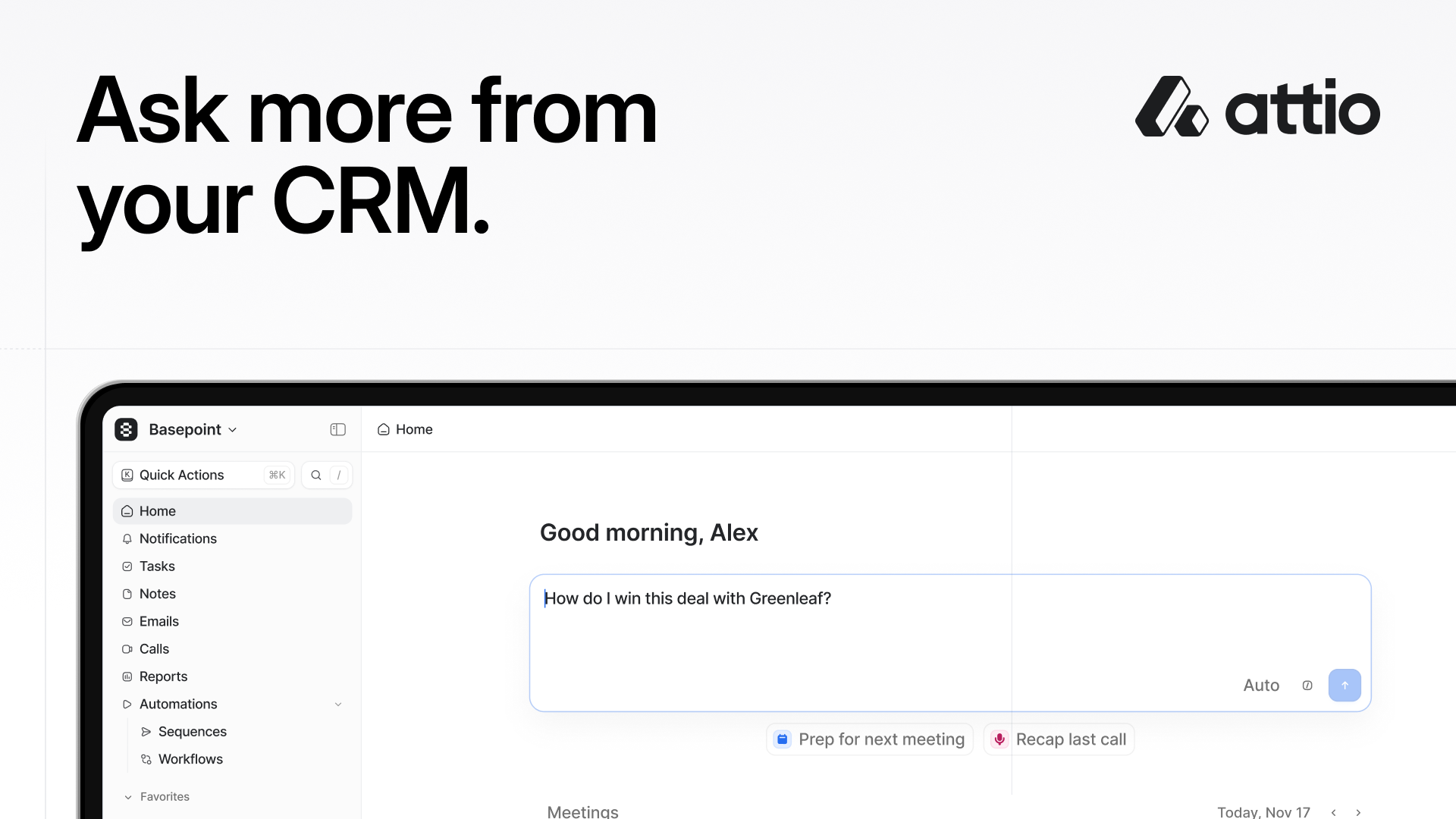
Attio is the CRM that transforms how top teams grow. Ask Attio how to win this deal, what to say in your follow-up, where your pipeline actually stands, and get answers with full context, instantly. With Universal Context, Attio’s intelligence layer, every signal across your tools becomes instantly actionable.
The engine behind every top 1% startup is a great CRM.
Perplexity’s Growth Playbook: 0 to $450M ARR in 3 Years
Hello there!
Every investor I know has the same debate about Perplexity on whether it’s a real $20B company or if Google is about to eat them alive.
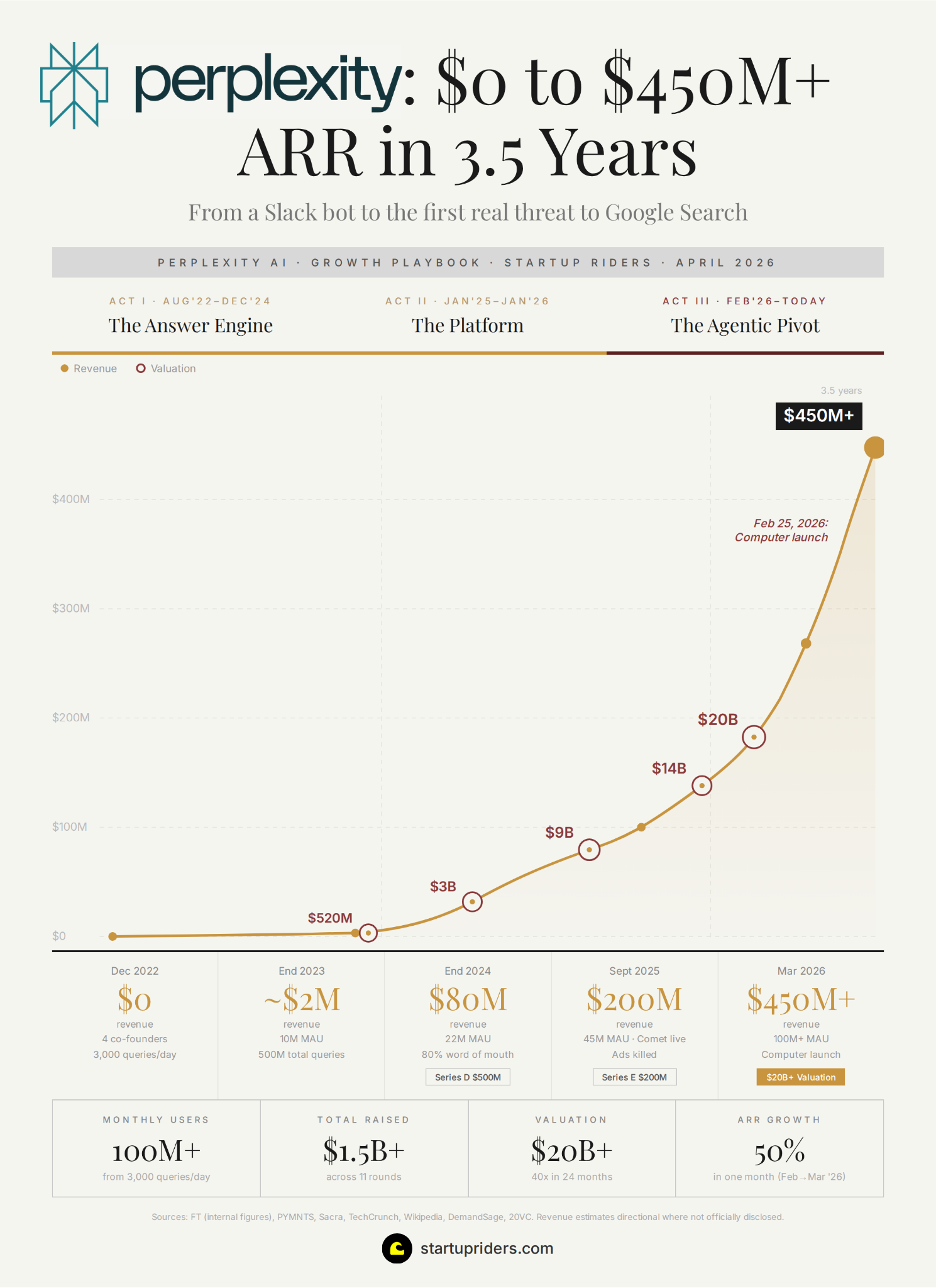
Then February happened and they added $150M of annualised revenue in 30 days, and blew past their 2026 internal target 9 months early.
So I spent the past week pulling apart every founder interview, growth-team podcast and leaked revenue number I could find.
What you’ll learn in this edition:
The Slack bot accident that became a multi-billion dollar product idea
Why the VP Growth told the company to stop worrying about acquisition
The specific activation metric that predicts whether a new user will stay or leave
Why they killed their own advertising business after making $20,000 from it
The trust architecture that earned them the right to charge $271/mo
And the pricing shift that just pushed them past half a billion ARR
And as usual, a few growth lessons for you to steal ;)
Lets dive in:
📐 Quick note on methodology: this analysis focuses on the 80/20 mechanics that help explain Perplexity’s growth (not a comprehensive profile, and not an endorsement or investment advice). Based on 10+ podcasts and long-form interviews (20VC x2, YC, HBS, and others), plus press from the FT, and TechCrunch, research from Sacra and Contrary, and Perplexity's own blog. All revenue figures sourced. Treat directional estimates as directional.
Act 1: The Answer Engine
$0 to $80M ARR. August 2022 to December 2024.
The founding accident
Perplexity almost didn’t build the product that made them famous.
The company was founded in August 2022 by Aravind (CEO, ex-OpenAI), Denis (CTO, ex-Meta AI), Johnny (CSO, ex-Quora), and Andy (co-founder of Databricks).
These are four people with world-class AI research backgrounds who, by Aravind’s own admission, “started the company without actually having a clear idea of what to build”. Which is interesting considering how many times I’ve heard from “tier 1 VC’s” that they only back founders that are completing their “life’s work”:
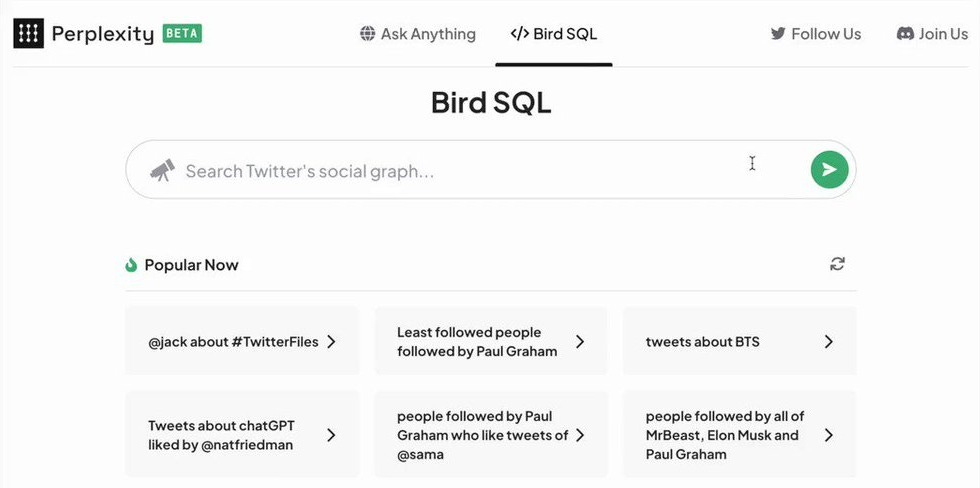
Their first product was called Bird SQL, which basically let you search Twitter using plain English. You could type something like “Who is Lex Fridman following that Elon Musk is also following?” and the system would translate that into a database query and return the answer.
In February 2023, Twitter killed free API access and that product died overnight.
But something else had been happening inside the company. They’d built a Slack bot that plugged into GPT-3.5 and let the team ask it questions.
The first question was about health insurance (their first employee needed a plan) and nobody on the founding team knew anything about it. The problem was that the Slack bot made things up, a problem we are all too familiar with in this AI era.
It (confidently) gave wrong answers about insurance plans, providers, coverage details, etc. Which was the known failure mode of every AI chatbot at that time. You probably remember how the internet was full of screenshots mocking AI mistakes.
But this lit up the idea that built the company.
Aravind and his co-founder Denis had both been academics. And in academic publishing, there is one hard rule, and that’s that every sentence you write must be backed by a citation from a peer-reviewed paper or your own experimental results.
They decided to force the AI to follow that rule. So not a chatbot that happens to cite sources, but instead a system architecturally designed so the AI can only say things it can find evidence for on the internet.
They also made a decision at founding which was NOT to try to build their own AI model. As Aravind told Fortune:
“It was a decision driven through conviction and pragmatism. Pragmatism because we were broke. Conviction in that it was already clear that AI models would become increasingly commoditized.”
They used OpenAI’s GPT-3.5, available on a pay-per-query basis, and focused all their energy on the search, retrieval, and the orchestration layer.
“The reason [AI] is going viral right now is because people want to laugh at AI’s mistakes. Your product is designed to not make mistakes, you are always pulling sources. I don’t think this will work.”
Aravind ignored him and they were off to the races.
Growth Lever 1: Trust as a growth engine
“Don’t blame the user for not having a good prompt. Blame the AI for not being able to help them expand to a good prompt.” - Aravind.
First a quick primer on perplexity vs traditional search:
“Traditional” Search: You ask Google a question, you get ten blue links, you click three of them, you read two and piece together an answer yourself.
ChatGPT Search: generates answers from its training data, which means it is drawing from memory (and as mentioned above, hallucinations happen).
Perplexity Search: they do that work for you. It searches the web, reads the relevant pages, and a clean answer with footnotes to every claim. It generates answers from live web search results (drawing from evidence), and when the evidence conflicts or doesn’t exist, the system says so instead of making something up. Basically a research assistant who shows their homework.
They also built a feature they originally called “Copilot” (now Pro Search) that asks clarifying questions before answering.
This matters for growth because it means even a vague question produces a great answer, which means more positive first experiences, which means more word of mouth. As you’ll see further down, their growth team runs a bunch of these 1% experiments, which staked together explains a lot of their growth story.
Why does trust matter so much for growth?
Because their citation architecture made the product more accurate and therefore made it recommendable. We’ve all been through that fear of double, tripple checking AI generated answers. In this case they figure out part of their growth loop went through making users share a Perplexity answer with a colleague and say “look, here are the sources” without risk(ish).
The retention data seems to back this up with c.85% of users who try Perplexity returning, and 90% of users coming back within 30 days of their first visit. Direct traffic (people typing perplexity.ai into their browser or using a bookmark) accounts for 82% of all visits as of mid-2025, and the vast majority of usage comes from people who already know and trust the product.
One more data point I loved is that the average Perplexity query is 9 words long, versus 3-4 words on Google. So users write longer, more specific questions because they’ve learned the system can handle complexity, same pull you probably feel when you decide to go to OpenAI vs asking Google.
This in itself is an interesting data flywheel, because longer queries give Perplexity more context, which produces better answers, which drives retention.
Hold onto the word “trust” because its basically the architecture that earned Perplexity the right to charge $271/mo and hold your credit card, and every lever below is a brick in that architecture.
Growth Lever 2: The three-query activation threshold
"In a product-led growth (PLG) strategy, the product is the primary driver of customer acquisition, activation, engagement, and monetization." - Elena Verna
Another of Perplexity’s growth levers is that you don’t have to sign up to use it. Which creates a specific challenge that Wyndomapped out well:
how do you convert anonymous visitors into retained users?
Raman Malik, Perplexity’s Head of Growth (ex-Lyft) says the growth team worked backwards from retained users. They looked at everyone who was still active at day 30 and day 60, then examined what those users did differently in their very first session.
The pattern they found is that users who hit 3 queries in their first session retained at dramatically higher rates. 3 queries is enough time in the product to understand the value and became the team’s north star: get new users to three queries in their first session.
Raman’s target was 30% of all logged-out visitors hitting this milestone.
The obvious way to force engagement is to add a signup gate at query 5 in the common style of “You’ve used your free queries, create an account to continue.”, which usually works for conversion, activations go up, but it also kills query volume.
People hit the gate, get annoyed, and leave, so you’ve juiced one metric (activations) while hurting another (total searches, which drive the data flywheel).
Interesting trade-off:
“Those are the trickiest ones to navigate. How do I value those two things down the road? Will that activated user retain and over time make up for the initial loss in query volume?”
Their answer was progressive, device-specific friction (instead of a hard gate):
On mobile browsers: a full-screen signup takeover blocks further searches
On desktop browsers: a softer half-screen prompt appears but users can keep searching. It only escalates to a full takeover by search #5
On the mobile app: nothing.
They figured out each surface has a different user intent. Mobile web is transactional, so a hard prompt converts. Desktop users tab-hop, so a soft prompt keeps them searching. And App users already committed by installing, so interrupting them hurts more than it helps.
The friction only works because Perplexity has already hooked you 2x before the prompt shows up:
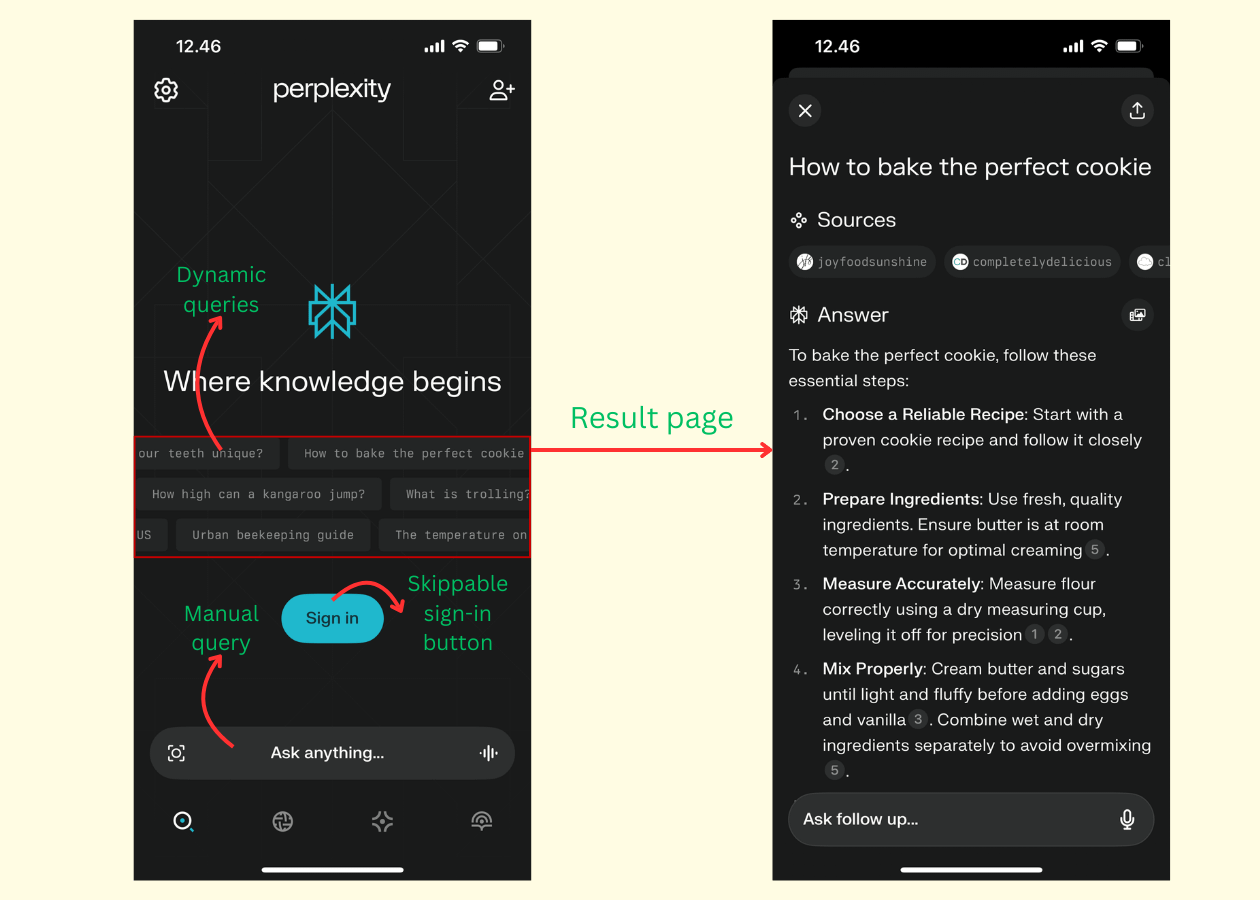
Rotating homepage queries: Instead of a blank search box, the homepage cycles through trending, engineered suggestions. It kills blank-page paralysis and hand-delivers new users into their first good experience.
Related searches at the bottom of every answer: Same trick Google uses, but tuned to pull you deeper into the rabbit hole. By the time you’ve clicked through two or three of these, you’ve hit the 3-query threshold without realizing you were being activated.
So by the time the signup prompt appears, the user has already felt the “aha.”
The biggest takeaway here is that activation shouldn’t be thought of as a gate but rather as a tiered system.
Growth Lever 3: The partnership distribution machine
“We can go out and scream from the mountain tops about Perplexity, but it is a lot better when someone else is telling you to use it” - Raman Malik
About 80% of Perplexity’s growth is organic word of mouth, but the remaining 20% comes from a partnership strategy that their CBO Dmitry Shevelenko built into a machine. He joined from Uber (4 years), and before that was at Facebook when it had 500 employees and 80 million users. The man knows distribution.
Their playbook was to give away a year of Perplexity Pro ($20/month subscription) through partners who already have your target audience.
The list tells the story:
LinkedIn (free Pro for premium members)
Samsung (pre-installed on all 2025 TV models with 12-month free Pro)
Airtel (India's largest telecom, with 360M+ Indian subscribers)
Lenny Rachitsky ’s newsletter (free Pro for paid subscribers)
PayPal/Venmo (12-month free Pro)
Snapchat (search integration reaching nearly a billion users)
The unit economics are elegant because in theory if a partner gives away 100K free Pro accounts, and 80% of those people never actually use the product, Perplexity’s variable cost on those 80,000 dormant accounts is close to zero. They only incur inference costs when someone sends a query, and the 20,000 who do use it enter the conversion funnel.
“We have a phenomenal Partnerships team. They are absolute sharks.”
Not everything in this era was smooth though as they’ve had their fair share of hiccups with Forbes, Condé Nast, The New York Times, and Dow Jones all suing or issued cease-and-desists over Perplexity reproducing their content without licensing.
The tension they create for them is clear because an answer engine reduces clicks to the publishers who wrote the content in the first place. So they responded in 2024 with a $42.5M publisher revenue-share program, splitting ad revenue with sources whose content appears in answers.
Apparently the lawsuits haven’t fully resolved but growth hasn’t slowed either.
Growth Lever 4: Retention over acquisition (and the Lyft lesson)
“This is not an acquisition problem. This is a retention problem.”
The first thing the VP Growth did when he joined was to map the entire funnel, and attention went straight to retention. It was “pretty healthy consumer retention.” But he double-clicked on something often overlooked:
a 10% improvement in retention raises the entire water level of your active user base, and it compounds.
Two tactics drove the biggest retention gains:
Cross-device conversion: Users on both desktop and mobile retained at significantly higher rates. Desktop during work hours, and mobile on the couch.
Audience mix-shifting: Casual “weekender” users asking novelty questions have lower retention than knowledge workers solving real problems. Students using Perplexity to find sources for papers are extremely sticky, so the growth team targeted acquisition toward high-retention segments, changing the composition of incoming cohorts.
What they explicitly did NOT do is spend money on paid acquisition.
Interesting story Raman tells on the 20vc pod, that he learned this lesson at Lyft, where he started his career spending millions on paid channels. One day, Lyft’s head of growth told them to turn off every single paid channel for new passengers, and signups barely moved (maybe 5-10% down), and all low-quality users dropped. Which means paid spend had been almost entirely cannibalizing organic traffic.
Also interesting his honest admission about a weakness, which can therefore be turned into a strength (plenty of evidence of sharing happening on Twitter for example):
“I don’t think sharing is inherent to the Perplexity user journey. I don’t think we have an inherent viral loop.”
Growth Lever 5: The campus ground game
“How do we take our best students and give them everything they need to drive growth for Perplexity and build density on a campus?”
Raman identified students as a high-retention, high-potential audience that Perplexity was under-indexed in compared to ChatGPT, and had an obvious fit (remember citations!).
Perplexity launched a formal Campus Strategist Program where students get a marketing budget, mentorship from the growth team, Pro accounts, and early access to features. In return, they host events, run workshops, and drive referrals through affiliate links. Large universities can have up to 100 partners.
At CMU, a campus strategist hosted “Boba & Perplexity Power Hour” where 120 students explored the product over free boba tea. At Penn/Wharton, a strategist organized a speaker event featuring Raman himself, drawing 150+ students from undergrad to MBA. Great tactics for step 0 of building a community.
“These are not big campuses. You can build density very very quickly. And as soon as you have that initial density, then you see word of mouth start to come alive.”
The numbers at end of Act 1
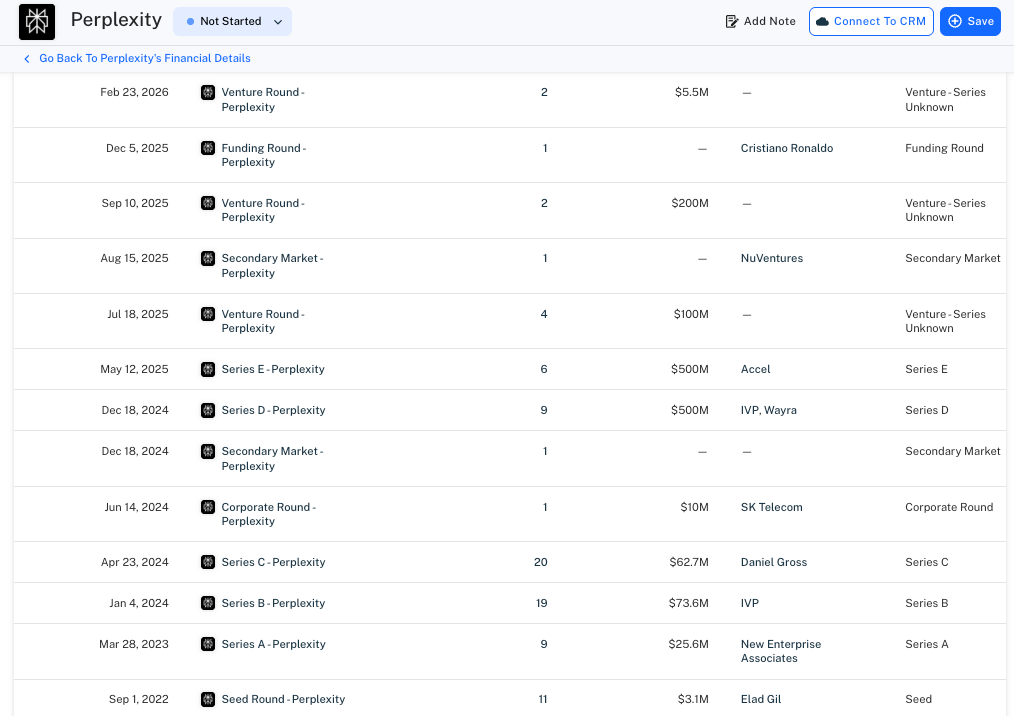
By December 2024: roughly $80M ARR, $900M+ raised, a $9B valuation and 22 million MAU, with every major AI company copying their citations feature.
Act 2: The Platform
From $80M to $300M ARR, in 12 months:
By January 2025, Perplexity's product was no longer differentiated because every chatbot cited sources. The question shifted to “how do we win before Google kills us with distribution”.