👋 I’m Ivan. I share venture capital intel, made founder-useful.
This week’s sponsor is AI CRM Attio:
Attio is the AI-native CRM for the next era of companies: Connect your email and calendar, and Attio instantly builds a CRM that matches your business model.
Instantly prospect and route leads with research agents
Get real-time insights from AI during customer conversations
Build powerful AI automations for your most complex workflows
Hello there!
Ben Evans just published one of the clearest analyses of the “AI platform shift”.
I went through the deck + pod.
Here’s what matter’s most:
1. AI adoption is early and mostly additive, but has already cracked the “Google habit”
What happened
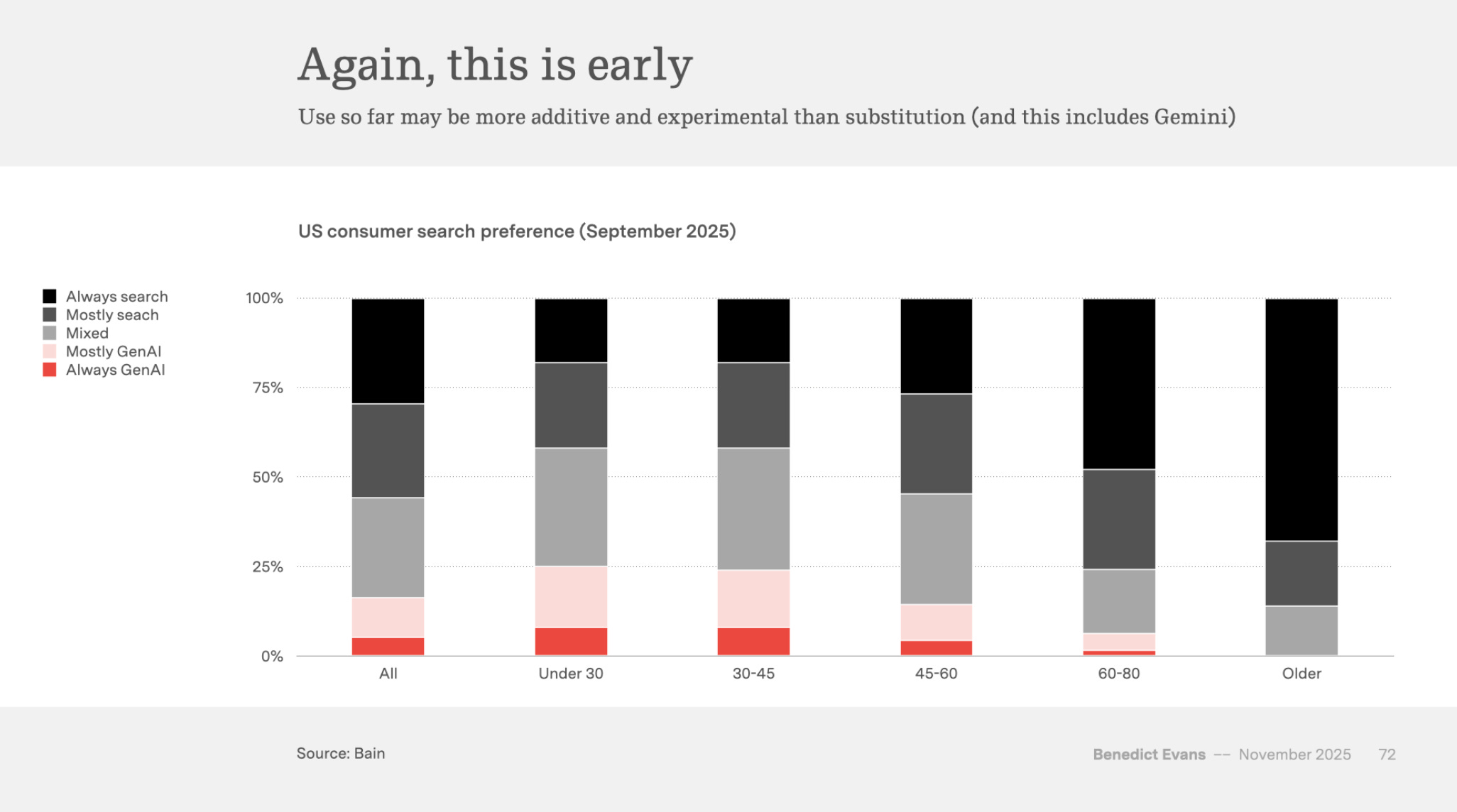
Despite the hype, most people still use GenAI intermittently, folding it into existing habits rather than replacing them.
The details
Even among under-30s, “Always GenAI” is a minority behaviour. Most consumers alternate between traditional search and AI tools.
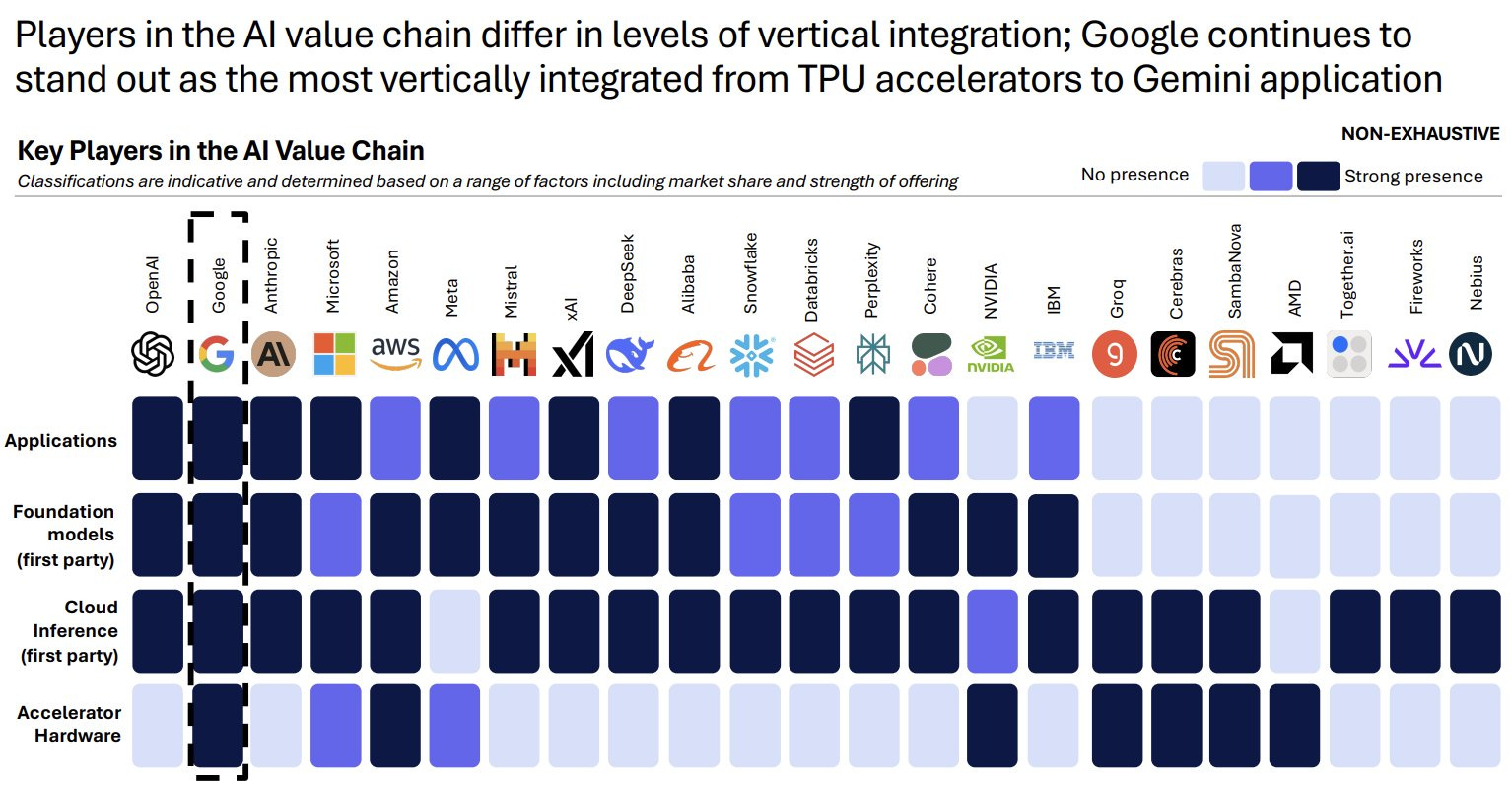
The threat to Google is likely not replacement but erosion. Once the reflexive habit of typing a query into Google weakens, the moat might begin to crack. That being said, Google is still the only player fully vertically integrated in this wave, and moving fast on all fronts (see Gemini’s 3.0. performance here).
So what
Search as we know it will likely not collapse suddenly. It will decay and change slowly. It’ll be interesting to see how founders build for hybrid behaviour.
2. We have lived through this panic before, and the pattern always repeats
What happened
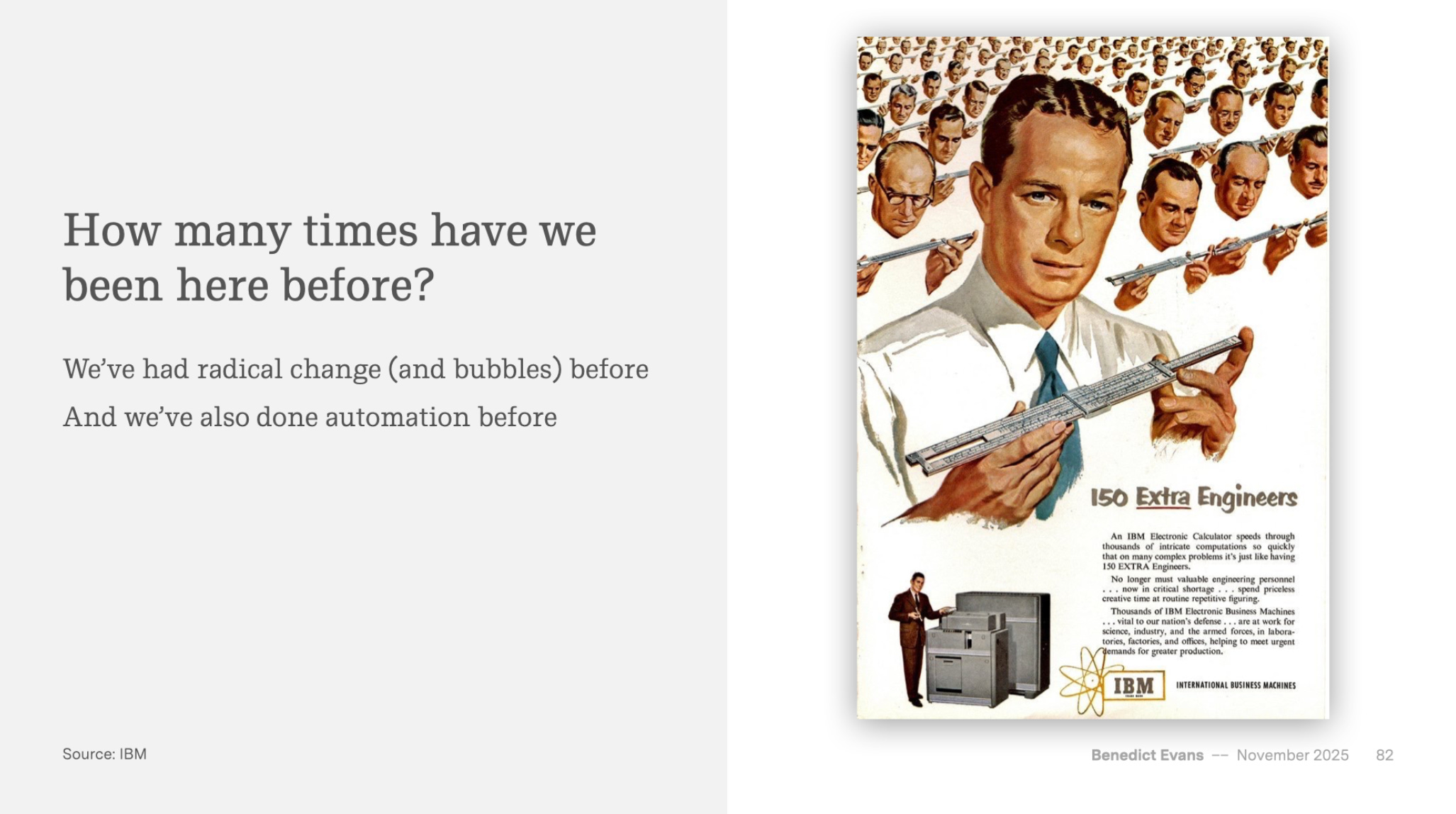
Automation fear cycles are not new. They follow a predictable psychological script.
The details
The IBM “150 extra engineers” advertisement above is almost identical to the conversations happening now about LLM job displacement. The technology shocks of the 1950s, 1980s, and 2000s followed similar curves including a period of panic, adaptation, productivity gains, and then new categories of work.
As Mr. Bill Gates once said, we “tend to overestimate destruction in the short term and underestimate long-term transformation”.
So what
Every platform shift starts with a change in how people behave, and AI is no different. We’re already seeing new defaults emerge:
Expressing complex intent in natural language (i.e. Lovable)
Delegating repetitive work to “infinite interns” (i.e. Harvey)
Feeling comfortable talking to a robot (i.e. HappyRobot)
Wanting fewer screens / our attention back (i.e. Balance Phone)
Expecting tools to remember us (i.e. OpenAI memory)
And many more that are emerging fast.
These micro-behaviours always arrive before the category shifts. They show you where workflows are about to break and where new ones want to form.
And the pattern is the same as every previous cycle:
Google followed the behaviour of link-based discovery
Instagram followed the rise of mobile photo culture (after pivoting from Burbn).
Shopify followed the self-serve ecommerce wave
TikTok followed swipe-first video.
Basically it seems like winners didn’t predict the platform shift but rather noticed the behaviour it unlocked and rebuilt the workflow around it.
3. Adoption tends to move in 3 phases, and we’re still in the first one
What happened
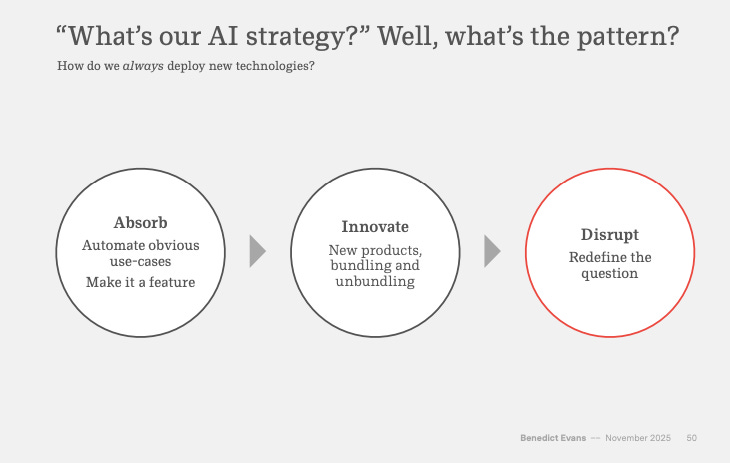
Every platform shift starts by absorbing the new tech into old workflows. Only later do the new bundles and new categories appear.
Despite the hype, we’re still very early in this first phase.
The details
LLMs today mostly sit on top of legacy processes like coding assistants inside IDEs, copilots layered onto Zendesk/Salesforce, meeting-note bots, marketing-draft generators, knowledge copilots etc.
These accelerate the workflow but don’t change its structure. Many workflows only exist because humans had to read, route, check, and summarise information manually.
So what
I like this question to stress our thinking about what could come next:
“If the human constraints disappear, does this workflow still make sense?”
Some examples:
support that resolves itself without tickets
FP&A that updates continuously without analysts
sales pipelines maintained by agents not reps
compliance that monitors in real time instead of via PDFs.
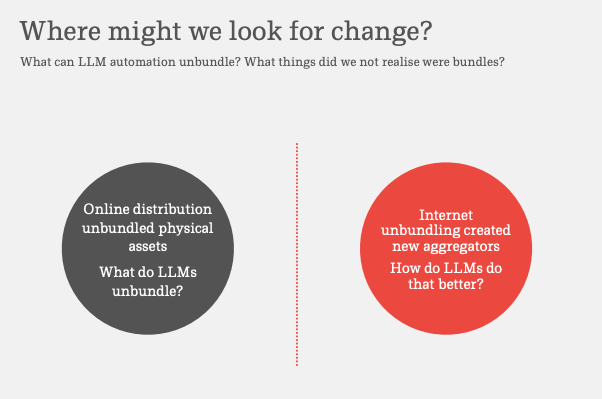
4. The central strategic question: what does this wave unbundle?
What happened
The internet unbundled physical things (newspapers → articles, stores → SKUs). AI now unbundles office work, the long, messy processes that only existed because humans had to read and decide things.
The details
Workflows like compliance checks, claims processing, RFPs, legal review, customer ops, and financial modelling are not “designed systems.”
These are chains of people passing information because no software could understand the content. Now models can understand it, which means these chains don’t need to stay glued together.
So what
The biggest opportunities lie in spotting these “fake workflows”, processes that exist only because humans had to push the work forward. Companies unbundling these are starting to create new categories (some experiencing early explosive growth).
5. Enterprises are reorganising around it
What happened
Enterprise AI adoption is both driven by economics and by vibe-revenue / novelty (despite interesting arguments on both sides of the debate). When reasoning becomes cheap, the rational response is to restructure work around it.
The details
For the first time, companies can delegate reading, summarising, drafting, checking, or routing tasks to software and not people. This is why adoption happens even when the outputs aren’t perfect.
So what
The CFO doesn’t care about “magic AI moments”. They care about turning 50-person workflows into 5-person workflows.
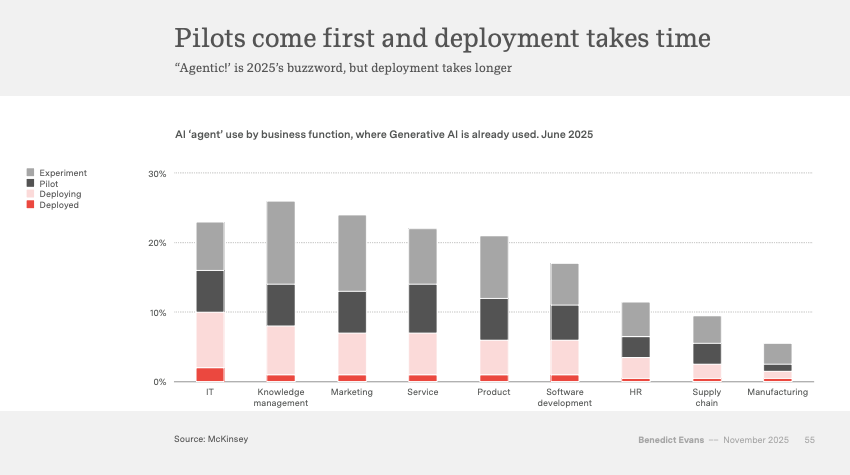
6. AI is stuck in pilots because it isn’t reliable enough (yet)
What happened
Enterprises are running hundreds of AI pilots, but very few make it into real workflows.
The details
Two things break when you try to automate real work:
Plumbing: security reviews, data access, permissions, compliance, audit trails.
Outputs: the model is powerful, but it sometimes thinks wrong and systems can’t yet catch those errors cheaply.
Until both issues are solved, automation can’t run unattended.
So what
There’s opportunity in infrastructure that makes automation safe including verification, monitoring, auditability, fallback logic, secure execution, and workflow-level dependability (i.e. Galtea).
7. AI can figure out what you’re trying to do, not just what you clicked