


👋 I’m Ivan. I study how top 1% startups grow.
In case you missed it:
Paid subscribers get 3 months of Granola AI free, 10 free PitchMagic deck reviews ($49), and a free year of doomscroll.fyi. See the perks.
Hello there!
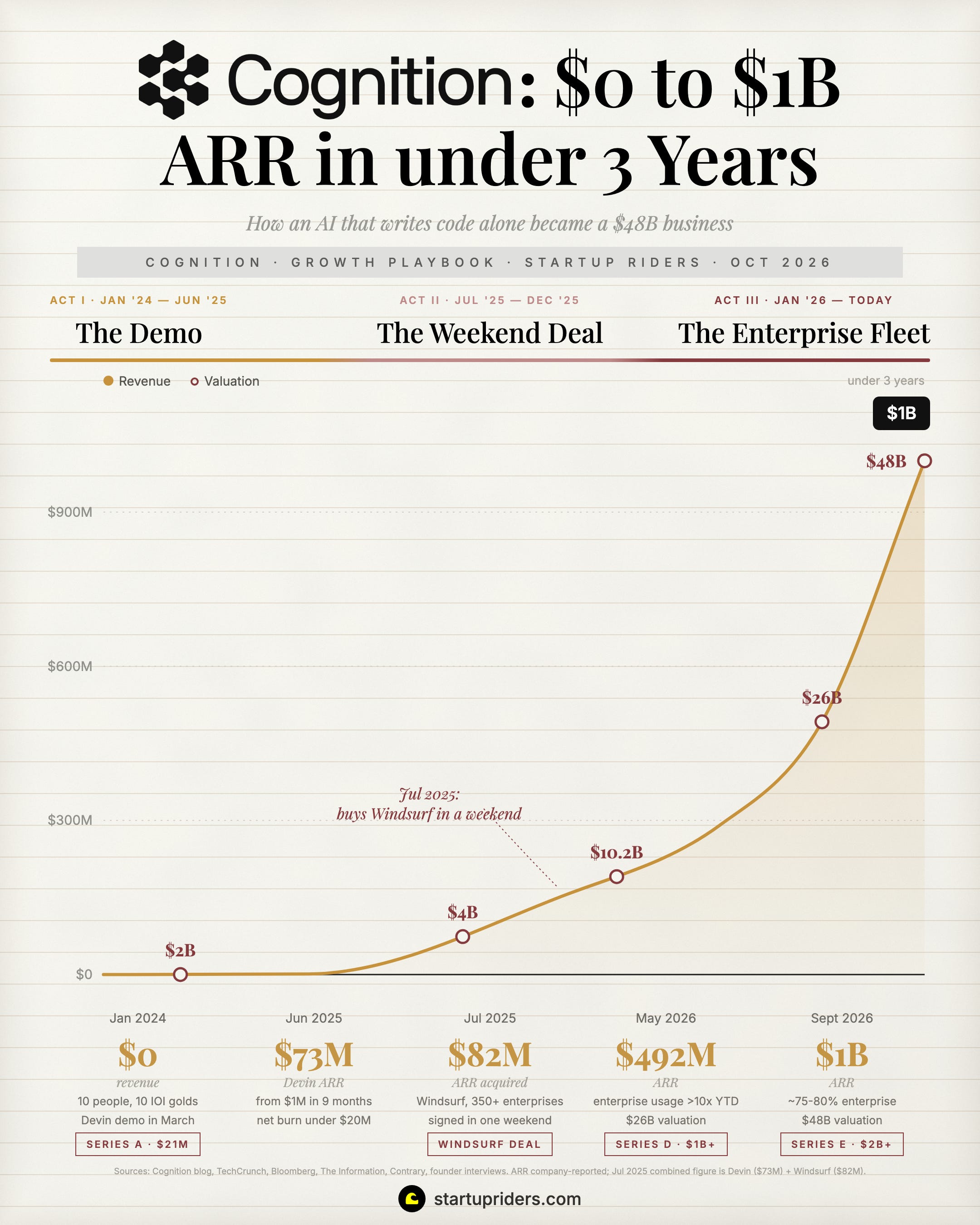
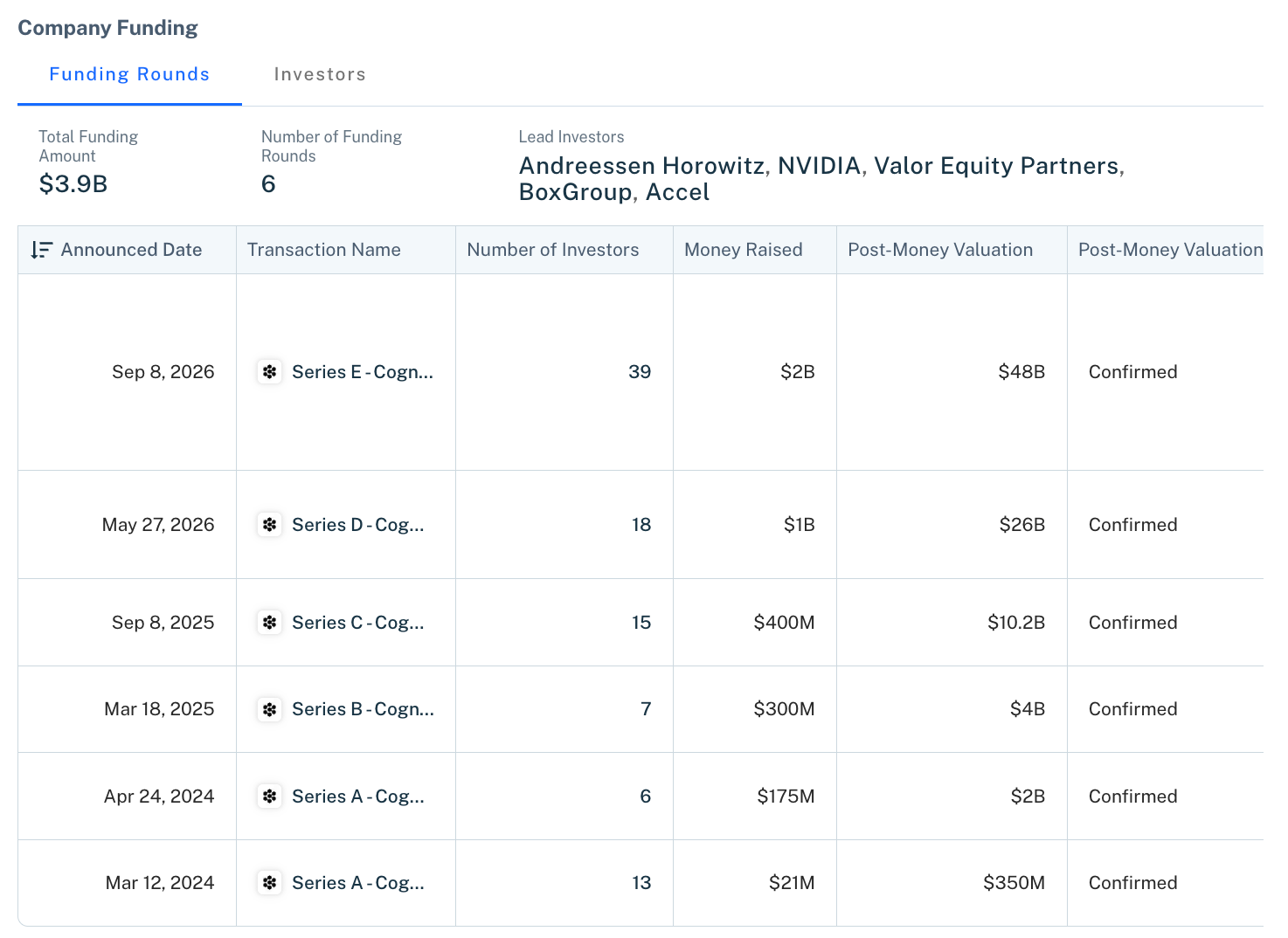
This week I’m diving into Cognition, the startup behind Devin, an AI that writes and ships code autonomously which just crossed $1B in annualized revenue a few weeks after raising $2B at a $48B valuation (barely 3 years after its founding):
In a nutshell:
Product: “Devin” kind of works like a junior engineer you message where you hand it a task (like fixing a bug or upgrading a library) and it works on its own in the cloud + comes back with a pull request (a proposed code change a human reviews and approves). It also owns Devin Desktop which is the AI code editor that used to be called Windsurf (which they acquired).
Money: self-serve plans from Free to $200 a month but the real business is enterprises that get billed by how much work Devin does (c.75% of revenue)
8 growth mechanics in this drop:
Claimed a new category with a demo (before the product worked!)
Sent the whole team to make their first big customer work
Sold the boring jobs engineers hate (+ a before-and-after number)
Priced the AI like a worker vs like software
Bought a ready-made sales machine (in a weekend!)
Set the product to start a job every time something broke
Took the risk off the buyer with a money-back guarantee
Bet on staying neutral between the AI labs (vs rivals picking sides)
📐 Quick note on editorial + methodology: this analysis focuses on the 80/20 mechanics that explain their growth (it’s not a comprehensive profile, not an endorsement or investment advice). I use AI like a fund leverages an analyst for groundwork, the direction + judgement are mine. Company-reported figures are marked as such, treat directional estimates as directional.
Today’s newsletter is brought to you by: PitchMagic.ai
Investors rarely tell you why they passed.
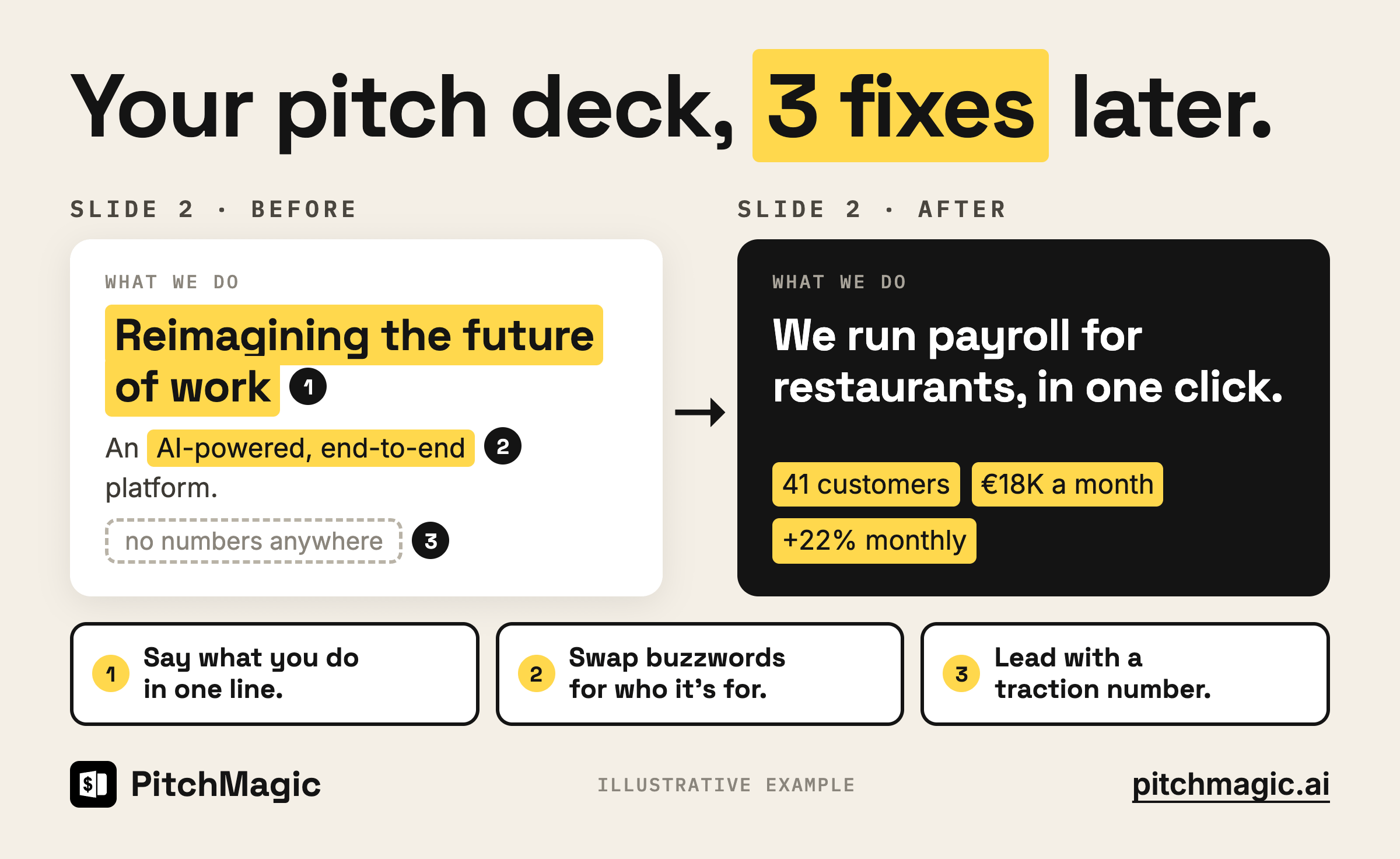
PitchMagic gives you that feedback, before you hit send!
I built it because friends kept asking me for feedback on their pitch decks.
It grades your pitch deck on the 4 questions investors ask themselves when making decisions, scores it, marks the exact words to change on every slide, and ranks the 3 fixes that matter most to get your foot in the door. Try it:
Zero To One

Who: the founding team hold a bunch of gold medals from the International Olympiad in Informatics between them and the team (definitely an edge in this AI wave both in terms of competitiveness and speed):
Scott Wu (CEO): three-time IOI gold medalist. Before this he co-founded Lunchclub (AI networking app) as CTO.
Steven Hao (CTO): one of the first engineers at Scale AI, MIT, IOI gold in 2014.
Walden Yan (CPO): early engineer at Cursor’s parent company who left Harvard in 2023.
Russell Kaplan (President): worked on Tesla Autopilot, then co-founded a computer vision startup that Scale AI bought in 2020 (ran machine learning).
Where they started: the team came together in 2023. Kaplan says that from where he was at Scale (saw big AI labs buying training data), he could see each new model getting much better at code and bet software engineering would change first.
Market wedge: coding assistants like GitHub Copilot already suggested the next line at the time but nobody yet sold an AI that took a whole task and finished it completely on its own. Scott mentions they were “late” (what a time to be in tech) to AI coding so they went after what was around the corner.
The MVP: was a demo and in March-24 they launched Devin as “the first AI software engineer” with their $21M round led by Founders Fund and about 6 weeks later they raised $175M at a $2B valuation.
First users: a wave of inbound pilots that in Scotts words “were all just failing.” Their first enterprise success was Nubank.
Growth Mechanics
Lever 1: Claimed a new category with a demo (even before the product fully worked)
“If you really plant your flag in the ground and put a stake into what you think the future is, and you run like hell towards that...” (Scott Wu, Founders podcast)

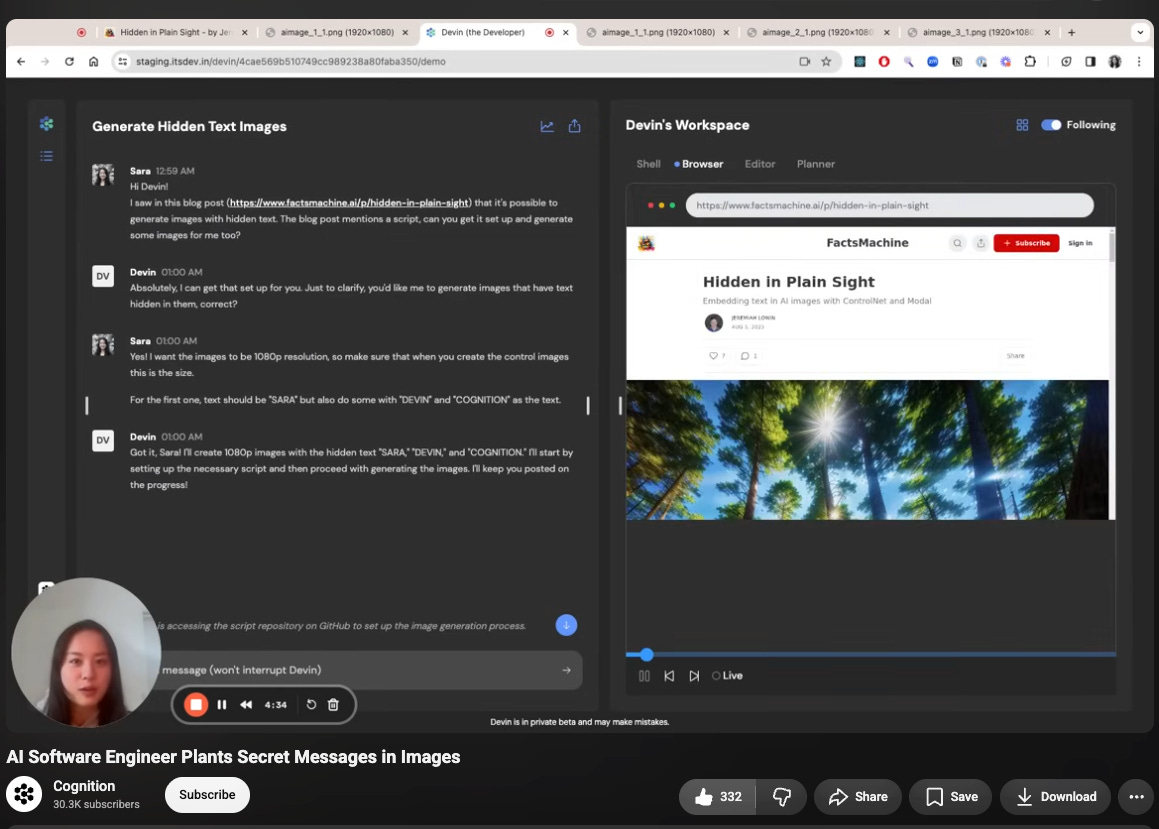
What happened: their launch videos showed it doing planning, coding, testing and fixing of software on its own (even though it wasn’t really ready for real work just yet apparently). But it made Cognition the name for a new category while most of the other tools at the time were still talking about “AI coding assistants”. It got them attention + pilots, hires and money.
The details:
They said Devin solved 13.86% of SWE-bench (test set of bugs from open-source projects) on its own against a previous best of 1.96% at the time, and it was tested on a quarter of the set (take it as a company benchmark).
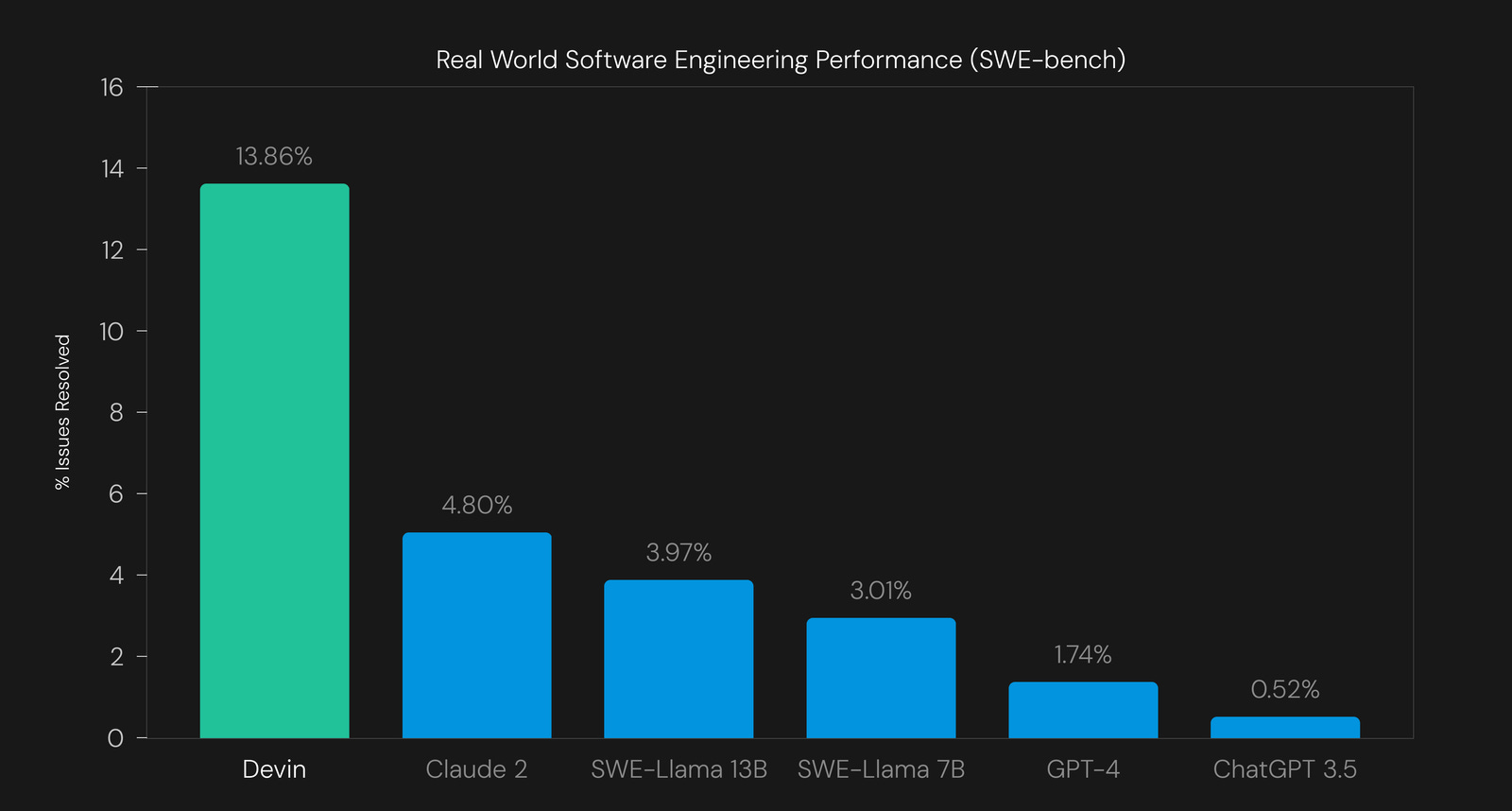
Their launch post on X has now over 30 million views.
2 years later Kaplan (one of the founders) mentioned that “it wasn’t even really useful for us for another 3 months after we built the prototype we shared with the world” (ChinaTalk)
Critics at the time “attacked” / really criticized the demo but Wu doesn’t argue with it either, he says “I think we were wrong on a lot of things, to be clear.”
A year later they did it something similar again with a free tool called DeepWiki which turned any public code project into a readable guide, with every page inviting you to “ask Devin”. It launched with 50K+ projects already covered and the CTO mentions it was built “more as a kind of like a marketing play, kind of as a public service”.
So what: naming a category before the product is ready is a way of borrowing attention against something you still have to build (which is risky) but what it got them was engineers who wanted in + a queue of big companies willing to try it. The pilots failing was probably the most useful part since it showed them where it broke, though obviously this only works if you can catch up fast (which I suspect is exactly why they hired IOI gold medalists, de-risking with proven talent execution speed + competitiveness).
Lever 2: Sent the full team to make the first big customer work
“We all flew to Brazil. I was there. The whole team was there.” (Wu, Founders pod)
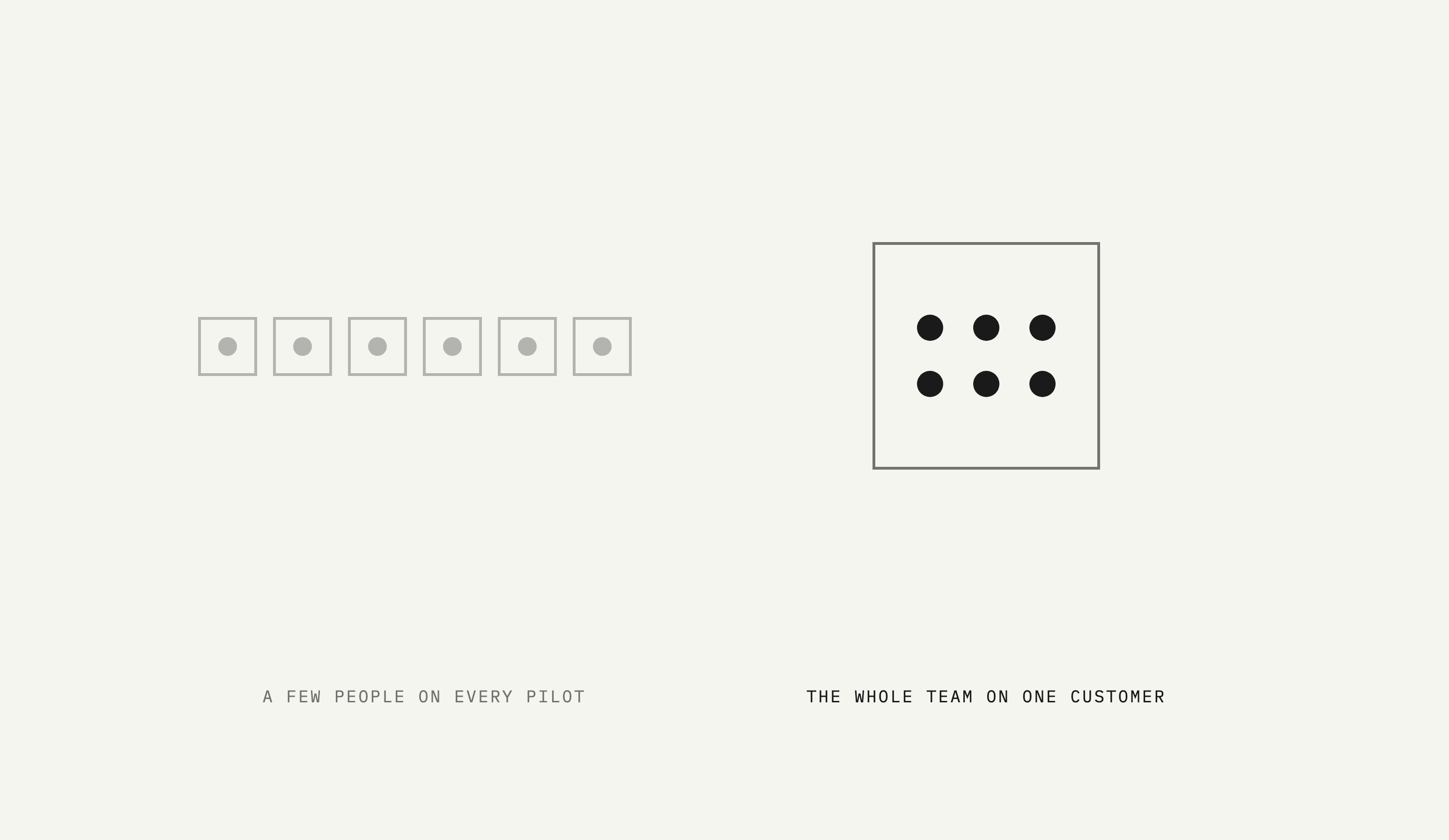
What happened: as discussed the pilots from the launch kept failing because agents weren’t good enough just yet so instead of spreading a small team across multiple trials they went all-in on one, a big code migration at Nubank. They flew the team over to Brazil and worked to really make Devin perform on that one job well. This is now apparently standard operating practice for them (sending Eng to live inside customers).
The details:
They say the Nubank job was an 18-month migration spread across 1K+ eng done “with 1/8 the human time at a 20x cost saving” (AWS re:Invent)
Goldman Sachs was next and also moved very fast, Wu says big companies usually take “like a 12 to 18 month cycle,” and “we did the whole thing start to finish in like 3 months” (Lux, May 2026).
They also used the same logic to get their first government contracts with the U.S. Army, Navy, Treasury and NASA’s Jet Propulsion Laboratory, selling Windsurf as “the only FedRAMP High AI IDE” (which is the US government’s strictest cloud security clearance)

They also skipped individual developers, they mentioned “We don’t focus at all on individual hobbyists who are just trying to make a cool thing,”
And these Eng who work inside customers (FDE’s we’ve talked about these a bunch in past editions here on this ai wave), are now according to the founders “maybe the fastest growing of all the roles”.
So what: going from many pilots to focus on one is a hard trade-off, and it was especially tough probably for them considering the state of the product at the time. But one bank with a painful very specific job probably gave them a better product spec than any roadmap would have (building for a real migration instead of an “imagined user”), and it also gave them a very credible logo.
Lever 3: Sold the “boring jobs” engineers tend to not like, with a before-and-after number
“With a single use case the time savings can be so high that it motivates the rest of the roll out immediately.” (Russell Kaplan, Sapphire Ventures)
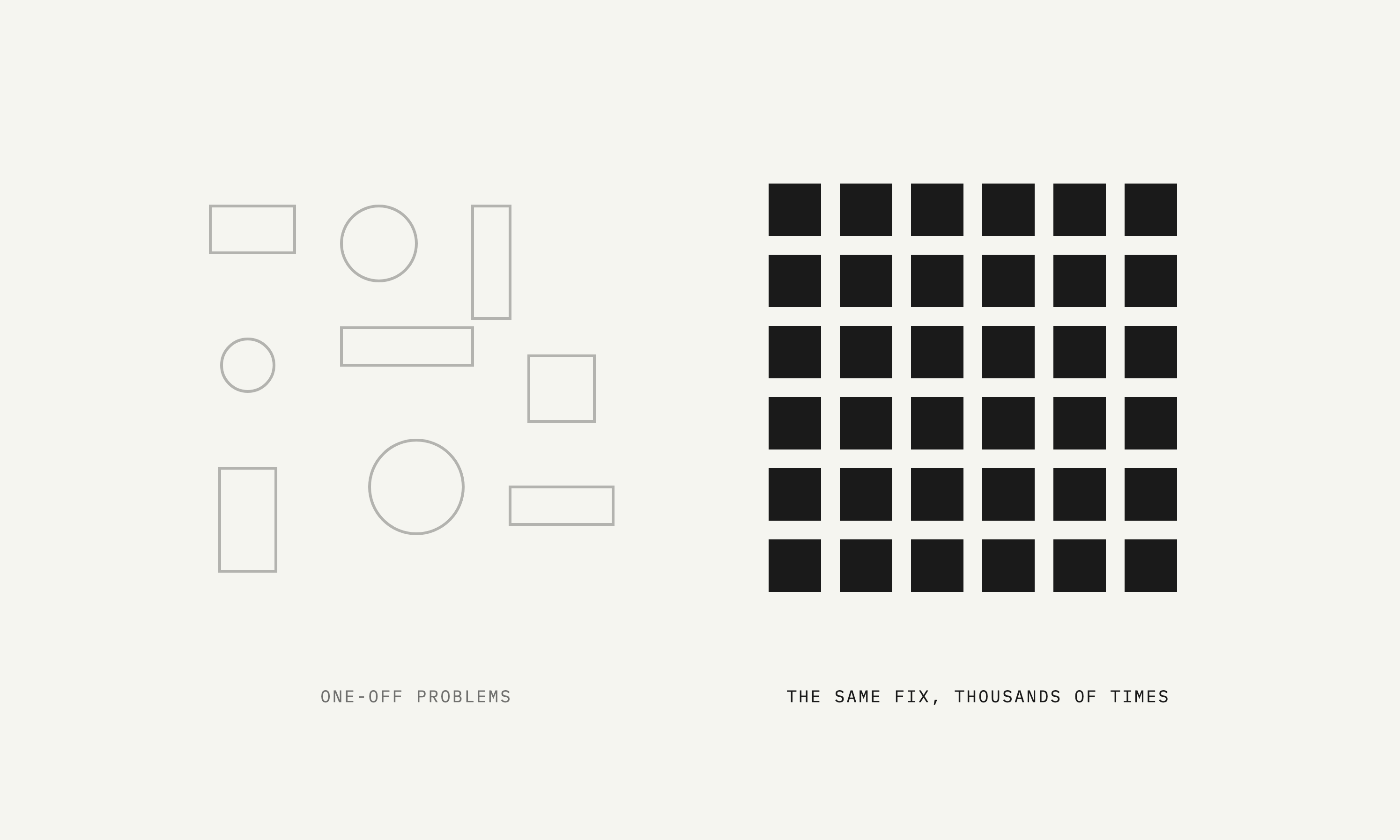
What happened: Copilot sold a seat to every developer Vs Cognition which sold specific projects that are painful / nobody wants to do really (or less likely). Examples are things like moving old code to new versions, upgrades, security fixes etc. That work is usually very repetitive + easy to check which is where an agent tends to beat (even now) a person. This in turn tends to be an easier to quantify number that you can sell or that a finance team understands better.
The details:
Wu mentions that a typical job as a “50,000-file codebase” where “it’s like the same eight things that you need to change in each one” (Founders podcast).
Itaú for example (Latin America’s largest bank) had “a 2-year plan” for a tax-ID change and got “the bulk of that project done in 3 weeks instead of 2 years”.
Kaplan says 1 hour spent directing Devin is probably worth like 8 - 12 hours of doing it by hand and that “the average ROI we hear from customers, is between 8x to 12x” (Kaplan, Hg Orbit).
Apparently internally they talk about the “show-off” version of Devin which is called “street performer Devin” (the one people ask “to just do really cool stuff”) and the team’s job is the other one aka “how do we have Devin solve real issues and real projects” (TBPN).
So what: this is basically a wedge where you have one project nobody wants with a before-and-after number getting them a fast yes, and then using that number to do the selling inside the rest of the company (land + expand). It also puts Devin up against contractors and consultants (less crowded fight than other coding tools?).
Lever 4: Priced the AI like a worker (vs software)
“It’s all usage based, but it’s essentially by the hour... we try to make things so that they’re about 10x cheaper than... basically the value of your time.” (Scott Wu, 20VC)
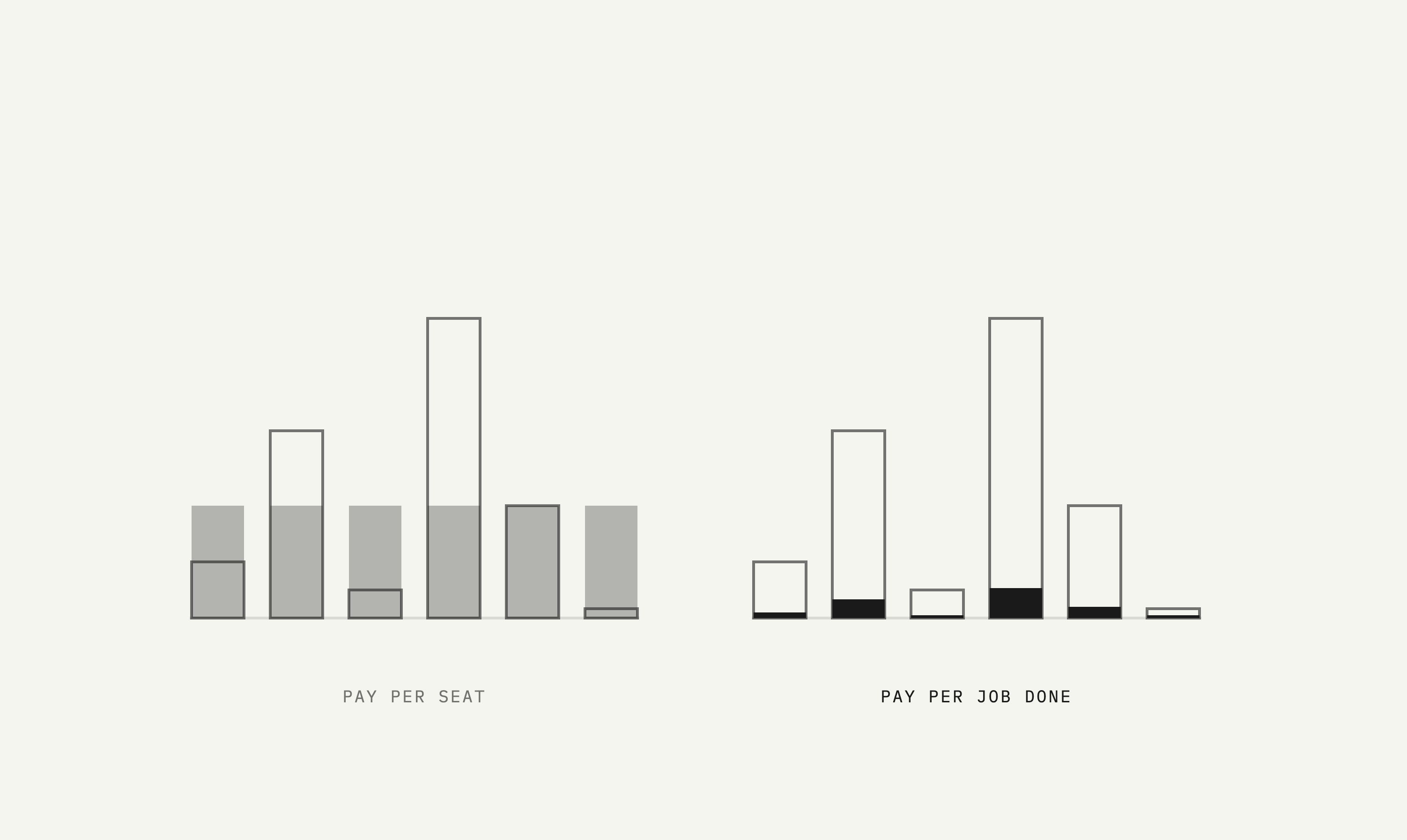
What happened: most software charges per seat whereas Devin charges for the work it does measured in “Agent Compute Units” (ACUs, roughly slices of Devin’s working time). So if an engineer’s hour is worth lets say $100 the target is for Devin to do that hour’s work for about $10, therefore the bill only grows if Devin works more.
The details:
When Devin launched publicly to everyone in December 2024 it started at $500 a month and 4 months later with Devin 2.0 they added a plan “starting at $20” with “No monthly commitment.”
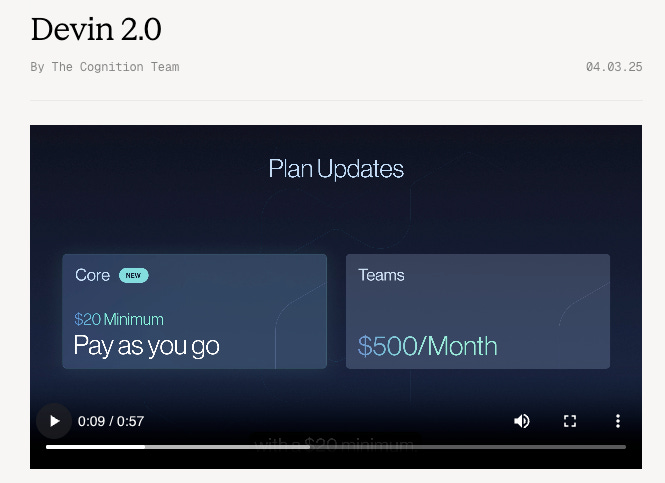
Accounts grew on their own, according to swyx (joined Cognition in 2025) “>5x contract expansions - not at renewal, but proactively” were “very common” in successful deployments
Jeff (who ran Windsurf) repriced its self-serve plans because growth came from people “trying to subsidize their own token use” (ProductLed)
So what: how you charge determines of course in a way what you get compared to and in this case per seat would have them sit next to other software subscriptions vs per unit of work they sit next to a salary (we’ve talked about this previously in the $1T blind spot). It also means of course that revenue grows as the product gets better at the job.
Lever 5: Bought a ready-made sales machine in a weekend
“Buying a company 5 times your size in a weekend um, is like really complex for a lot of reasons.” (Russell Kaplan, Chemistry Ventures)

What happened: in July 2025 Google hired Windsurf’s founders and top researchers in a licensing deal which left the rest of the company behind (including the product, the customers and a sales and deployed-engineering team of around 200 people). Cognition at the time which was “all of 35 or 40 people” doing “70 or 80 million of revenue run rate” (Sourcery) called that evening and signed Monday morning, and just like that Cognition had a sales machine.
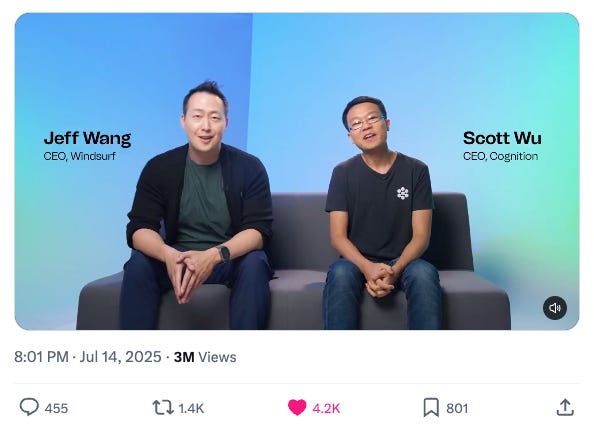
The details:
The deal brought “$82M of ARR” and “350+ enterprise customers” (Cognition). The price was never disclosed but reports put it around $220-250M.
The 2 had “< 5% overlap in enterprise customers” so a lot of the immediate work after was selling each side’s product to the other’s.
It worked fast as the deal “more than doubled our ARR,” and combined enterprise revenue was “up over 30% in the seven weeks” after.
Fun fact, in order for the deal to hit on Monday, Wu told the lead lawyer that if they pulled it off his bonus would be enough to “go buy a Porsche” (Lux).
It also brought Windsurf’s partner channel. Its former sales leader says Windsurf ran “100% of our revenue through partners,” aka IT consulting firms that install software for big companies (First Round).
So what: all-in-all this is a pretty wonderful deal and great strategic moves where same deal took their closest rival off the market and gave them distribution / access to hundreds of big companies overnight.
Lever 6: Set the product to start a job every time something broke
“A lot of people are actually using it via API. And so they’re basically plugging in Devin to their Datadog alerts, or plugging in Devin to their Snyk... or Veracode or SonarQube security scans.” (Kaplan, Chemistry Ventures)
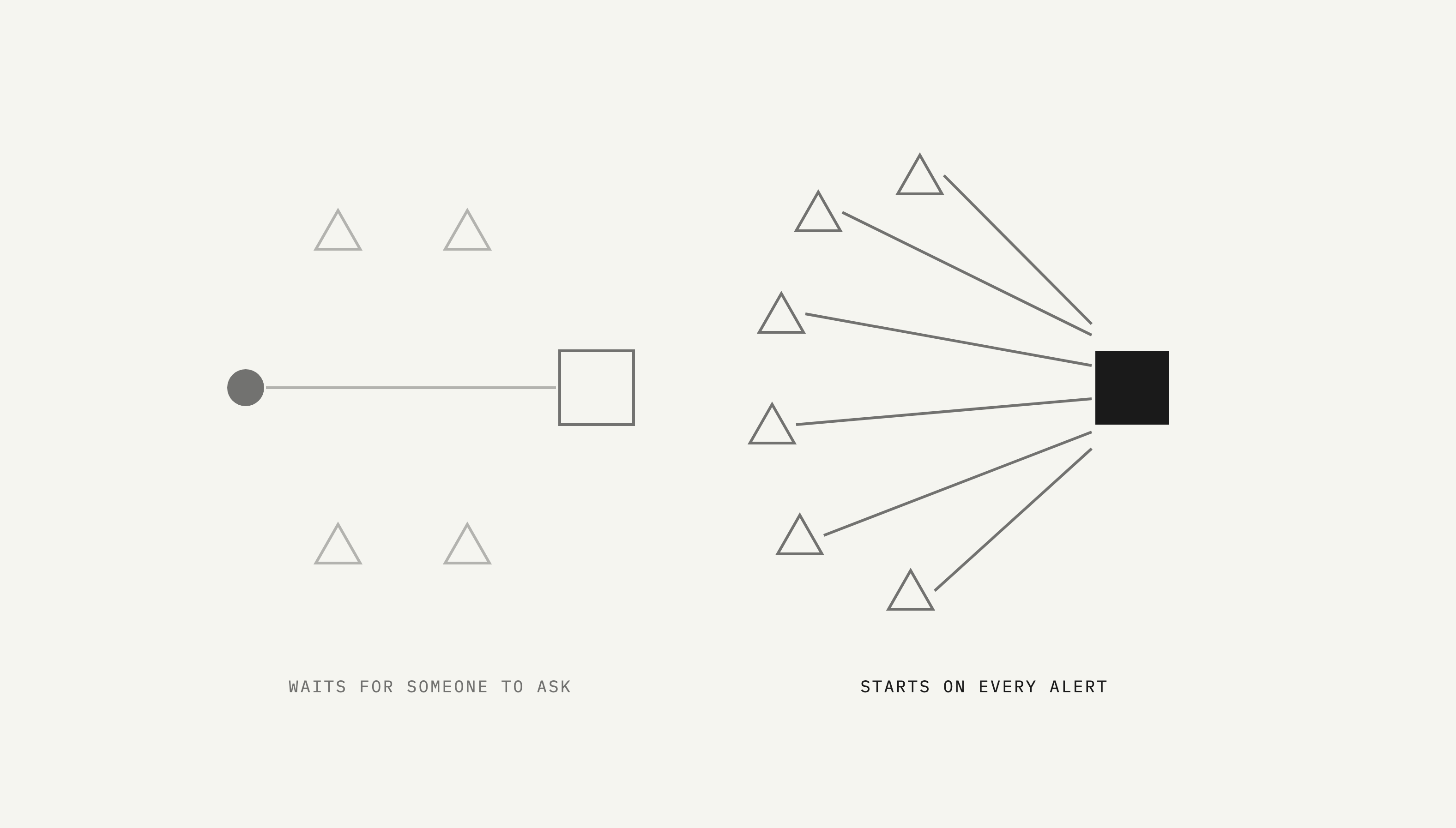
What happened: most AI tools sit and wait for a person to type but in their case customers started connecting Devin to the systems that raise alarms like monitoring tools or security scanners. There are alerts now that start a Devin session by itself so the work (and the usage bill from lever 4) grows with the customer’s alerts instead of with how many people remember to use it.
The details:
Jeff Wang (from Windsurf above remember) says “event driven agents are roughly 40% of all of the workload right now” (Zero-Shot Learning).
Itaú “fixes 70% of security vulnerabilities automatically” with Devin
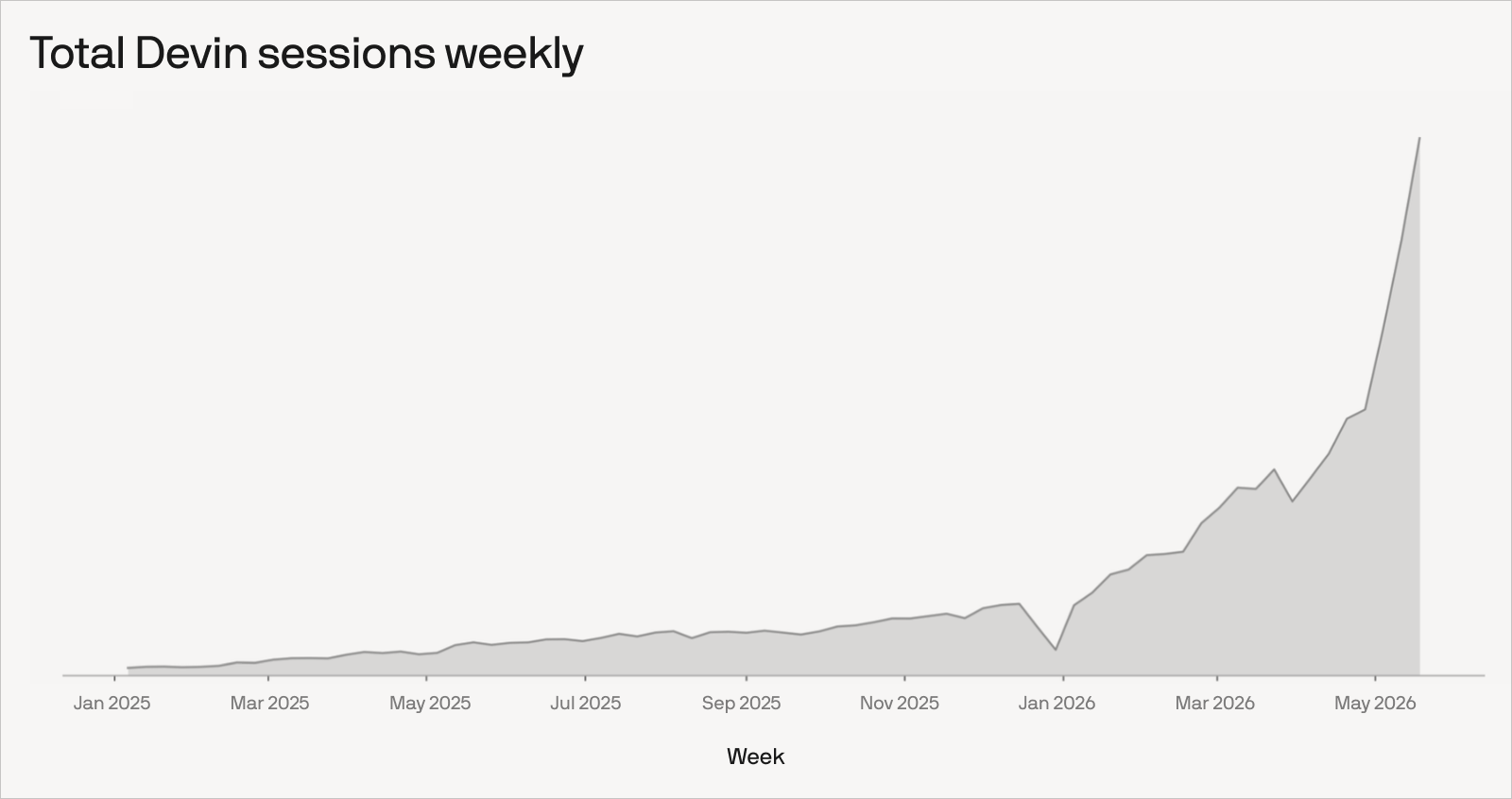
Engineers welcome it because it takes the chores “you don’t want to take away the things that they want to do. You want to take away the things that people don’t want to do.”
So what: what they built here is a trigger where usage stops depending on people remembering to open the product and starts growing with alerts the customer’s systems fire, and once it’s wired in it’s hard to take out.
Lever 7: Took the risk off the buyer with a money-back guarantee
“If Devin delivers less engineering value than you’re paying for, Cognition will fund your usage up to $10M until it does.” (Scott Wu, Cognition blog)
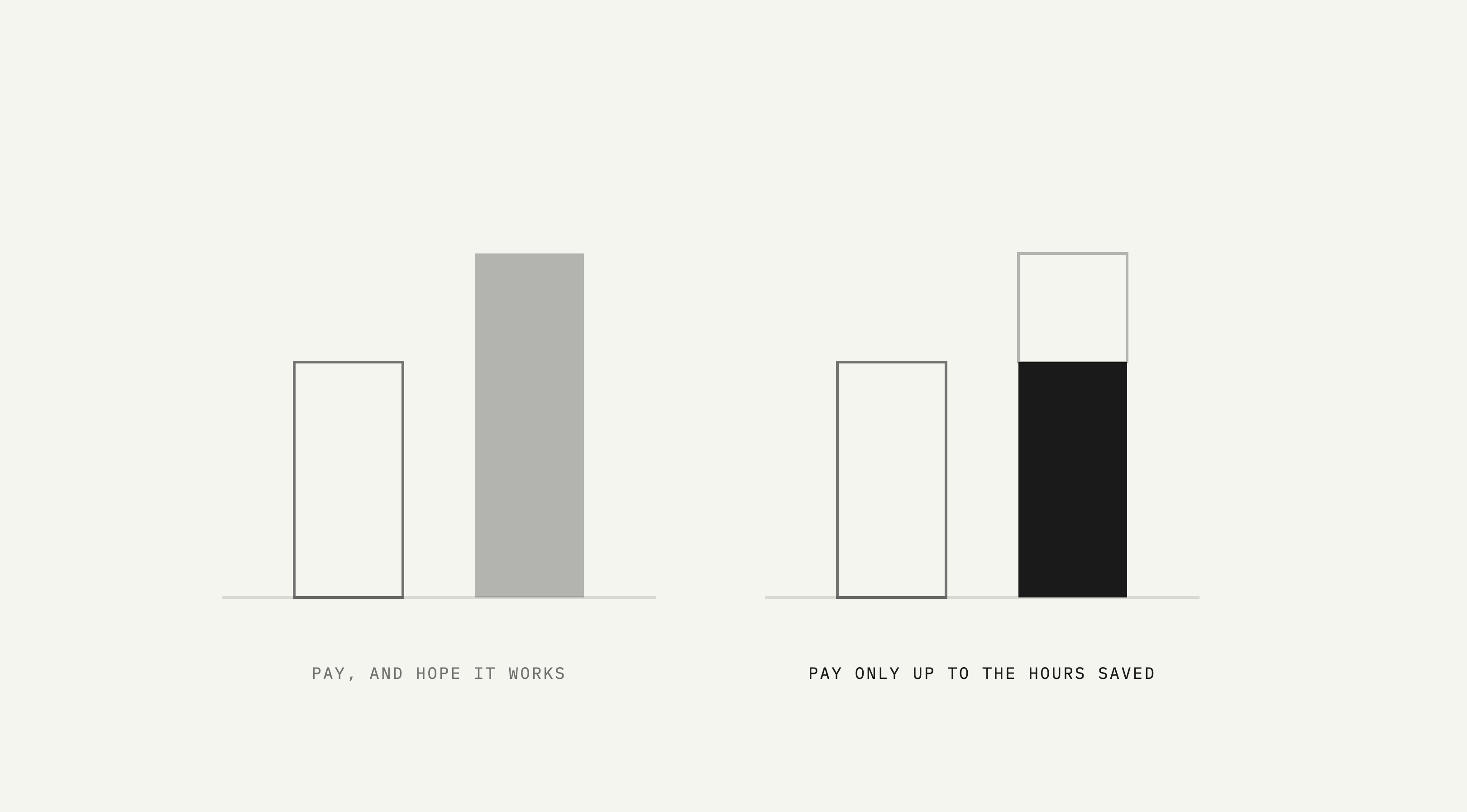
What happened: as we’ve been seeing big companies having been spending heavily on AI with no idea what they got back (tokenmaxxing). In June this year Cognition launched the AI Productivity Guarantee in which AI reviews every finished Devin session and estimates how long a human would have taken, and if the value comes in under what the customer paid in a year, they cover the gap (up to $10M)!

The details:
The launch post argues that “the industry needs to move from maximizing usage metrics to maximizing outcomes.”
Jeff puts it even more bluntly where he says “We sell outcomes. We don’t really sell the dev tools”
What makes it even more credible is that apparently they use it on themselves too, Walden Yan for example says their merged code changes grew about 7x in a few months while engineering headcount grew only about 10% (Latent Space).
So what: this is a classic risk reversal play where the buyer’s biggest objection (what if we pay and get nothing) goes away which in turn makes it so big companies can commit faster and bigger. Also meaningfully sets them apart vs competitors who bill for usage (whether it helped or not).
Lever 8: Bet on staying neutral between the AI labs vs rivals picking sides
“Signing away our trust to a specific model would be a scary thing to do. Nobody even knows who’s going to have the best model in 12 months.” (Scott Wu, Colossus)
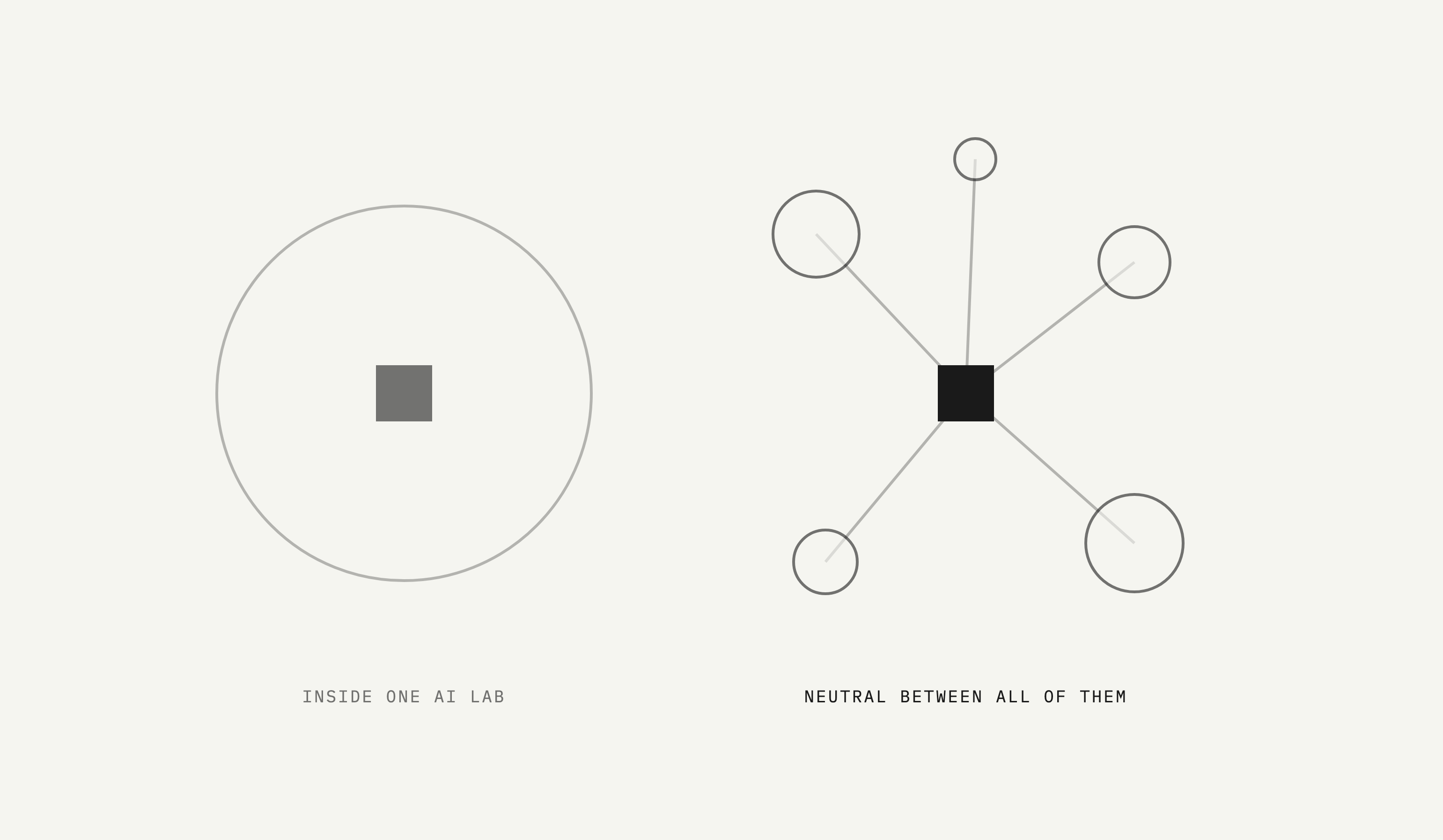
What happened: Cognition calls itself “the Switzerland of AI” 😅. Devin runs on models from every lab and (more and more) on their own cheaper ones. Meanwhile Cursor (big rival) went the other direction and sold to SpaceX ($60B) so it now belongs to surprise surprise, one of the labs.
The details:
Big companies want partners that will still be neutral in 5 years because as we all know this field in particular is moving extra fast. As Wu puts it, “the way enterprises work is they want to have long-term partnerships. And frankly, it’s just hard to know what’s going to happen in the long term” (Sourcery).
Their own model SWE-1.6 had “become the most used model in Devin Desktop”
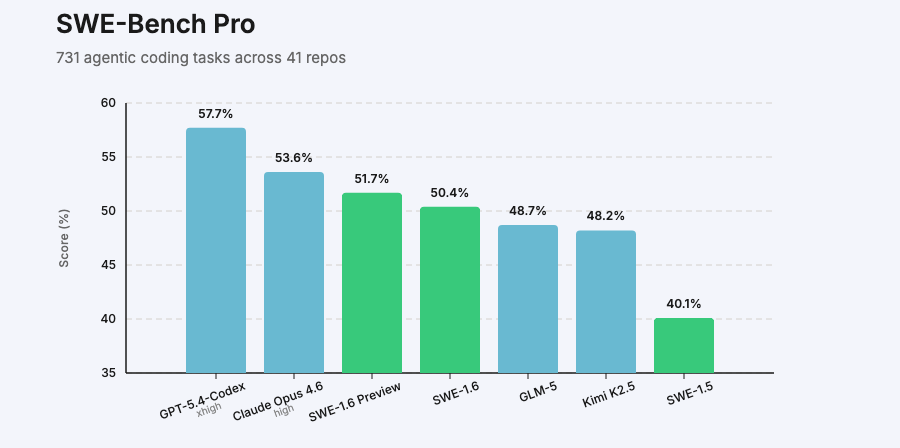
Their net burn was “under $20M across the company’s entire history” as of Sep-2025. In 2026 a leased Nvidia cluster could move cash burn to $800M though.
So what: being neutral lets them sell to big companies that don’t want to necessarily depend on 1 AI lab (or on a rival’s new owner) and of course lets them send each job to the cheapest model that can do it best. We’ll see if they can afford to stay independent in the future.
All in all its a super interesting space to watch, both because the AI coding race seems to be far from over, and because AI coding itself is the accelerant for this entire AI wave (when Devin and co. get better, everything gets better, faster). Stay tuned.
That’s it for this week friends!
Cheers,
Ivan
P.s. If you want to help me out, the best thing you can do is share my work. 🙏
🚀 Building something in this space? We invest €100K-3M at pre-seed and seed. If you’re raising or know someone who is, please send us your deck via DM.
📚 Bibliography
Founder and operator interviews (60 found, 59 read in full; key ones below)
Scott Wu — No Priors (May 2024)
Scott Wu — The Making of Devin, AI Engineer (Jul 2024)
Russell Kaplan — Hg Orbit (Apr 2025)
Scott Wu — Lenny’s Podcast (May 2025)
Scott Wu — 20VC (Jul 2025)
Scott Wu & Jeff Wang — Latent Space, the Windsurf oral history (Jul 2025)
Jeff Wang — Altimeter, On the Fly (Aug 2025)
Russell Kaplan — Sapphire Ventures (Aug 2025)
Scott Wu — A Cheeky Pint with John Collison (Aug 2025)
Scott Wu — AI & I, Every (Sep 2025)
Russell Kaplan — Talks at GS with Marco Argenti (Oct 2025)
Jeff Wang — Mala’s podcast (Oct 2025)
Russell Kaplan — AWS re:Invent (Dec 2025)
Steven Hao — GNE keynote (Dec 2025)
Russell Kaplan — ChinaTalk (Mar 2026)
Jeff Wang — Diary of a Sales Engineer (Mar 2026)
Scott Wu & Russell Kaplan — Joe Lonsdale, American Optimist (Mar 2026)
Jeff Wang — ProductLed (Apr 2026)
Scott Wu — Lux Capital (May 2026)
Scott Wu — Colossus, The Wu Tapes (May 2026)
Graham Moreno — First Round podcast (May 2026)
Walden Yan — Latent Space (May 2026)
Russell Kaplan — Chemistry Ventures (Jun 2026)
Scott Wu — Founders podcast with David Senra (Jun 2026)
Graham Moreno — The Crew Podcast (Jun 2026)
Scott Wu — Sourcery with Molly O’Shea (Jul 2026)
Scott Wu — RAISE Summit (Jul 2026)
Russell Kaplan — LangChain, Max Agency (Jul 2026)
Jeff Wang — Zero-Shot Learning (Aug 2026)
Primary sources
Cognition: Introducing Devin (Mar 12, 2024)
Cognition: Devin 2.0 (Apr 3, 2025)
Cognition: Acquiring Windsurf (Jul 14, 2025)
Cognition: Funding, growth and the next frontier (Sep 8, 2025)
Cognition: Infosys collaboration (Jan 7, 2026)
Cognition: Cognition for Government (Feb 25, 2026)
Cognition: Series D (May 27, 2026)
Cognition: The AI Productivity Guarantee (Jun 4, 2026)
Cognition: One year of building together (Jul 14, 2026)
Cognition: Series E (Sep 8, 2026)
Cognition: $1B run rate (Sep 25, 2026)
Devin pricing (accessed Oct 1, 2026)
swyx: Cognition (Sep 2025)
Bessemer: Devin’s next commit (Sep 2026)
Coverage and analysis
Not Boring: Weekly Dose of Optimism #85 (Mar 15, 2024)
Maginative: Cognition raises $175M at $2B (Apr 25, 2024)
CNBC: Google hires Windsurf’s CEO (Jul 11, 2025)
TechCrunch: Cognition acquires Windsurf (Jul 14, 2025)
TechCrunch: Cognition offers Windsurf staff buyouts (Aug 5, 2025)
Contrary Research: Cognition (2026)
Sacra: Cognition (2026)
Turing Post: Cognition (2025)
Sourcery: Devin writes 95% of our code (Jul 28, 2026)
TechCrunch: Cognition hits $48B valuation (Sep 8, 2026)