👋 I’m Ivan. I study how top 1% startups raise and grow.
While everyone’s obsessing over AI, there’s a quieter wave forming in preventive health, one that AI is actually accelerating.
I got curious about this space for a personal reason: I wanted to find an all-in-one preventive health service for my parents. Something simple that doesn’t require them to navigate the healthcare maze.
Here’s what I found instead: chaos.
In this issue:
🏥 Why preventive health is broken (and who's fixing it)
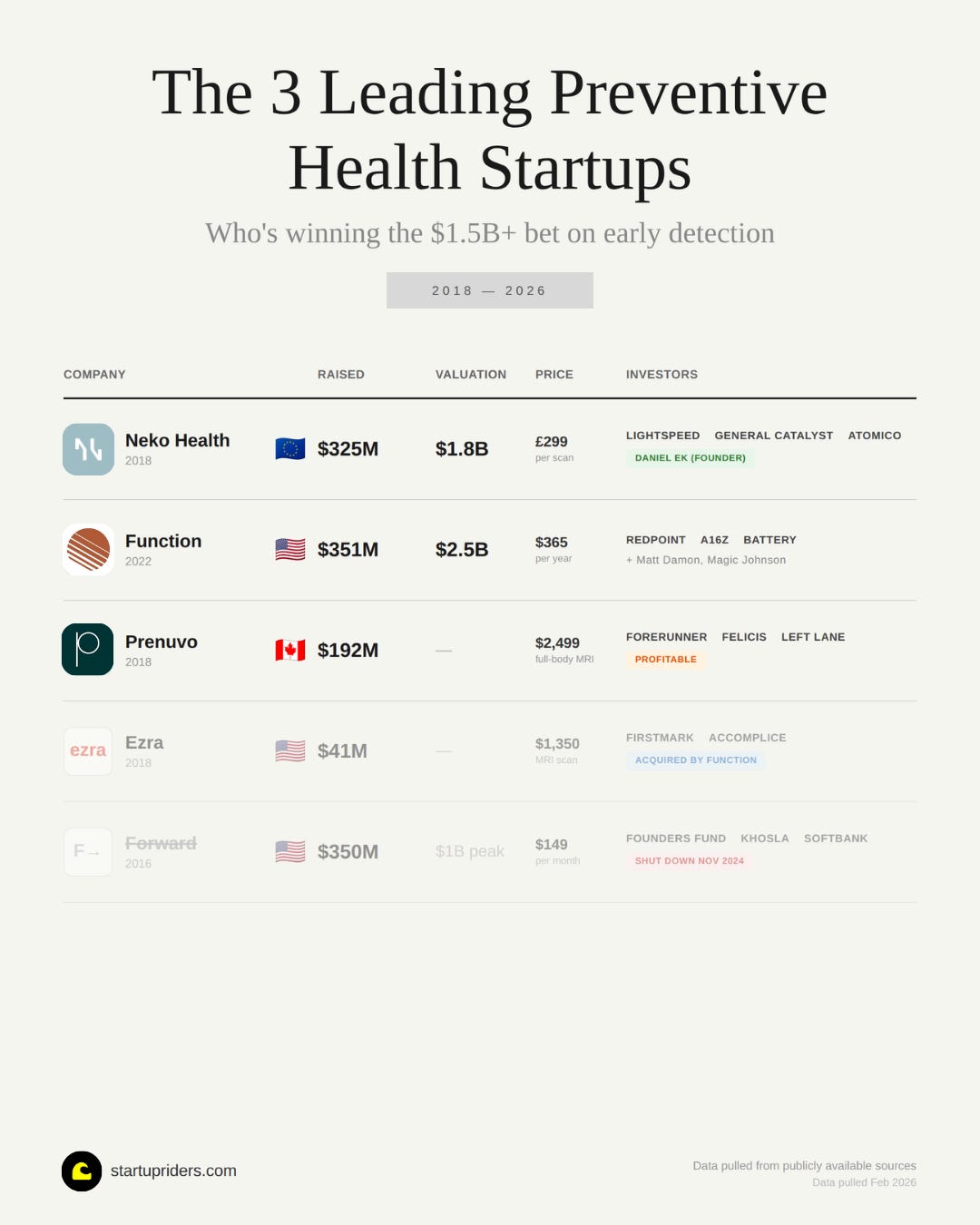
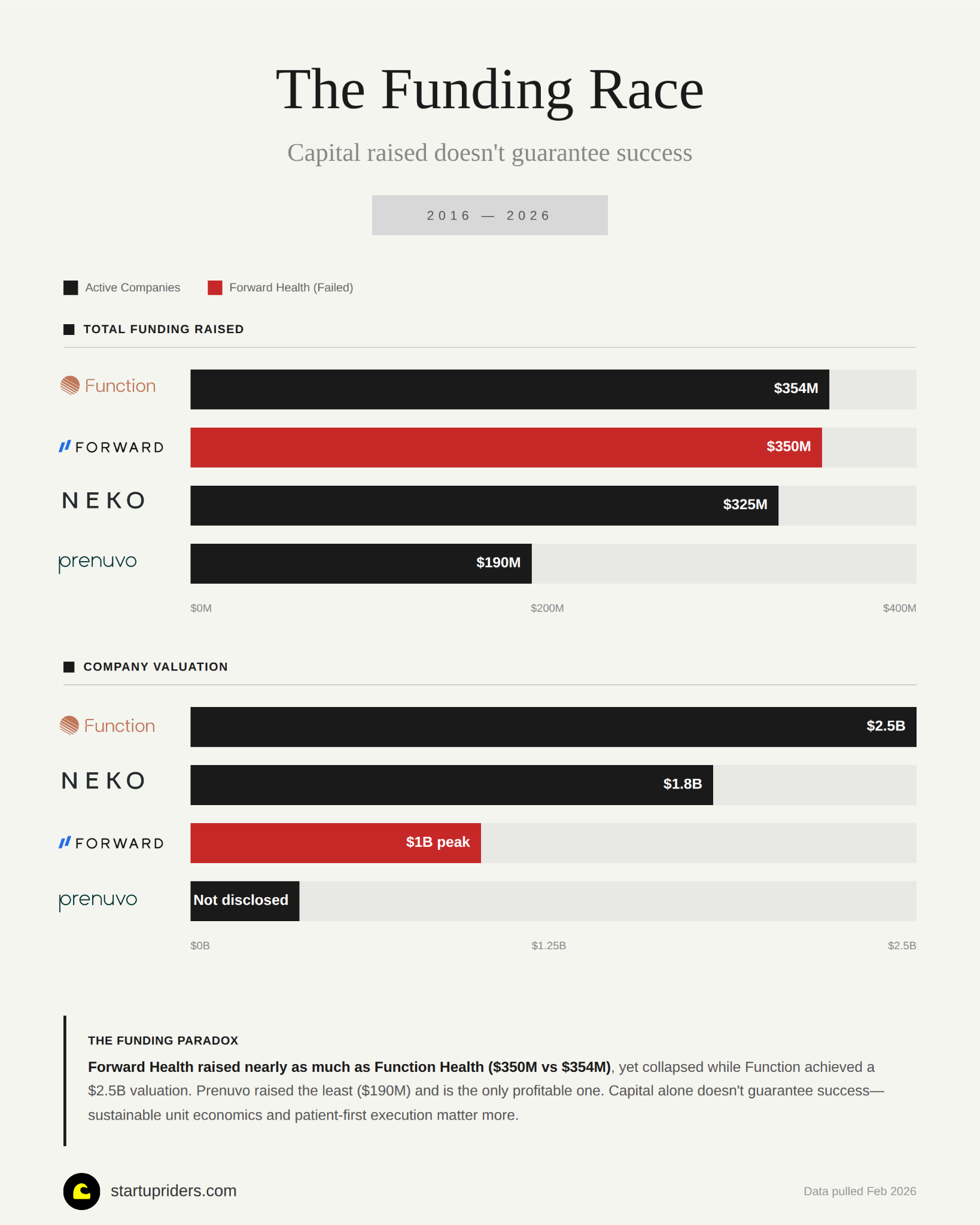
🏆 The 3 leaders: Function ($2.5B), Neko ($1.8B), Prenuvo
💀 The $350M failure: What killed Forward Health
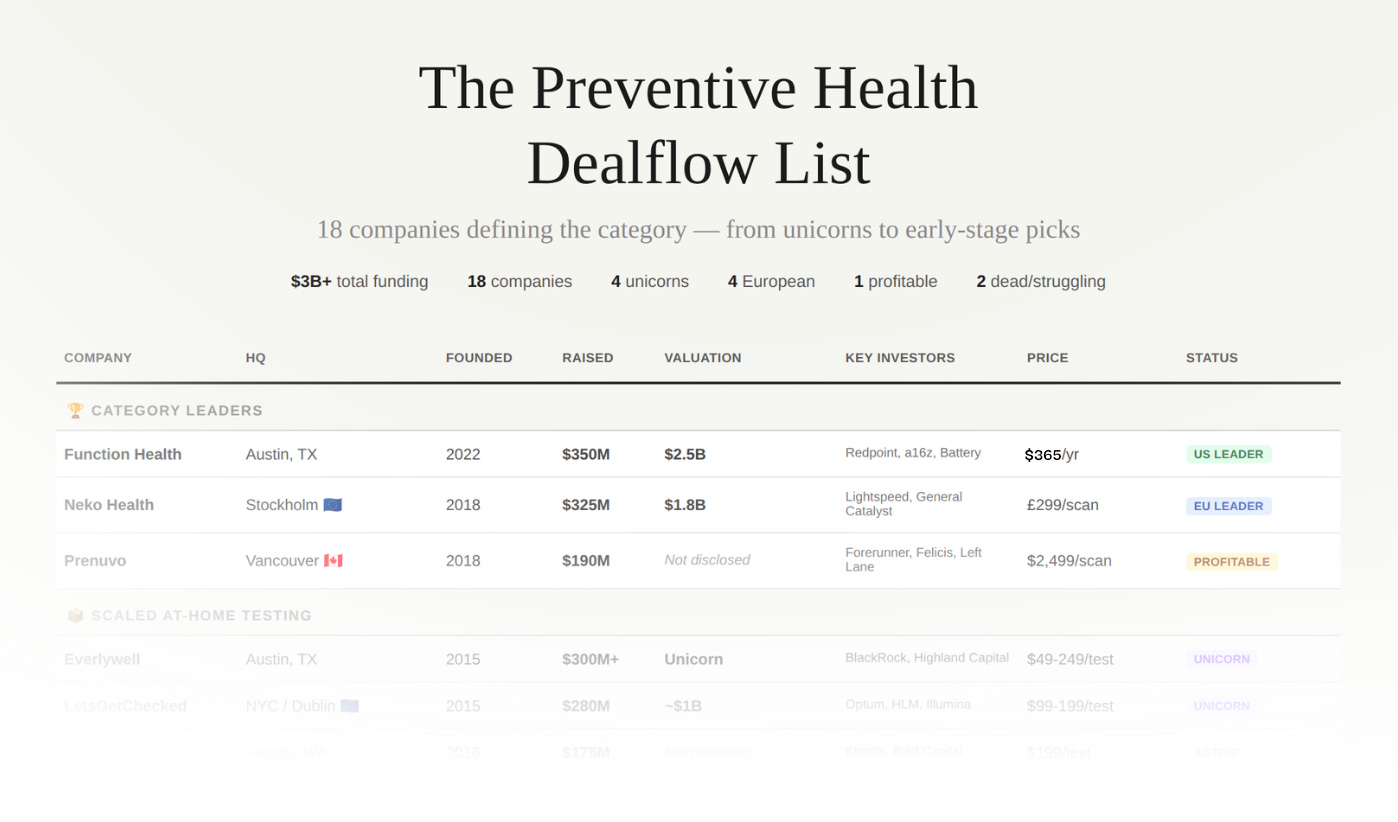
📊 18 startups mapped (dealflow)
Let's dive in:
This week’s sponsor is AI CRM Attio!
Attio is the AI CRM for modern go-to-market teams. Attio connects to your email, calendar, calls, product data, billing data and more — so your CRM is always complete, always enriched, always in sync.
Prep for any call in seconds with full context across your business
Instantly prospect and route leads with research agents
Build powerful AI automations for your most complex workflows
1. The problem
Information lives in silos. Your blood work is here, your imaging is there, your genetic data is somewhere else. Nothing talks to each other.
Nobody knows what tests to actually get. Beyond whatever your GP orders (usually the bare minimum), you’re on your own. Good luck finding out what the 80/20 of preventative testing is (I had to ask my friend Jorge Bestard, check out his newsletter!).
It’s expensive, confusing, and fragmented. Want comprehensive screening? You’ll need to:
Schedule 4-5 different appointments
Pay 4-5 different providers
Collect paperwork from 4-5 different systems
Make sense of it yourself
No reminders. No proactive alerts. No app that ties it together.
The experience is stuck in 1995. Sterile clinics. Anxiety-inducing environments. Reactive instead of proactive.
What’s missing is an Apple-like preventive health product that’s non-invasive, non-scary, integrated with your phone and wearables, and priced for the mass market.
2. The solution
A few companies are racing to build exactly this. Three stand out:
Neko Health → Europe’s bet (Daniel Ek’s company)
Function Health → The US lab-first approach
Prenuvo → The premium MRI play
3. The numbers
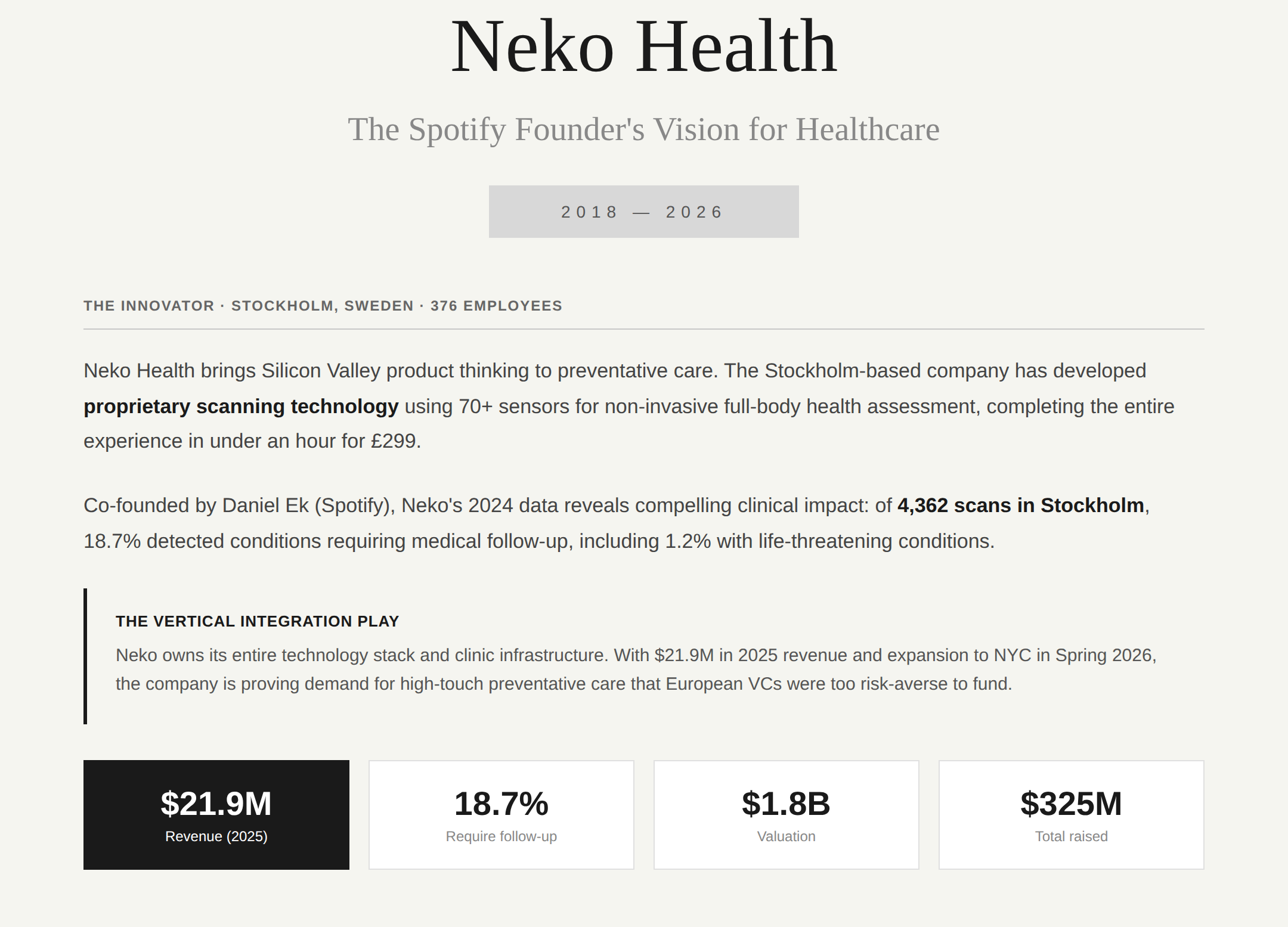
Neko built custom hardware: 70+ sensors that scan your body in 15 minutes. No MRI. No radiation. They’re vertically integrated: own the device, own the clinic, own the AI. European expansion is slow but deliberate.
Function went asset-light on hardware but deep on data. 160+ lab biomarkers, AI-powered insights, and they acquired Ezra (MRI scanning startup) to add imaging. Celebrity backers include Matt Damon and Magic Johnson. Fastest to unicorn status.
Prenuvo is the premium play. Full-body MRI at $2,499. They’re the only profitable one, reportedly hit $100M revenue in 2024. Kim Kardashian and Cindy Crawford are investors and evangelists.
4. The funding race
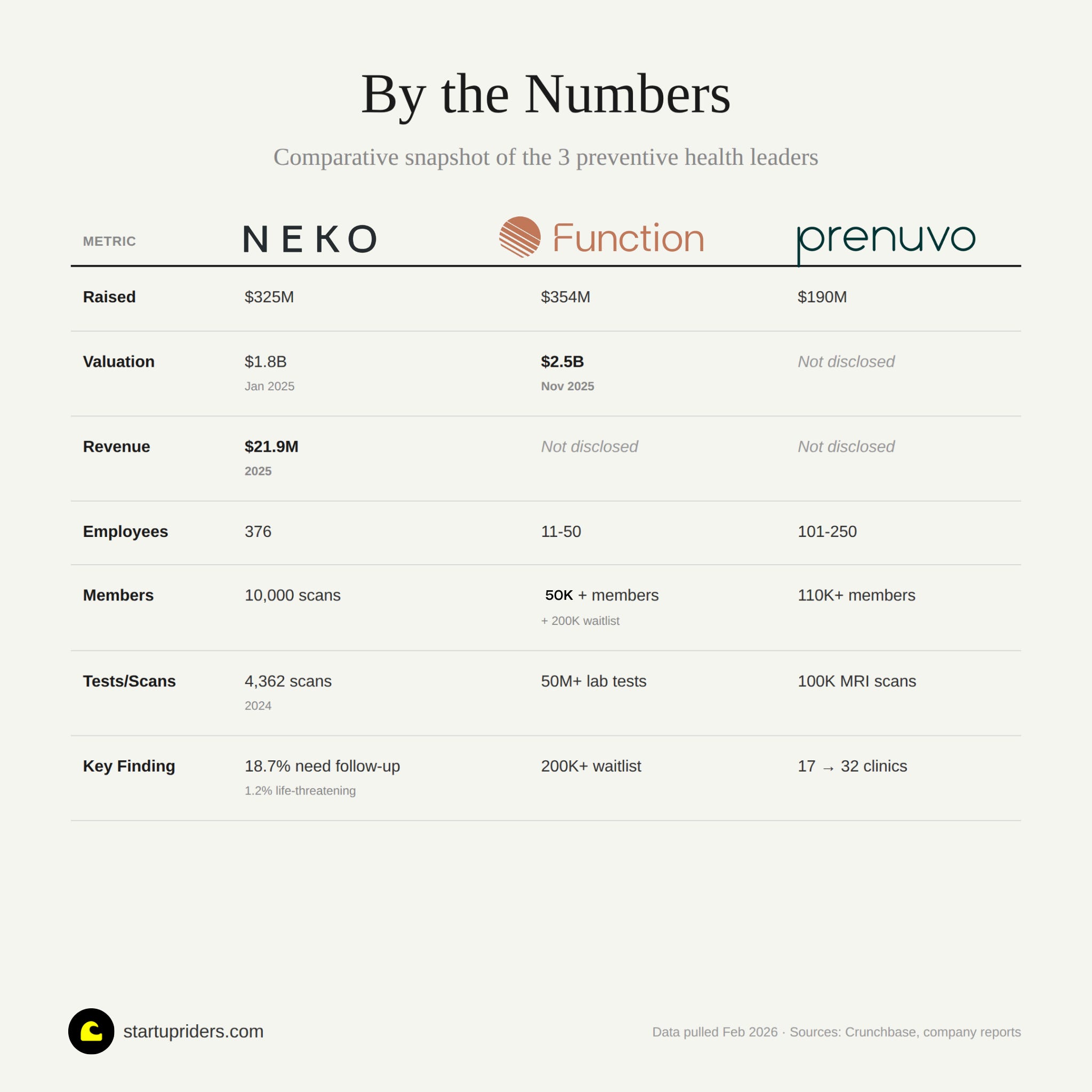
Forward Health raised almost as much as Function Health, $350M from Founders Fund, Khosla, and SoftBank with a peak valuation of $1B, yet they unfortunately had to shut down in November 2024.
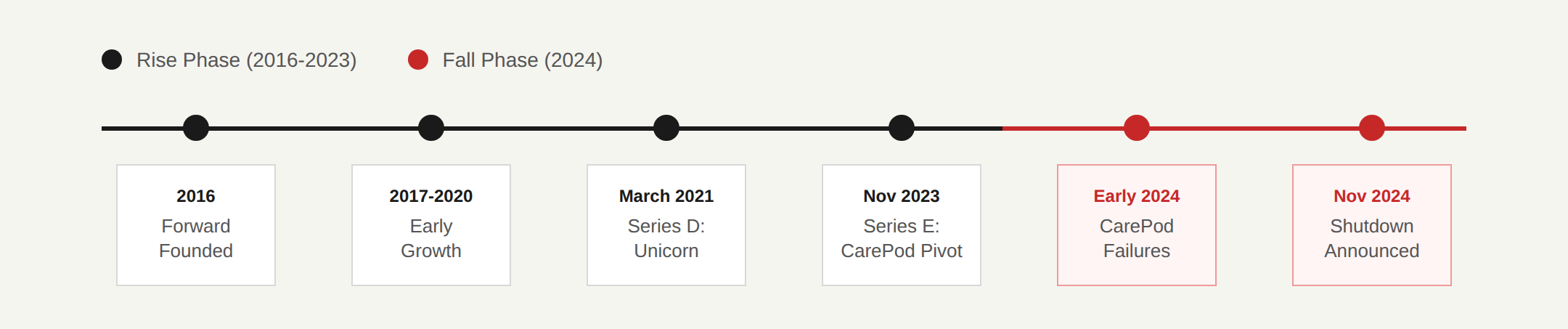
From what I could find in research they tried to do many things like primary care, AI-powered “CarePods” and tech-forward clinics at a premium pricing of $149/month.
But unfortunately a mix of expensive real estate, technical glitches, a model that was harder to scale and prioritising tech over healthcare delivery likely impacted them.
Today Neko and Function are the two leading the pack across 🇪🇺 and 🇺🇸:
5. Why Europe has so few Neko-like companies
It is a pity and my hope is that it is changing, but largely due to:
Regulation: Medical imaging and screening moves slow in the EU where compliance is likely heavier.
Reimbursement: Preventive care isn’t well-paid by public health systems and consumer-pay models are harder to scale when people expect healthcare to be “free”.
Capital risk appetite: Full-body scanning requires hardware, clinics, operations, compliance etc, etc. EU VCs historically have a lower appetite for this type of risk. Neko likely only exists because Daniel Ek (spotify’s founder) can take long-term, founder-led risk.
This is a rare case where Europe is under-built in a category that:
Has real consumer demand
Has proven US traction
Has willingness to pay (even in Europe)
Has massive upside if cracked (and this is going to exist, one way or another)
But things are changing, and a new wave of startups is leading the charge!
🔐 The Preventive Health Deal-flow List
The 18 companies defining this category, from $2.5B leaders to early-stage picks:
Full funding data, investors, and status
18 early-stage startups to watch (Seed–Series B)
Downloadable Google Sheet