



👋 I’m Ivan. I study how top 1% startups grow.
This week’s sponsor is AI CRM Attio!
Attio is the AI CRM for modern go-to-market teams. Attio connects to your email, calendar, calls, product data, billing data and more — so your CRM is always complete, always enriched, always in sync.
Prep for any call in seconds with full context across your business
Instantly prospect and route leads with research agents
Build powerful AI automations for your most complex workflows
Hello there!
This week I’m bringing my friend Jordi Noguera to co-write this edition. Jordi is also my colleague at JME Ventures, where we invest in startups from pre-seed to Series A. He’s been following Freepik closely for a while and put together the research behind this edition.

Why Freepik? Because it’s probably the best real-world case of a company that watched AI threaten to destroy its business, and instead of playing defense, ate its own product and came out growing faster than ever.
And it did it from Málaga, without a single euro of venture capital!
Three acts and three growth lessons, let’s get into it:
1. People were making logos in Word, and Freepik saw the gap. (2010–2020)
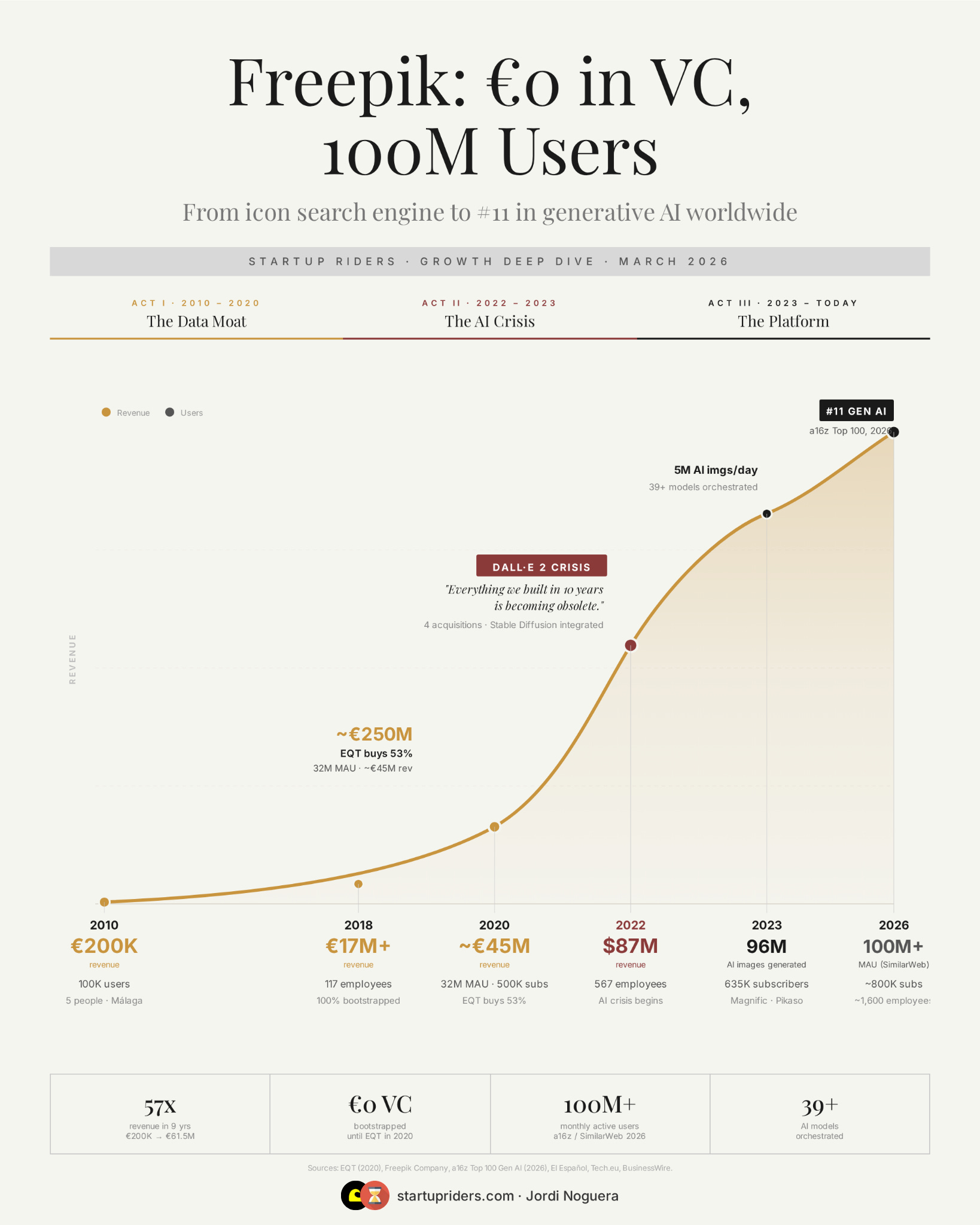
Few people know this, but Joaquín Cuenca had already sold 2 companies before Freepik. First Loquo, a classifieds portal sold to eBay in 2005. Then Panoramio, together with Eduardo Manchón (who later founded Mailtrack.io, now Mailsuite, with ~€8M in revenue and 110K paying customers), sold to Google in 2007. Joaquín stayed 3 years at Google Zurich as Tech Lead for Panoramio before starting Freepik in 2010.
The other co-founder, Alejandro Sánchez Blanes, was building BeSoccer (formerly Resultados de Fútbol) and Joaquín was helping them. They needed tons of illustrations for the app and were browsing stock pages one by one looking for them. It consumed so much time that he ended up building a search engine for himself.
He published it publicly and within just over a month, more than 100,000 users showed up.
At the time, people were making logos in Word using WordArt and there were few options for graphic design. Freepik was born in that gap.
How the stock image market works
To understand what Freepik did, you have to understand how this market evolved.
The industry starts in the 90s with Getty Images, digitizing photography. You bought unique photographs (”the pieces”) for $199–699 per image. Then Shutterstock appeared with a “microstock” model where they sold the same photograph for $3–69 (with a subscription) but to many more people. More marketplace but less exclusivity.
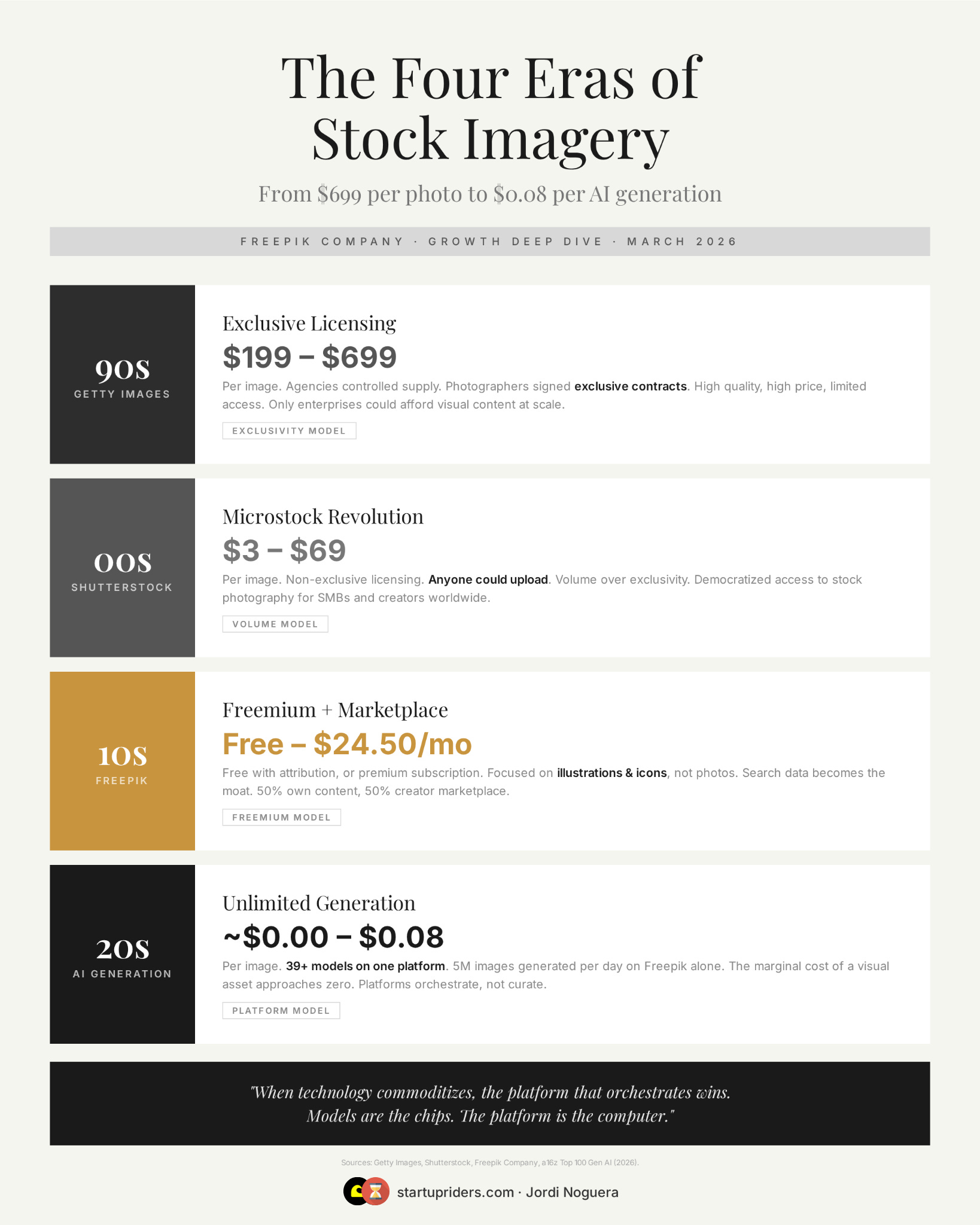
There was a massive market shift happening at the time. Everything was moving from TV ads and print to web, and that meant you needed way more items per project at a much lower price. Anyone could “create.” The market was going from low volume, high price to high volume, lower price.
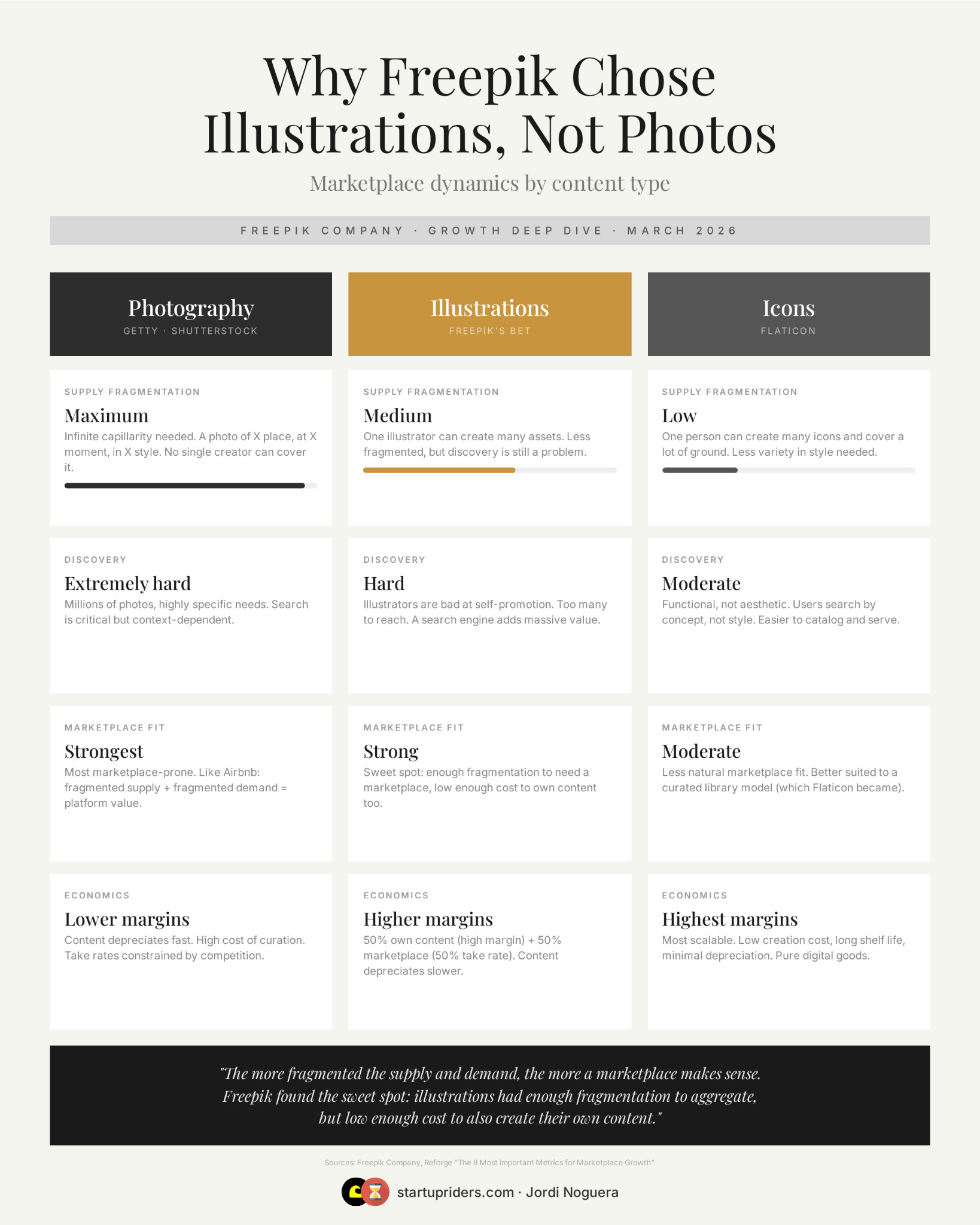
Freepik’s key decision was to specialize in illustrations and icons. Getty and Shutterstock were only in photos. But illustrations have very different marketplace dynamics.
Airbnb would be a good comparable. The more fragmented supply and demand are, the more sense a marketplace makes. Illustrators weren’t good at positioning themselves, and there are so many that it’s impossible to reach them all.
Depending on the type of content, the dynamics and economics change a lot.
Photography. Maximum fragmentation. You need infinite capillarity to have every photo in the world (if you want a photo of X place, at X specific moment, in X style). This is the most suited for a marketplace for that reason.
Illustrations. A single illustrator can create many. Less fragmentation, but discovery is still hard.
Icons. Even less variety. One person can create many icons and cover a lot of ground.
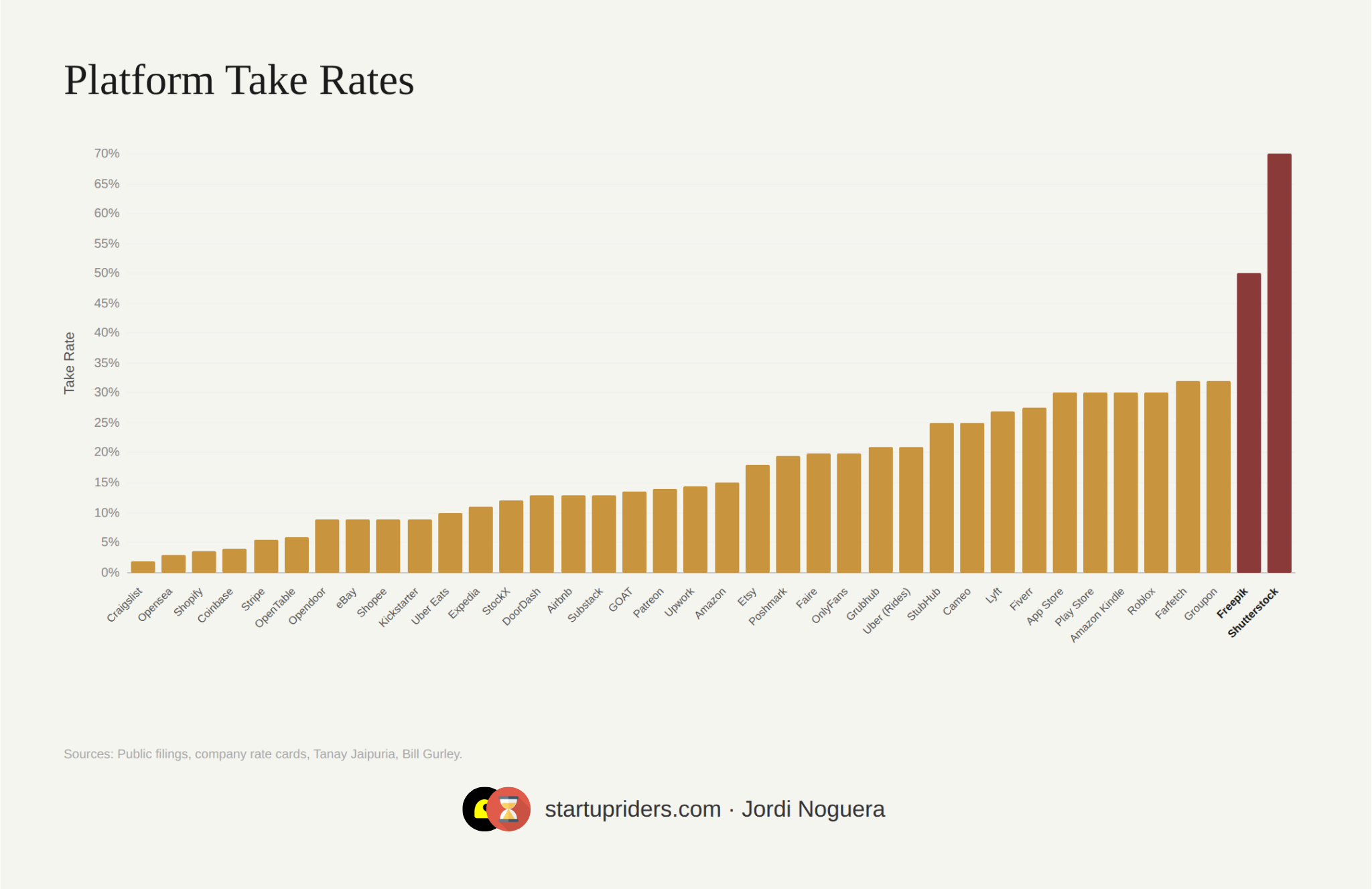
A real case of my own. I had a company where we were Shutterstock and Getty users. We had €0 and were bypassing these platforms all day long. We bought photographs for commercial use (much higher price), and if you could find the author directly you’d get it cheaper. But finding them was nearly impossible. That explains why Shutterstock’s take rate is what it is.
The data moat nobody saw coming
What Freepik did differently was start as a mini Google for free illustrations, a search engine that scraped third-party pages. The problem was that the experience on those third-party pages was terrible. So after 3 years they started creating their own content.
Netflix would be a good comparison. They went from aggregating third-party content to producing their own. Same pattern.
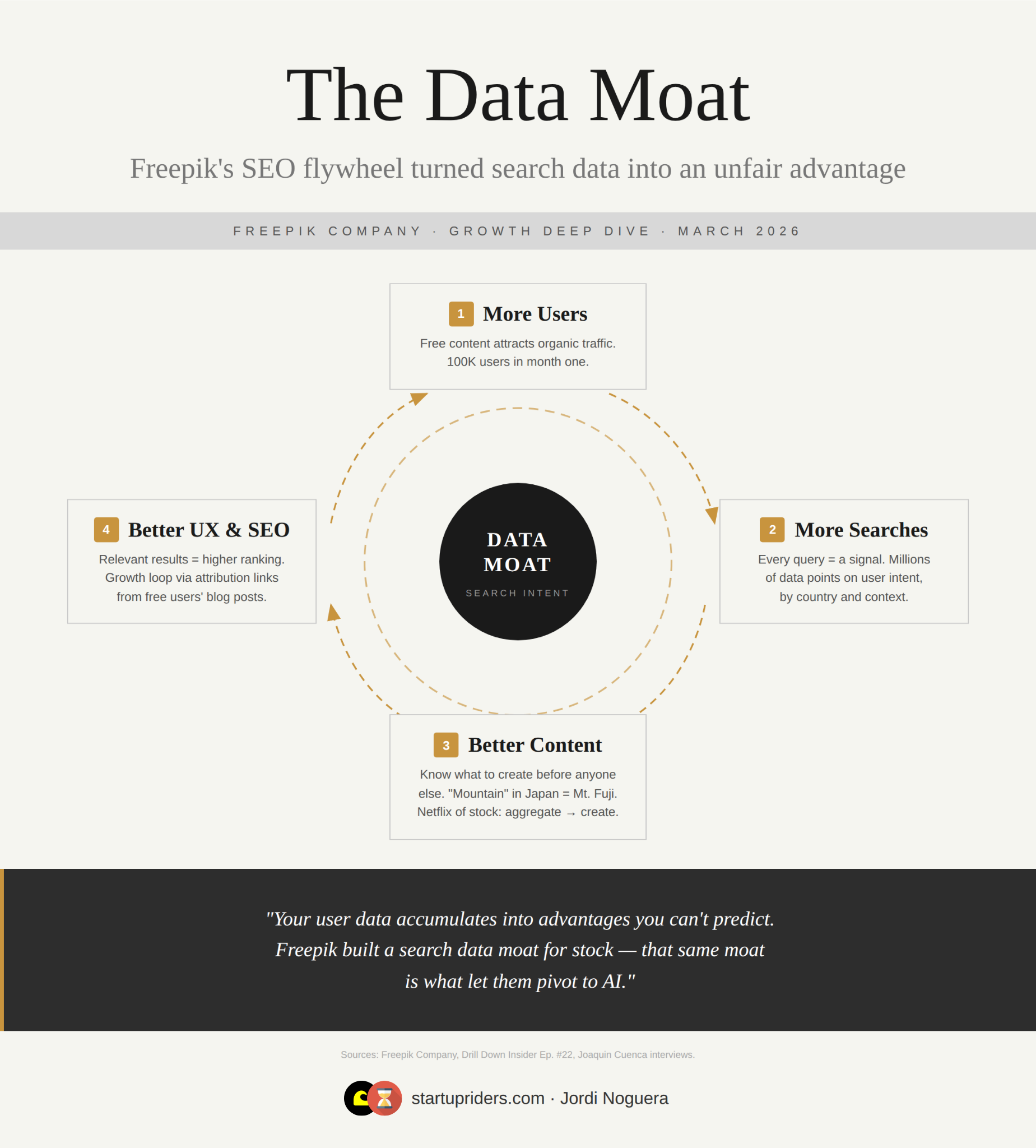
Their access to search data from users became their “unfair advantage”.
How did they monetize at first? They “gave away” the content they created to users who had blogs, in exchange for referencing Freepik when they published it. Readers learned about Freepik and over time started coming in as users themselves. Pure organic growth.
Joaquín tells a case from Japan that captures the depth of this understanding well. When a user typed “mountain,” they actually wanted Mount Fuji. You had to show Mount Fuji at the very top. That level of user understanding, country by country, search by search, generated the flywheel.
Over time, many users who used the free illustrations were willing to pay. They moved to a freemium model and opened the platform for any designer to upload content and earn from downloads.
The model ended up at 50% revenue from own content and 50% from third parties with a 50% take rate. This matters because the economics are very different depending on the model.
Own content carries more risk because you’re investing in the content (an asset that depreciates, and photography depreciates faster than illustrations or icons), but it leaves you higher margins. Third-party content (marketplace) carries less risk because you’re just publishing on the platform, but also lower margins because of the take rate. Freepik had both. Smart diversification.
By 2020 the numbers spoke for themselves.
32M monthly users (from the EQT press release)
500,000+ paying subscribers with an average ticket of ~€7
Revenue of €45M over 9 years from €200K in 2012
With zero outside funding. Fully bootstrapped.
In May 2020, EQT Mid Market Europe buys 53% of Freepik for a valuation of ~€250M. Drake Star Partners advises the sale. Two of the three co-founders exit (Alejandro and Pablo Blanes). Joaquín Cuenca stays. Doesn’t sell a thing. In October of that same year, Atwater Capital enters with an additional minority stake and Vania Schlogel (founder of Atwater) joins the board.
Having a founder like Joaquín, with that level of ambition, is one of the reasons I like Freepik so much. In Spain, similar to Factorial or PLD Space.
2. “Everything we’ve built in 10 years is becoming obsolete.” (2022–2023)
In 2019–2020, DALL-E 1 appears, OpenAI’s image generator. First image diffusion model with any quality at all. The quality was terrible, but it showed something no previous system had achieved, which was real genericity. It could draw “a radish walking a dog.” Sounds absurd, but that’s exactly the point. No previous system could do that.
It might seem obvious now, but at the time, extrapolating that the technology would keep advancing, what was the point of Freepik? There were two possible stances.
The comfortable one was to think it wouldn’t change much.
The uncomfortable one was to assume everything changes and that AI improves in a matter of months.
With AI, there have always been three stages.
First you think it won’t be able to do the task, and it does.
Then you think it won’t do it as well as the top expert, and it does.
And finally you think it won’t surpass the expert, and it does. Cases like chess or Go (the Netflix documentary is incredible). The same pattern repeated with images.
Then DALL-E 2 arrived in April 2022. Joaquín was at home with COVID and spent entire days watching what people were generating. The quality jump was, in his words, “so dramatic” that the conclusion was inevitable. In one or two years, AI would match the quality of every image in Freepik’s catalog.
His reaction was honest. “Initially I’d say I felt some despair. I had no plan. I didn’t know what to do.”
The only thing he was sure of was that what Freepik had been doing for 12 years was no longer going to be the business of the future.
He had to tell more than 500 employees that everything they’d built over the last decade was becoming obsolete. Some employees needed psychological treatment. This is serious.
And yet, the business was better than ever. In 2021 they’d closed with €61.5M in revenue (+37% YoY), 380 employees (+26% YoY), and already exceeded 500K paying subscribers. By 2022 the headcount had grown to 567 (+49% in a single year) and revenue was around $87M. 70% of revenue was already recurring (subscriptions). Double-digit growth for years, “wildly profitable.” That’s the context that makes the decision harder, because they really weren’t in crisis but at the best moment in the company’s history.
What was happening in the market?
I always say that in a business there are two types of risk, technological and market. We’ve had many years of venture capital where almost every company has zero technological risk but does have market risk. The conversations are always about metrics, acquisition, positioning. You rarely talk about the technical approach at a deep level because you assume the team is capable of building the product.
Freepik had the opposite problem. Zero market risk with 100M users and more than proven demand, but suddenly a brutal technological risk.
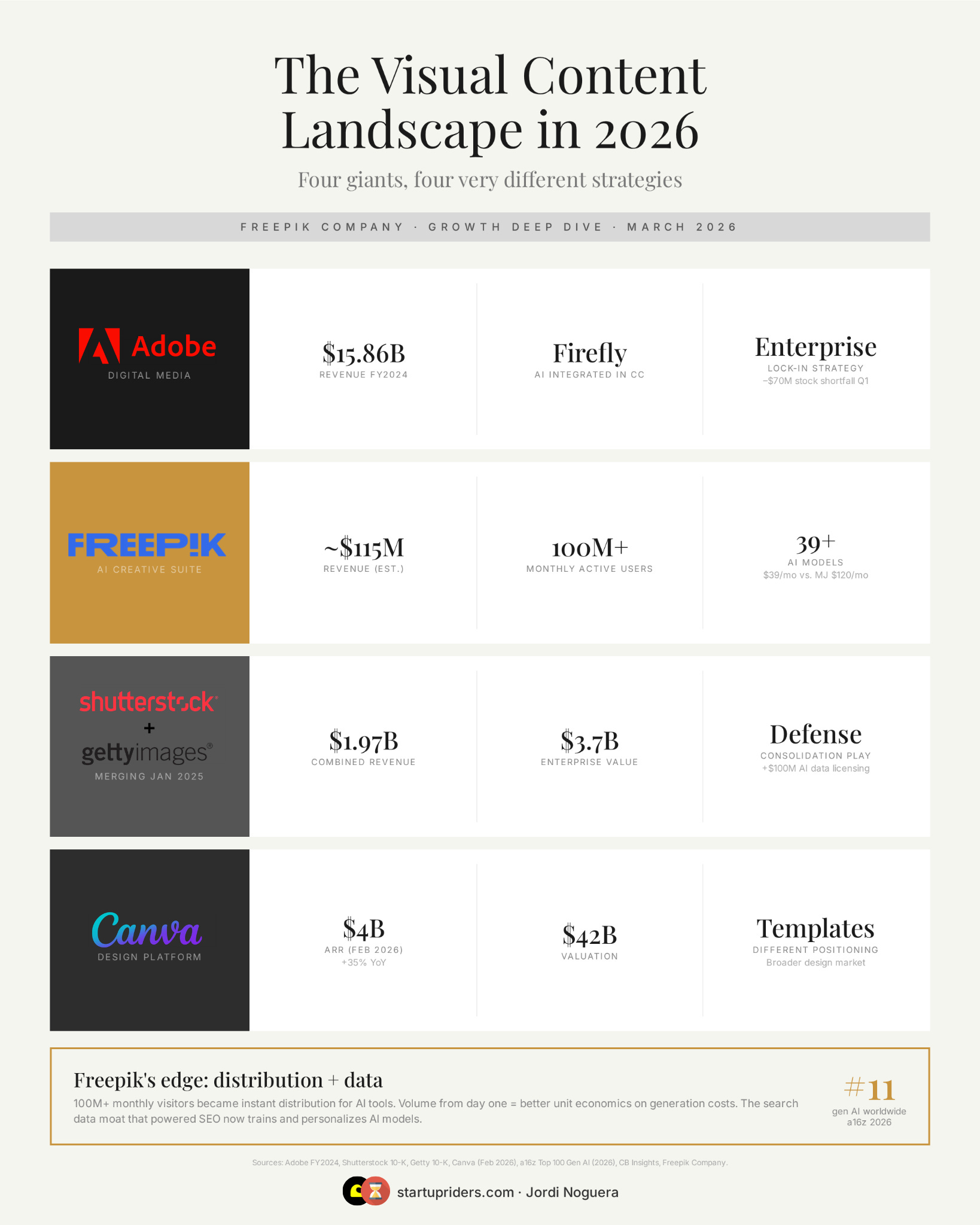
Adobe’s position was understandable. They acknowledged the technology was incredible, but their stance was “this is illegal.” They had 400M images in their catalog and were in a comfortable position to defend this. Incentives explain everything.
Was it legal or illegal to train models with images? At the time, nothing was clear.
Freepik’s position was different. They thought ChatGPT and everything around it was too valuable for society, that no country would want to be left out of the race, and that if the law interpreted that all text and all images needed copyright clearance to train on them, ChatGPT couldn’t exist. Freepik didn’t see a future where states would impose that limitation.
They decided to take the aggressive position and assume the technology would exist and improve significantly over time.
How AI image generation works (for the curious)
Before generative AI there was an important intermediate step, GANs (generative adversarial networks). One neural network generates an image and another tries to determine if it’s real or not. Both improve by “fighting” each other. The result was decent quality but only for very narrow domains, like frontal human faces for example. Zero genericity. Only worked for a specific task.
Then diffusion models appeared (DALL-E, Stable Diffusion, Flux). The process works like this.
You take an image of a cat and add noise, which is random variations in the pixels, like grain or static.
You train a neural network to learn to remove that noise.
You repeat with more noise. The network keeps learning to “reconstruct” the original image.
You repeat this up to 100 times.
The magic step. Instead of starting with a noisy image, you start with pure noise. And the network is able to invent the cat.
This allowed you to take much larger image datasets (potentially every image on the internet) and generate new images from them.
But it had limitations. Small models got confused with details, so if you asked for “green cat on blue table” the cat came out blue. They couldn’t count well. Hands were a disaster because of too many possible finger combinations. And text inside images was unreadable.
Now with autoregressive models (like Nano Banana Pro, similar to how ChatGPT works but for images) the image is divided into parts and each piece is like a word predicting the next one. This has massively increased comprehension of what you’re asking for. Hands come out right, text is readable, fine details work.
Freepik’s decision was to build while walking
Joaquín’s decision framework was simple.
We don’t have AI researchers, so we can’t create models ourselves. We don’t yet know what value we can add because there’s a machine that does everything, so what do we do? If the answer is “nothing,” fine, that option leads nowhere, discard it. But if the answer is “something,” what happens if we act now and shape how this technology reaches our users?
The decision was to grab this technology as soon as it was available and discover the value along the way.
“Strategy came after action.”
Joaquín believes companies should build while walking. It’s very ambitious to think you’ll know what’s going to happen in 5 years, and the only way to move forward is step by step.
They started hiring and building an AI team without knowing exactly what to do, but with the stance that doing things leads to understanding things.
The first use case was improving the search engine. Before, it worked with a tag system where the illustrator uploaded content, added tags, and that’s how it was found. With AI, the search engine could understand the image directly. They used CLIP (Contrastive Language-Image Pre-training, from OpenAI). They integrated it in less than an hour after OpenAI’s release. That execution speed says a lot about the team’s mindset.
The second use case was generation. Stable Diffusion arrives as open-source in September 2022 and Freepik (through Wepik) integrates it into the platform, becoming the first non-professional editor to do so. They positioned themselves as “the simple way to use the model.” And just as they had the moat of most-searched keywords in the past, they now started getting real data on what users wanted to create.
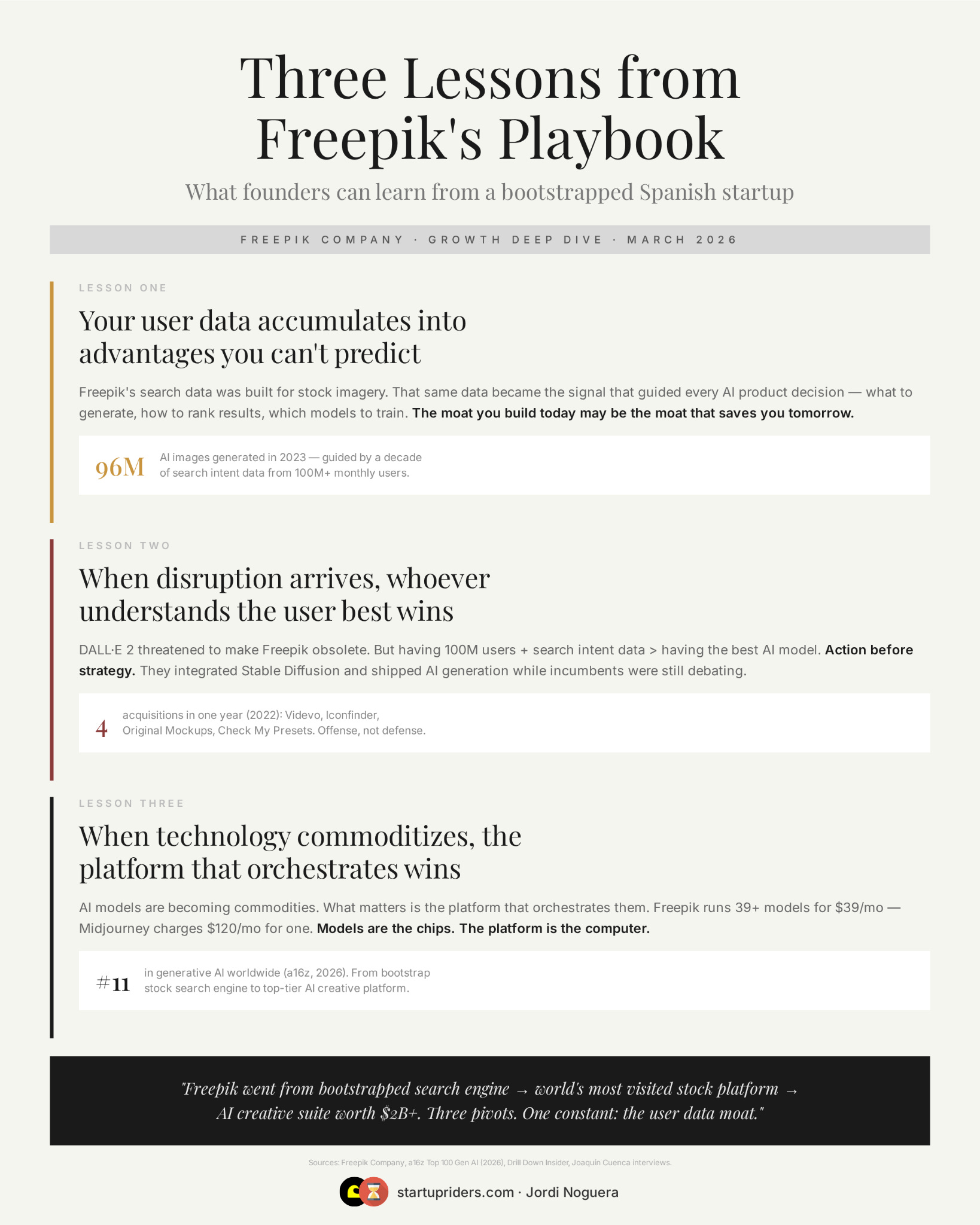
And something counterintuitive happened. The business accelerated. Freepik grew faster after the pivot than in the five years before. AI generated new demand, it didn’t cannibalize stock downloads. By the end of 2023, Freepik reported 150M+ monthly users (vs. 41M in 2021), 2M MAU on AI tools alone (300% YoY growth), and 120M+ assets created with AI on the platform that year. 60% of new users came through AI tools.
In parallel, 2022 was the year of expansion through acquisition. They bought Videvo (UK, stock video), Iconfinder (Denmark, icon marketplace, whose CEO Martin LeBlanc Eigtved became Chief Product/Experience Officer at Freepik), Original Mockups (Colombia, 3D resources), and Check My Presets (photo filters). Four acquisitions in one year, each adding a new content vertical to the ecosystem.
Why? Because the 100M monthly visitors became instant distribution for AI tools. Volume from day one, which meant better unit economics on AI generation than any pure AI competitor. Lower inference costs that get passed on to the user, which brings more users. The flywheel again:
“We entered the game with a huge user base. Immediately we got many people creating images. Immediately we were able to secure very good unit economics for those generations.”
3. Models are the chips, and the platform is the computer. (2023–present)
The last time we had a technology that developed exponentially was chips. And what happened was that every improvement in the CPU enabled new use cases that were previously impossible, and each new use case created a bottleneck that in turn created the next use case.
It’s an analogy Joaquín uses. The technology is incredible (the CPU), but what you need is a computer, not to solder things together. Just like the iPod was born as a wrapper around a Samsung hard drive, but no, it was something else. It was the experience layer on top of the hardware.
Freepik’s reflection was that, just as it used to be very hard to publish a text and now it’s as easy as one click, the same thing can happen with visual content creation. There’s a new technology that enables anyone to have quality, infinite visual resources. That creates a bigger market, with much more volume. And to work with that, you need a platform that helps you manage it.
That’s where the orchestrator concept was born. Models are like CPUs and Freepik is the computer. Very specific models started coming out for specific tasks, and they realized the biggest help to the user was orchestrating those models, just like a computer orchestrates different components, and letting you do different things from a single place.
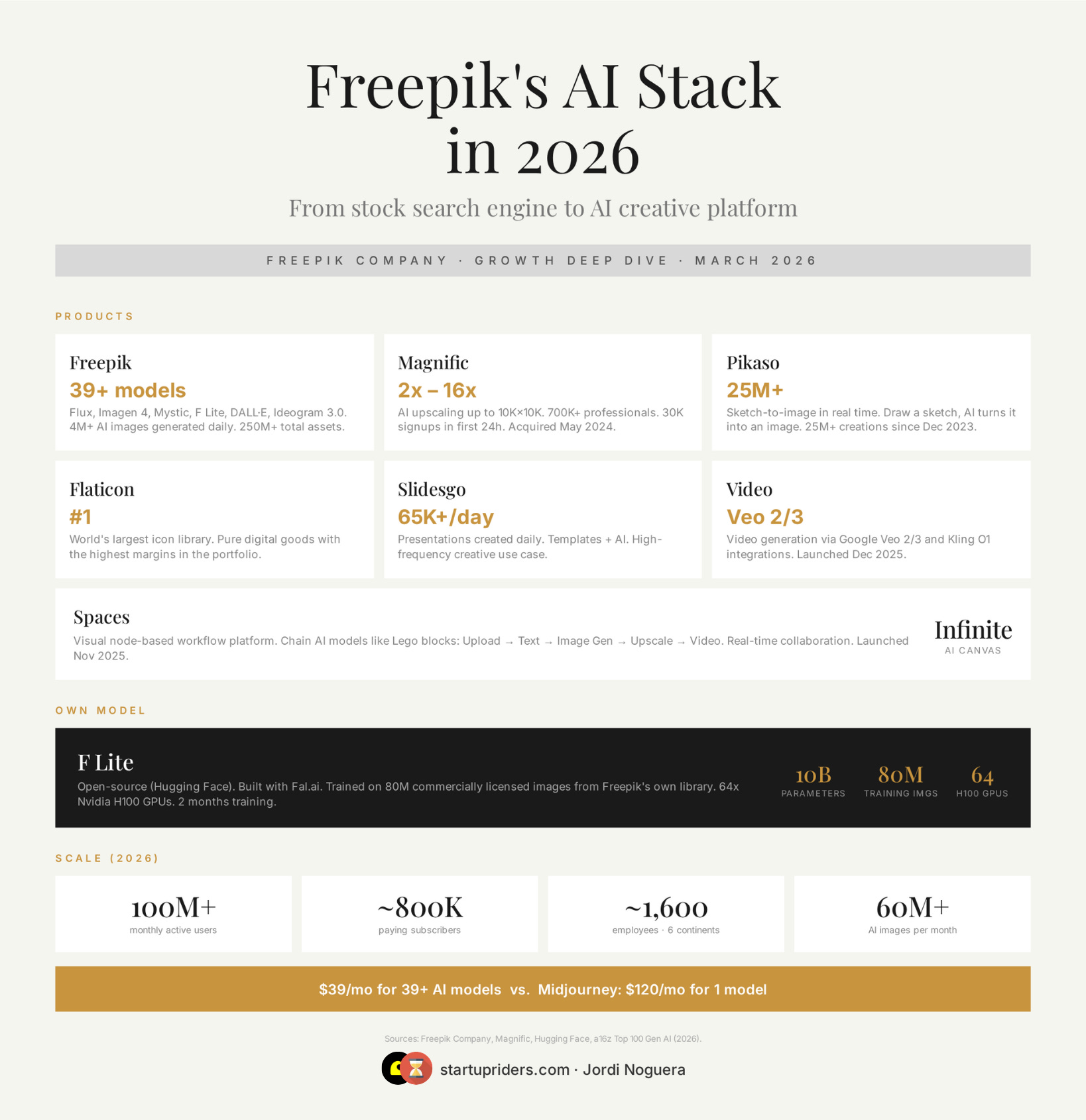
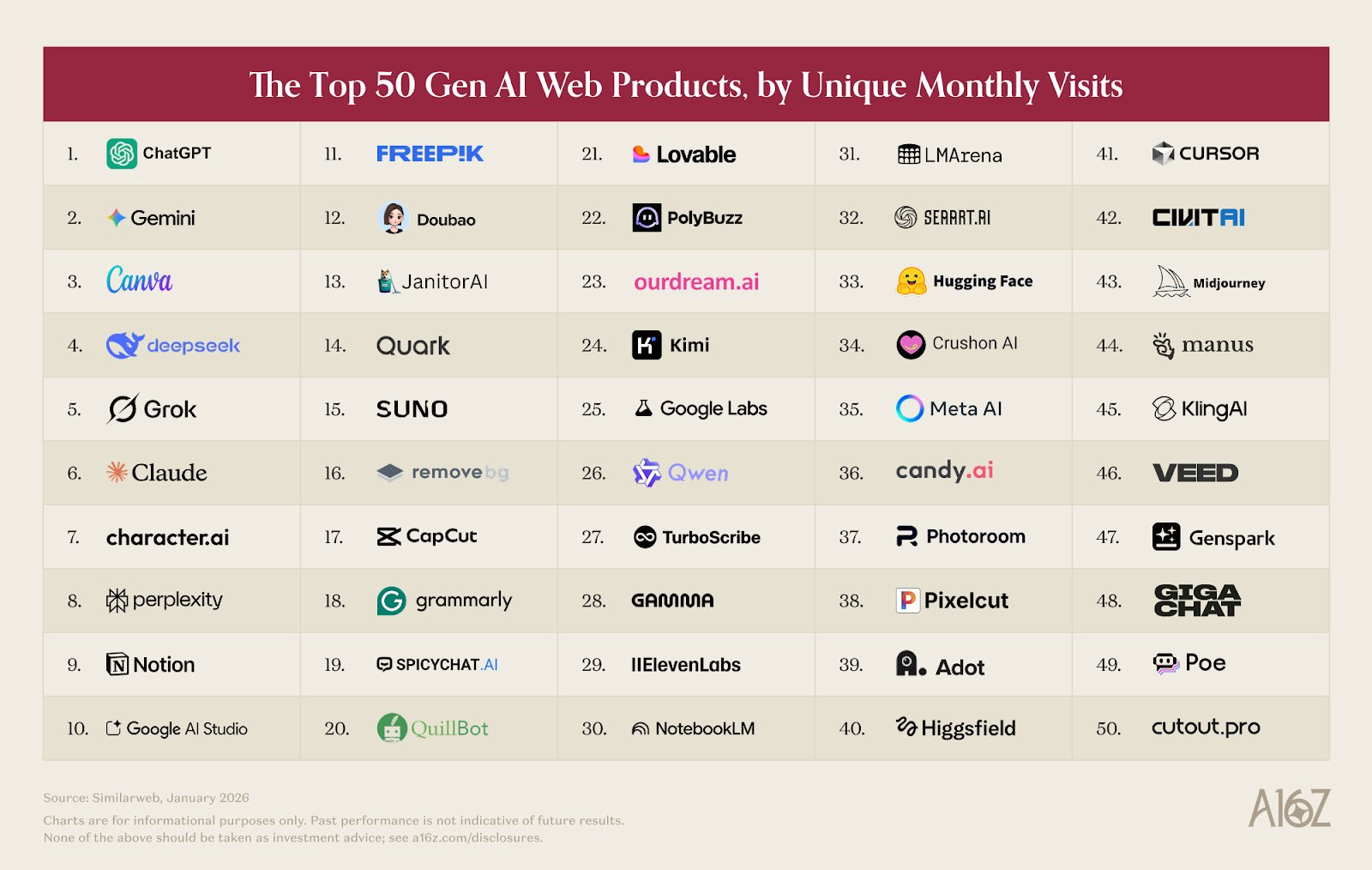
Today Freepik is ranked #11 in a16z’s ranking of the 50 most-visited generative AI products in the world. Above Remove.bg (#16), Grammarly (#18), CapCut (#17), and Midjourney (#43). A bootstrapped company from Málaga.
The acquisition of Magnific in May 2024 was a turning point. Javi López and Emilio Nicolás (Murcia) created an AI upscaler that went viral, 30,000 signups on day one, and Freepik bought it, bringing 700K+ professionals into the ecosystem. The co-founders were integrated into Freepik Labs under Omar Pera (CPO, and a JME Ventures portfolio founder!).
When you don’t have heavy fixed assets, the ability to move fast is enormous. You can pivot because you don’t have as much sunk cost. It’s the innovator’s dilemma in reverse. The one who had nothing to protect was the one who could attack fastest.
I look at Freepik and see something similar to what happened with Kodak and digital cameras, but with a different ending. We’re watching Kodak adapt to digital cameras. I’m surprised by the ability of 500 employees, with tens of millions in revenue, to turn the ship and say “I’m going to cannibalize myself.”
And the entire market has been moving from the low volume, high price model (exclusive photos at €300) to high volume, lower price. With the rise of social media everyone needs to publish more, and tools have appeared that give access to many more people. Freepik has surfed each of those waves.
Conclusion
The Freepik story is about what happens when a company that knows its users better than anyone encounters a technology that threatens to destroy it, and chooses to attack.
Three times the market changed and three times the data moat turned out to be what mattered. First for SEO, then for understanding what users wanted to create, and now for training AI models with clean data.
🚀 Building something in this space? We invest €100K–3M at pre-seed and seed. If you’re raising or know someone who is - please send us your deck via DM.
Bibliography
Podcasts and interviews with Joaquín Cuenca
Drill Down Insider Ep. #22: Freepik CEO Joaquin Cuenca (March 2026). Cory Johnson.
Freepik CEO: “The Day I Realized AI Would Destroy Us” (2026). A Company That Refused To Die.
Joaquín Cuenca at Upscale Conf 2025 (San Francisco, 2025).
La IA era la única opción para no morir como empresa (Podcast IA, 2025).
Freepik en Itnig (2021). Podcast Itnig.
Spicy4tuna: Freepik (December 2025).
Data and research
a16z. Top 100 Gen AI Consumer Apps, 6th edition. Top 50 Gen AI Web Products by Unique Monthly Visits (Similarweb + Sensor Tower, January 2026).
Reforge. The 8 Most Important Metrics for Marketplace Growth.
Getty Images + Shutterstock merger ($3,700M, January 2025). Press releases. Getty Full Year 2025 Results (GlobeNewsWire, March 2026). Shutterstock Full Year 2025 Results.
Canva. $4B ARR (SaaStr, Feb 2026). Valuation $42B (tender offer, August 2025).
Adobe. FY2024 Earnings. Q1 2026: $70M shortfall in stock photography.
Freepik. F Lite: Open-source 10B parameter model (April 2025). Official Freepik blog. GitHub / Hugging Face.
Freepik. Magnific acquisition (May 2024). Official press release. Tech.eu.
Freepik. Freepik Spaces launch (November 2025). BusinessWire.
Freepik. Pikaso launch and metrics (December 2023). BusinessWire.
Freepik. Nano Banana Pro. Official Freepik blog.
Freepik. Ideogram 3.0 integrations (March 2025), Google Veo 2/3, Kling O1 (December 2025).
EQT. Freepik acquisition announcement (May 2020).
Atwater Capital. Minority stake (October 2020). Private Equity Wire.
Mordor Intelligence / SkyQuest. Stock photography market size $4.5–7.2B (2024).
Kaptur. The Silent Collapse of Photo Licensing Revenue. AI impact on photographers (Sep 2024, Feb 2025).
El Español. Freepik closes 2021 with record revenue (Feb 2022). Freepik reaches 567 employees (Dec 2022).
Tech.eu. Europe’s quiet AI giant (Jun 2025).
That’s it for this week folks.
Cheers,
Ivan
P.s. send me your questions about startup growth by replying to this email, I’ll try covering them in future editions 🤙

Mmmmmm "data moat" what are the other 2 word combinations that fuel our hunger... 💙
It’s a fascinating story, but I’m curious how much of this “bootstrapped to 100M users” narrative actually generalizes versus being a one-off byproduct of timing, SEO arbitrage, and accumulated search data that no new founder can realistically replicate today.
If most of Freepik’s moat now comes from scale-driven AI unit economics and existing distribution, does holding it up as a playbook risk misleading early-stage teams who don’t have a decade of data or traffic to lean on?